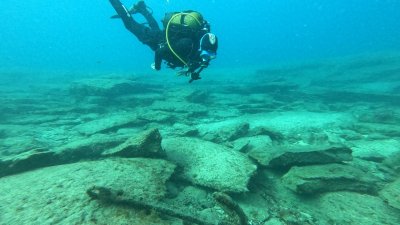
Archaeology is a science that allows us to study how the life of ancient societies was through material elements. Within this branch, underwater archaeology is the great unknown. "Underwater archaeology is a branch of archaeology that is responsible for studying past cultures through the material remains we find in the water," explains Sebastiá Munar, one of the three underwater archaeologists who have studied the seabed of the San Marcial de Rubicón site, in Yaiza.
San Marcial de Rubicón was the first European city founded in the Canary Islands. The baptized as Rubicon Project is a research carried out by the two public universities in the Canary Islands, the University of La Laguna and the University of Las Palmas de Gran Canaria, which seeks to delve into what life was like for the ancient inhabitants of the archipelago. To do this, they have also extended their archaeological surveys to the sea.
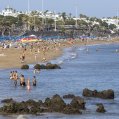
At the beginning of this 2026, this scientific expedition began its first underwater excavation on the coast of Lanzarote. For fourteen days, a group of three underwater archaeologists, guided by the project directors, María del Cristo González, from the University of Las Palmas de Gran Canaria, and Esther Chávez, from the University of La Laguna, inspected the seabed located between Punta del Papagayo and Los Pozos Beach.
Thirty-six points that turned out to be marine debris
The start of this expedition was based on studying the points of interest determined after a marine geophysical survey carried out in 2021, which through a side-scan sonar allowed the detection of up to 36 submerged objects. This is how Esther Chávez, co-director of the project, explained it to La Voz. Maritime work in the area had been halted until all the documentation required by the Coastal Demarcation was obtained and pending financing.
"We realized that most of it were mooring elements associated with recreational boats," adds underwater archaeologist Munar. The area where the underwater surveys began is frequented by hundreds of recreational boats throughout the year. "All of that has an impact on the seabed, we thought not everything was going to be recent, but it was," adds the director of the archaeological project Esther Chávez. "They use the seabed as a dump, it's a shame," he laments.
Thus, the underwater waste generated by recreational vessels can affect the conservation of heritage remains, especially through the "dragging" that anchors cause when they are dragged along the seabed.
After investing time and money in this area and encountering this amount of marine debris, they expanded the search area and located a space at a greater depth where they did find archaeological materials belonging to an ancient anchorage.
Sebastià Munar donned the diving suit along with his colleagues Stella Rendina and Ximo Gual de Torrella, with whom he usually works. Although it was his first time in Lanzarote and also in the Canary archipelago, Munar has carried out surveys in other parts of the country such as Murcia or Catalonia and, for the most part, in his native archipelago, the Balearic Islands.
The three underwater archaeologists were assisted by the boat's owner, Íñigo Labarga, and advised by the also underwater archaeologist Sergio Olmo, who had drafted the project, but due to health problems cannot dive.
Divers towed by a boat
On their first time in Lanzarote, in particular, and in the Canary Islands, in general, this trio of underwater archaeologists inspected waters between five and 25 meters deep. So the time they could dedicate to the dive varied: "The deeper it is, the less bottom time we can be working," explains Munar.
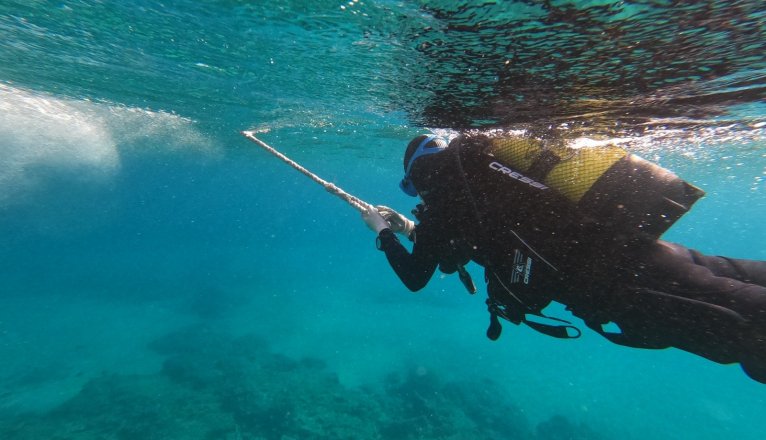
To carry out this first marine prospecting campaign, they have used the "towed divers" system. A pair of underwater divers were towed by a dinghy, which follows with the help of a GPS along streets previously mapped out to comb the area. "Thanks to the great visibility of the waters of Lanzarote, we can review the entire seabed in an orderly manner," says the underwater archaeologist.
In this line, Chávez explains that the two divers who are submerged, tied and dragged by the boat, carry a buoy. "If they detect something they release themselves, since they carry the buoy the captain realizes they have released themselves and the person who releases themselves documents the object or objects, takes the coordinates, takes photographs, videos and continues," adds the project manager.
During the seabed survey work, they determined up to eight prospecting lines, 1,600 meters long, separated by a distance of thirty meters. "The prospecting area we have inspected is truly extensive, allowing us to identify and locate the archaeological remains," he adds.
Despite the fact that the volcanological origin of the Canary Islands causes the seabed of Lanzarote to have "great steps", where the depth drops to 300 or 400 meters, on this occasion the work was carried out on the platform between Lanzarote and Fuerteventura, which is less than forty meters deep
Materials from the 15th century
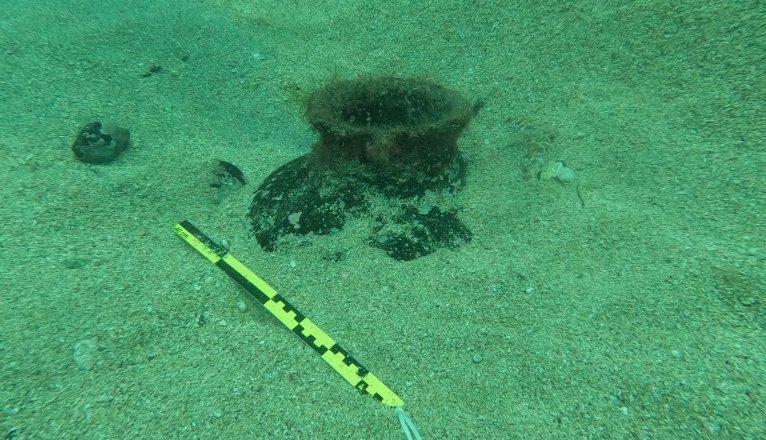
Throughout the two weeks of prospecting, with three daily dives, the researchers managed to locate several ceramic remains, especially from amphoras and bowls. "This area, protected from the trade winds, was used as a refuge for boats," adds the underwater archaeologist. This anchorage seems to have been used as such from the time of the conquest of the Canary Islands until the 19th century.
Despite the location of these ceramics, Munar explains that many of the vessels perhaps did not even stop by the island, but rather sought refuge on its coast to then continue on their way, while others, the larger ones, disembarked their cargoes on the Papagayo beach, but anchored at a certain distance for safety.In this regard, Esther Chávez explains that most of the materials appeared at a **depth of nineteen meters**, off the beaches of Los Pozos and Papagayo.
The researchers attribute the origin of this pottery to commercial exchanges in the area: "Either they fell accidentally or they were thrown voluntarily into the sea," adds Munar. In this regard, Esther Chávez explains that the materials are modern, belonging to the 15th and 16th centuries. "There is some bowl that could be from the 15th, 16th, 17th centuries," she states, but its exact dating will have to wait for a more detailed study.
This first campaign has served to delimit the archaeological zone, but the objective is to carry out a second campaign in which to collect material and analyze the detected materials and determine what dates they belonged to. "For this we have to be prepared on land to receive that material, because it must undergo a desalination process and have the adequate conditions so that it does not crack and is destroyed," explains Chávez.
The value of citizen collaboration
Finally, these researchers thank the work of citizen collaboration. "They have been passing us information about where historically findings of these archaeological materials have occurred," adds Munar.

Add La Voz de Lanzarote as a preferred Google source.
Stay informed with the latest current news.