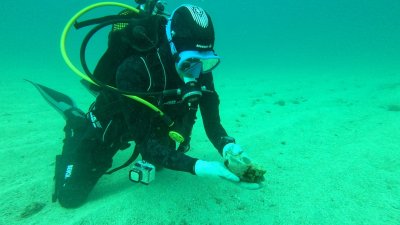
Archaeological research in San Marcial de Rubicón (Yaiza, Lanzarote) is expanding to the sea with the first visual underwater surveys in the coastal sector between Punta de Papagayo and Playa de las Mujeres. The objective of this new phase is to determine and document the possible existence of material remains linked to the Franco-Norman expedition that initiated the process of conquest of the Canary Islands in the 15th century.
During the first weeks of January, a team of underwater archaeology conducted several inspection dives at points of interest identified during the 2021 marine geophysical survey campaign. However, none of the 36 anomalies detected with this non-invasive research technique corresponded to concentrations of archaeological material or archaeological structures.
Given these results, the study area was expanded to other possible anchoring zones historically used by European populations, in order to identify previously undetected evidence. Through these new dives, several ceramics have been located that could correspond to the modern era, among other previously unrecorded submerged archaeological remains.
The archipelago's underwater cultural heritage "is one of the most fragile elements and, at the same time, one of the most forgotten in archaeology," acknowledges the Minister of Universities, Science, Innovation, and Culture, Migdalia Machín. Therefore, this project "significantly contributes to expanding the inventory of the island's underwater archaeological heritage," and above all, it deepens "the historical scope of San Marcial de Rubicón by accessing spaces never before investigated," Machín emphasizes.
The mayor of Yaiza, Óscar Noda, insists that "after the sixth excavation campaign, which concluded last October, we continue to highlight the complexity of the work on land, and now at sea, carried out by the scientific team in charge of the research, to provide us with more information about the first European city in the Canary Islands in the 15th century. The results will be disseminated in due course, as all entities involved in this project have been doing. The public has the right to know how public money is invested.""Archaeology in San Marcial de Rubicón always holds surprises for us," states the co-director of the research, María del Cristo González, "that's how it has happened on land, and we expect it to happen at sea." In the end, the city "was composed of its land and its sea," so "we have to intervene in all those areas that can help us reconstruct the history of this site," concludes the archaeologist
Three specialists in underwater archaeology
This second phase of the project has focused on the intensive and systematic review of a marine area of 46.5 hectares, with special attention to the coastline of Pozo beach. The methodology used, based on direct visual inspection, is particularly effective for detecting poorly preserved underwater sites or those located in shallow waters, offering greater reliability than indirect geophysical survey methods.
In this regard, the prospecting system used is the "towed diver," which consists of dragging a pair of researchers from the vessel at a very slow speed to document findings on the seabed. Through the use of underwater cameras, GPS georeferencing, and recording the depth of the diving equipment, an inventory of the located concentrations of archaeological material is carried out
The team is composed of three underwater archaeology specialists, Sebastià Munar, Stella Rendina, and Ximo Gual de Torrella, assisted by a surface support boat with a boat master, Íñigo Labarga, under the direction of María del Cristo González (ULPGC) and Esther Chávez (ULL), and the advice of underwater archaeologist Sergio Olmo.
It should be noted that in this phase of the investigation, no manipulation of the archaeological remains or removal of sediments from the seabed has been carried out, as "the conservation of these objects in situ is prioritized," explains Munar. The detailed study of these materials will be addressed in future campaigns within the framework of the collaboration agreement between the Government of the Canary Islands, the Yaiza City Council, the University of La Laguna (ULL), and the University of Las Palmas de Gran Canaria (ULPGC).The 'Rubicon Project' is a priority commitment for the Ministry of Universities, Science, Innovation, and Culture, as through archaeological research, it not only reconstructs the material history of the archipelago but also strengthens scientific knowledge from the public universities of the Canary Islands


Add La Voz de Lanzarote as a preferred Google source.
Stay informed with the latest current news.