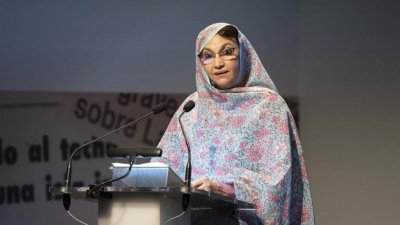
Sahrawi activist Aminetu Haidar has warned the Spanish Government that by backing the Sahara "to be an autonomy under Moroccan sovereignty, it contributes to perpetuating an illegal occupation" and "facilitates the exploitation of its resources and the continuation of serious human rights violations”.
Sixteen years after her hunger strike at Lanzarote airport, following Morocco's prevention of her entry into El Aaiún and her expulsion to the Canary Islands (on November 14, 2009), Haidar has returned to the island for the premiere of 'Aminetu: 50 Years of Occupation,' a documentary filmed around another anniversary: the 50 years since Spain abandoned its former colony.
On October 31, the UN Security Council approved a resolution considering that "genuine autonomy could represent the most feasible outcome" for the Sahara, and encourages the parties to "present ideas that support a mutually acceptable final solution".
This resolution follows the same line as that defended in recent years by the main EU countries. In March 2022, the Spanish Prime Minister, Pedro Sánchez, sent a letter to King Mohammed VI, in which he considered the Moroccan autonomy proposal, presented in 2007, to be the "most serious, credible, and realistic" basis for resolving the conflict.
Haidar, however, maintains that "Spain must fulfill its legal and historical duty, guarantee the decolonization and the right to self-determination of the Sahrawi people," as she said on Friday night during the screening of the aforementioned documentary at the César Manrique Foundation
"Gratitude to the people of Lanzarote for their solidarity and commitment to justice"
Haidar thanked the people of Lanzarote for "their solidarity and commitment to justice," describing it as "a great honor" to return to the island to express her gratitude for the support she received in 2009. "When I was illegally and forcibly deported from my country, Western Sahara, by the Moroccan occupation regime in collusion with the Spanish State," she denounced.
The activist stressed that her story is not just hers, but represents a "collective testimony" of the Sahrawi people, "a people who have suffered too much already" and have experienced "exile, repression, torture, forced disappearance, illegal occupation and who, despite it all, are still standing."Haidar pointed out that there are three walls "that feed into each other and demand a coordinated solution." The first, political and diplomatic, "where the word referendum has been systematically emptied of content" and MINURSO (the UN mission for the Sahara) has become the custodian of an eternally postponed hope."
"The recent and ambiguous October 2025 Security Council resolution consolidates this worrying setback by taking the Moroccan autonomy proposal as a basis, without even mentioning the Polisario Front's proposal," he criticizedThe second wall, he continued, is legal and economic, due to the phosphates from Bou Craa, fishing, and wind farms that "European and Spanish companies, violating international law and the rulings of the Court of Justice of the European Union, finance and legitimize the occupation."
"Spain has become a facilitator of stagnation"
"Spain has become a facilitator of stagnation, normalizing language that legitimizes the occupation, and every sack of phosphates, every tomato labeled as a product of Morocco, is another brick in the wall of colonization," he/she pointed out
The third, "and perhaps the most dangerous wall," is that of generational despair, according to Haidar.
The activist recalled that in the Sahrawi refugee camps, 60% of the population has been born in exile, so, "for them, the promise of the referendum is a distant story".


Add La Voz de Lanzarote as a preferred Google source.
Stay informed with the latest current news.