
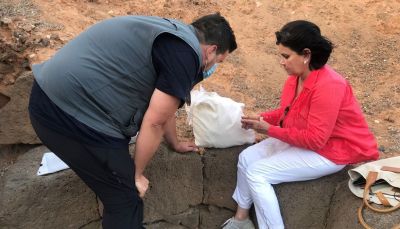
The traditional pottery of Lanzarote, handmade between the 16th and 20th centuries, will be the subject of an exhaustive study by a multidisciplinary team with the endorsement of the University of Las Palmas de Gran Canaria (ULPGC). These ceramics, such as the Mojón type, maintained a generational tradition well into the 20th century that, until now, lacks detailed interdisciplinary research.
The study proposes to locate the largest number of private collections of ceramic pieces, the search for people who have had some connection with the traditional pottery trade, the location of old images, especially photographs and, if possible, video recordings, in addition to verifying the existence of possible potteries or ceramic workshops. It will also carry out a search of documents from the 16th, 17th, 18th and 19th centuries.
The Director General of Cultural Heritage of the Government of the Canary Islands, Nona Perera, is optimistic ”with the results that will be obtained in this work because it allows us to be more aware, to know more about the past and, above all, the social, family and economic environments that revolved around the painted pottery of El Mojón” and emphasizes that it is the first time that the Directorate General of Cultural Heritage has approached a multidisciplinary study of this matter.
Regarding the ceramics of El Mojón, Nona Perera highlights that, “of all the Canarian pottery, it is exceptional" and that is why its research is promoted. "It is the only one that is decorated with plant, animal or geometric motifs on a layer of tegue, giving it a significant contribution. Another is that its origin is unknown, although it is linked to population contributions, slaves from North Africa who at a certain moment, in dates after the conquest, are brought to Lanzarote. Another exceptional feature is that it is a ceramic that had a very long life and there are people who knew the last potters who painted their pieces”, she points out.
Methodology of the research project
The research project contemplates surface archaeological prospecting, without sounding, with selective collection of painted ceramic materials, in the population centers of El Mojón, Teseguite, La Villa, Los Valles, Haría, Caleta del Sebo and Pedro Barba, on the island of La Graciosa, and towns in the north of Fuerteventura such as Corralejo, Los Lajares, La Oliva and El Cotillo. Ethnographic prospecting will be carried out, with audio and video recordings, as well as a search for graphic materials, in addition to undertaking an analysis of the archaeological collections held by the Historical Heritage Service of the Cabildo de Lanzarote and public and private deposits. This work will be carried out by several authors on the islands of Lanzarote, La Graciosa and Fuerteventura, the last two with the intention of searching for ceramic exchange.
On the other hand, the initiative includes the study of ceramic pieces from archaeological contexts documented in various interventions carried out on the island; the elaboration of a typology of decorative elements and a proposal for a functional typology.
The archaeological prospecting, without physical sounding, will include the completion of the field diary, cartographic work, inventory, cataloging, with individualized and group photography, with metric reference and the correct storage of the collected material.
The audiovisual records will have a type questionnaire, trying to collect popular knowledge about ceramic pieces, production, raw material extraction areas and trade.
On the other hand, the work in the archaeological collections of the Heritage Service of Lanzarote and public and private deposits, will collect aspects related to the piece: destination and use, conservation, origin of ownership, among other aspects, providing the files photography, description, measurements, decorative motifs, history of the piece, property, place where it is located, state of conservation, state of danger, among other extremes.
The research team is made up of Pedro Carmelo Quintana, Doctor in History from the ULPGC, specialist in Modern History, member of the University Institute of Textual Study and Analysis, IATEX; Antonio Manuel Jiménez, Doctor in Geography and History from the ULPGC, specialist in the study of traditional ceramics of Gran Canaria; José Ángel Hernández. potter and ceramist, member of the El Alfar collective, researcher, specialist in traditional pottery from La Gomera, Tenerife and Lanzarote; Juan Manuel Zamora. researcher; Antonio de Armas Acuña, professor, potter and ceramist and researcher of traditional pottery from Lanzarote. The photography will be signed by José Farray Barreto. senior technician in artistic photography, whose work stands out especially on the island and the painted ceramics of El Mojón. This team is led by Jesús Manuel Cáceres, Bachelor of History and Master in Cultural Heritage Management.


