
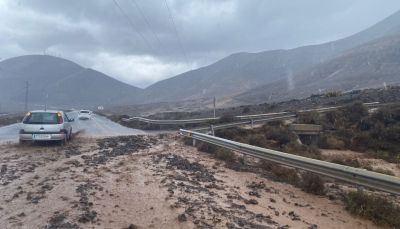
Lanzarote was the Canary Island that received the highest percentage of rainfall compared to the archipelago's average during the month of March. In this sense, it recorded an "extremely humid" March and reached 200% of the rainfall in the Canary Islands.
Despite the rainfall that ended last month, the province of Las Palmas only accumulated 76.1 liters of rainfall per square meter in 31 days. This qualifies it as a "very dry" month, being the eighth driest since records began in 1961. This is according to the State Meteorological Agency (Aemet) in its climatological advance published in April.
In addition, Tinajo recorded the third highest temperature in the Canary Islands last March, reaching 32.5 degrees. It was only surpassed by the municipalities of La Oliva (Fuerteventura) and La Aldea de San Nicolás (Gran Canaria). Meanwhile, the La Graciosa heliport recorded the sixth highest that same day, with 28.9 degrees.
According to this report, from March 12, the establishment of an African ridge near the Canary Islands led to an increase in temperatures, reaching its peak on the 16th and 17th. From the 18th, the trade winds and the approach of cold air masses produced a new decrease in temperatures that lasted until the end of the month.
Compared to a warm March, the approach of an Isolated Depression at High Levels (DANA) to the Canary Islands was also recorded, which generated "the highest rainfall of the month." During that period, Aemet highlights the "high intensities" of the rains. Thus, on March 23, the Los Dolores station in Tinajo reached 24.8 liters per square meter accumulated in 24 hours and a maximum intensity of 31.2 millimeters per hour.
In this line, the years 2023 and 2024 are currently being placed as the warmest and driest in the history of the Canary Islands, with a temperature anomaly of more than two degrees.
The DANA not only brought rain, but also recorded strong winds throughout the Archipelago, even reaching gusts of more than 100 kilometers per hour in the highest points of the western islands.


