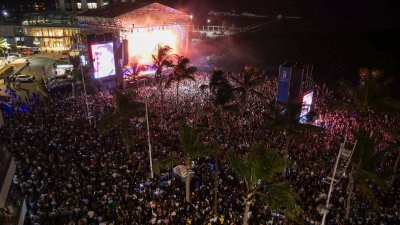
Noise pollution is the third most serious environmental risk factor in Europe -after air pollution and extreme temperatures- and in Spain, 30% of the population especially suffers from it but it is a problem "almost always ignored by the authorities", according to the association of Jurists against Noise (JcR).
This organization, which celebrates 25 years of existence, brings together legal professionals specialized in a problem on which "we have worked in the civil, administrative litigation and criminal spheres" obtaining "multiple rulings regarding many acoustic emitters", EFE is told by its president for the last 11 years, Yomara García Viera, who has just handed over this responsibility to Alfonso Terceño Ruiz.
"Silence is undervalued," he laments, especially in cities, where "it seems we can make all the noise we want" but it has devastating effects on health.
According to data from the National Institute of Statistics, the number of deaf people or people with hearing impairment increased by almost 18% between 2008 and 2020 but, in addition to this condition and the difficulty in falling asleep, different studies link excessive noise with cardiovascular, neurological, and cognitive problems, among others.
"Even if we normalize the situation, noise harms us because it shoots up cortisol levels (the so-called 'stress hormone', which influences everything from blood sugar to blood pressure) and, furthermore, has cumulative effects on the body," warns García Viera, since "it integrally affects our health."
Significant reports
The reports from the European Environment Agency updated in mid-2025 linked noise pollution -basically generated by transport, construction and industries, railways, and music and leisure- to some 66,000 premature annual deaths in the Old Continent.
According to the World Health Organization, Spain leads the list of affected European countries and globally ranks second behind Japan and, according to an analysis by tour operator Altezza Travel on 30 of the world's major cities, New York is the noisiest, with a score of 134 out of 150, but Barcelona ranks second with 112 points for its "human hustle and bustle", which includes "tourists, street music, parties and bars open until late hours".
In the list of its five noisiest cities in the country at a national level are, after Barcelona, those of Sevilla, Palma de Mallorca, Granada and Bilbao due to the combination of moderate traffic, lively street life, tourists and nightlife, while the quietest are, in this order, Cartagena, Zaragoza, Vigo, Valencia and Oviedo.
Some cases
García Viera describes as "epidemic" the high levels of noise, not only in cities but also "now even in rural areas, with vacation homes, motor gatherings, country celebrations..." and especially during popular festivals: "in my case I have worked a lot on the topic of the carnival in the Canary Islands, an issue that has required a lot of effort because it is very complex".
A striking ruling is that of the Court of First Instance of Las Palmas de Gran Canaria which last month ordered the carnival to be moved to "a place where the living conditions of the residents are not altered" of El Puerto and condemned the City Council to compensate the complaining residents with nearly 600,000 euros for violation of several fundamental rights, due to noise pollution,
The ruling regrets that "everyone wants the carnival but nobody wishes it to be celebrated in front of their home".
One of JcR's latest judicial victories has occurred in Palma de Mallorca, where the High Court of Justice of the Balearic Islands condemned the City Council a few days ago for the "acoustic torture" of public shows organized in the bullring.
The court insists on the concept of torture "not as a mere rhetorical expression, but as a legal reality" due to the "intolerable sound emissions" with levels that "widely" exceed the limits of the municipal ordinance and, not in an isolated episode, but in a "systematic and repeated manner throughout the years".
"We often work like David against Goliath," states García Viera, but "nothing is more satisfying than a family coming to your office with their children to thank you because they can finally rest."



Add La Voz de Lanzarote as a preferred Google source.
Stay informed with the latest current news.