Tourist overcrowding already floods all the spaces of the Canary Islands. Almost a year ago, on April 20, 2024, hundreds of thousands of people took to the streets in the archipelago to demand a change in the tourism model, with three major requests: the implementation of an ecotax, a tourism moratorium on hotels and vacation rentals, as well as the restriction of housing purchases by non-resident foreigners in the islands. However, to date, none of these three measures has been approved.
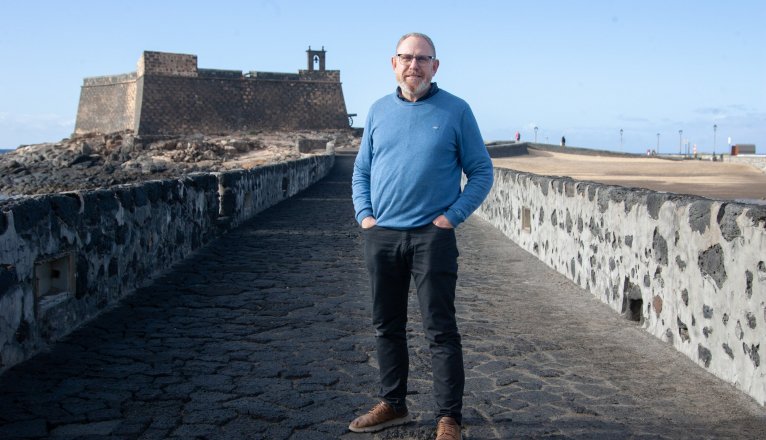
To learn about the impact of tourist overload in the Canary Islands and the specific challenges of some natural spaces in Lanzarote, the Doctor in Geography from the University of La Laguna Fernando Sabaté, who has dedicated his career to studying the Canarian ecosystems, the value of agriculture and social mobilizations for the right to nature, offers an interview with La Voz on the occasion of his visit to Lanzarote.
A tax for environmental conservation
This professor of Geography advocates for the implementation of an ecotax, a tax that would tax tourist overnight stays in the archipelago and be used for the conservation of natural spaces, which are increasingly under pressure from visitors, and at the same time, defends that tourism growth must be contained "once and for all, because we are dying of success".
After the mobilizations of 20A, the Ministry of Tourism of the Government of the Canary Islands, in the hands of the Popular Party, defended that the rest of the islands should implement the so-called Lanzarote Model, that is, a tax that is applied to access to certain spaces, as is the case on the island with the Centers of Art, Culture and Tourism.
However, this expert points out that the implementation of a tourist tax or ecotax and the payment of tickets to specific places, "can coexist, in the same way that one goes to Paris and in the establishment where one stays, pays a tourist tax and then pays an entrance fee to visit the Louvre Museum or so many other places".
Regarding this baptized Lanzarote Model, he explains that "with all certainty, the tandem César Manrique and the Island Council of Lanzarote was a very fortunate combination" between the public administration and "the collective good, the creativity and the intelligence of an artist like César", but he points out that "that does not mean that we also have many problems, things to solve and reverse".
In this sense, he insists that the application of an ecotax in Lanzarote would serve to rehabilitate spaces, restore degraded areas of the island, to provide environmental agents and "continue developing environmental education policies for all audiences" and that these must always be maintained.
The case of La Geria, a unique space in the world
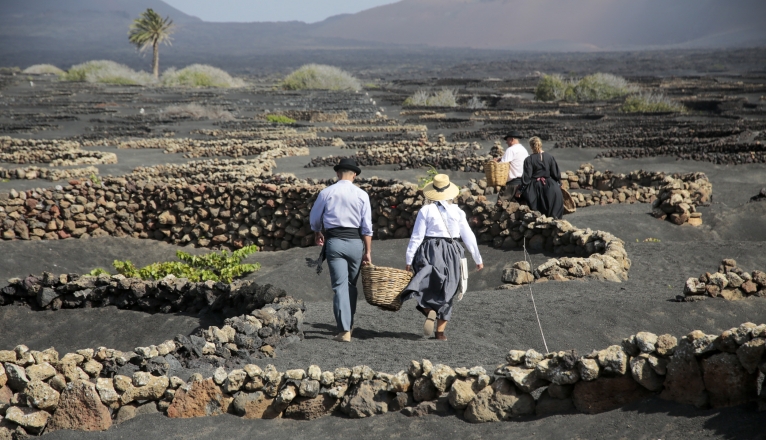
Sabaté was invited by the César Manrique Foundation to give a workshop on La Geria, where he delved into the values of a fragile territory and the social and political opportunity to reflect on the problems facing the archipelago today.
About La Geria, he explains that it has an "immeasurable value" and describes it as "the result of a messianic moment, which occurs after the well-known eruptions of 1730 and that completely changed the history of Lanzarote". These eruptions allowed "in a desert territory, to introduce crops that normally need a lot of rain and put them into practice profitably", he continues on the other end of the phone. From this adversity, the people of Lanzarote managed to build "an unusual, grandiose and unrepeatable landscape" and "internationally recognized".
Despite its incalculable value, mass tourism, the abandonment of cultivation and the search for profitability, which displaces traditional agriculture, are putting at risk the conservation of this unique space in the world. Sabaté indicates that the current situation of La Geria requires "regulation and management" of its resources.
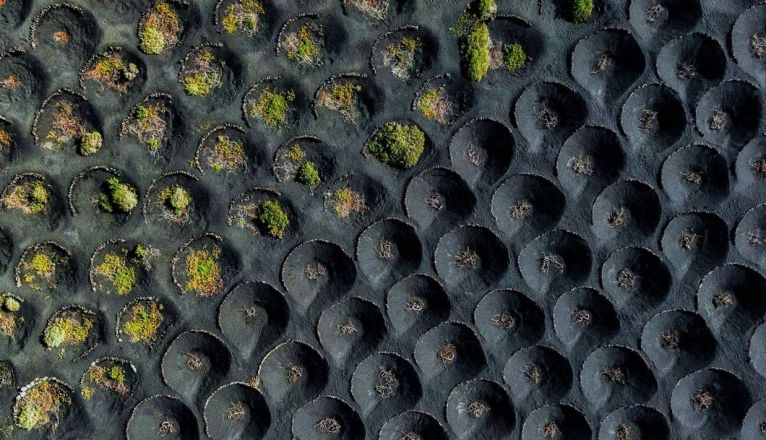
Thus, he exemplifies that the ecotax can be used to implement surveillance in the area, with the hiring of environmental agents, also to carry out studies and interventions in the landscape, such as restoring and rehabilitating the zocos, in addition to improving transport to the area with public buses to fight against the supremacy of the private vehicle.
The geographer explains that "the speed of transit through a territory has to be linked to the quality of its landscape". He also points out that in this space "the serious error of widening and expanding the road in the northern section was committed", while warning of the risk that would entail repeating "that error, in the southern section".
Precisely, in this southern section, Sabaté criticizes the transformation that this protected landscape is suffering with the introduction of "crops in rows", instead of the traditional zoco, a practice that he considers a "perversion" of the original spirit of the area.
The researcher offers some ideas on how the recovery of this space could be. Among them, he urges the creation of a specific body for "democratic deliberation", but also for the management of La Geria, which has "certain financial autonomy", in addition to restoring the degraded areas of the landscape.
To this he adds the importance of preserving the democratic memory of this place. "The elderly people who built and worked in that space, who gather a whole wealth of wisdom, are leaving us, we must rescue that knowledge, which helps you to finish understanding how that landscape worked, many of its small elements, its details", he reflects.
Sabaté offers two options: implement measures to fight against the disappearance of spaces as emblematic as La Geria or "let it fade away in time and what the people of Lanzarote built in the 18th century, the citizens of the 21st century will see how it disappears".
Rethinking mobility in Lanzarote
Beyond the case of La Geria, the Cabildo de Lanzarote has announced that it will carry out a pilot test to prevent access by private vehicle to the Volcán del Cuervo and Caldera Blanca during Holy Week and for a period of 15 days. In return, it will offer shuttle buses that will leave every 30 minutes from Mancha Blanca.
"In general terms, I am not in favor of restricting access to spaces, except in very fragile, very valuable places," adds Sabaté. In this way, he defends that accessibility "cannot always be of the same nature" and that "we cannot expect to reach all places by car, whether rented or private". Thus, without going into a specific case, he adds that limiting access "does not mean that one cannot end up accessing certain spaces, but from a certain point one has to walk or use a public transport system".