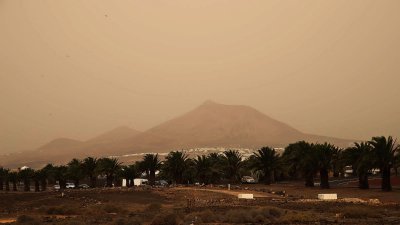
Lanzarote suffered a climatic anomaly of between five and six degrees in March of this year. According to data collected by the State Meteorological Agency, after experiencing one of the coldest months of February in its history, the Canary Islands recorded one of the warmest periods of the year in March.
According to the Climatological Advance of the Canary Islands from the State Meteorological Agency (Aemet), last March was the warmest since 1961 and the fifth driest since that year. "To carry out this analysis, we use all the advanced geostatistical stations that we have available in the Archipelago," explains the delegate of Aemet in the Canary Islands, David Suárez.
In the particular case of Lanzarote, the daily temperatures between March 1 and May 1 have suffered a notable increase compared to those recorded in the period between 1981 and 2010. To make these climate estimates, Suárez explains that periods of 30 years must be taken into account, since temperatures are "very variable" on an annual basis.
For example, last March 30 became the hottest day of the spring so far. That day the island registered a maximum of 34 degrees and a minimum of 24, which meant an anomaly of 11 degrees in the maximums and nine degrees in the minimums. Meanwhile, in April the maximum recorded rose to 31 degrees at the end of the month.
Winter was also warmer than normal, only a constant drop in temperatures was noted during the month of February, both in minimums and maximums.
Precipitation
With this increase in temperatures there has also been a notable decrease in rainfall. Meanwhile, historically, between 1981 and 2010, it was estimated at around 12 millimeters of accumulated weekly precipitation between April 12 and May 31. During this year, water has been largely absent from this season, reaching an approximate weekly average of 4 millimeters between April 5 and May 3.
In the past winter there was a positive anomaly between the week of December 8 and the week of December 22. At that time, the island exceeded 20 millimeters of accumulated precipitation. From then on, from the end of the year until the end of February, it suffered a negative anomaly, it rained half of what was expected for that same period between 1981 and 2010.


Add La Voz de Lanzarote as a preferred Google source.
Stay informed with the latest current news.