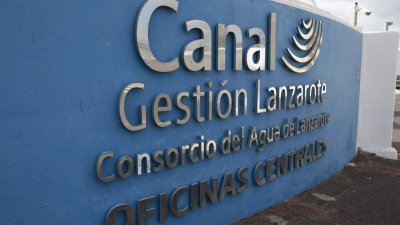
An administrative report, to which this medium has had access, proposes the public intervention of the service —through the seizure of the concession— after verifying a “serious, structural and continuous disturbance” in the provision of an essential service which currently is at levels of “maximum precariousness”.
The document concludes that the management of Canal Gestión Lanzarote SAU has led the system to a situation of extreme vulnerability. The network registers losses of 55.4% of the water produced, while several critical breakdowns remain unresolved for months. In this context, the Water Consortium considers the ordinary path of requirements exhausted.
Production at the limit and structural cuts
The report describes a particularly worrying scenario in the desalination plants. Janubio operates at 66% of its capacity since the beginning of the year due to a breakdown in a pumping group still unrepaired after three months. In Díaz Rijo, more than 1,200 hours of interruptions have accumulated in just one quarter.
According to the document, “supply cuts have become consolidated as part of the service in a structural normality that does not seem to evolve towards its resolution”.
The most delicate situation is located in the Lanzarote IV desalination plant, the one with the largest capacity, where access has remained restricted for months due to occupational hazards associated with the lack of maintenance in pressure equipment, which prevents carrying out preventive work.
Insufficient purification and effects in the primary sector
The problem extends to the sanitation system. The report indicates that the main wastewater treatment plants operate in an “inexpert and insufficient” manner, repeatedly failing to comply with environmental parameters.
In Playa Blanca, residents and City Council maintain complaints due to bad odors linked to the lack of oxygenation. In Arrecife, the public company ACUAES has warned of the improper use of recently delivered facilities. In Tías, essential equipment has remained up to six months out of service due to lack of maintenance.
As a consequence, the availability of regenerated water for agricultural use has been reduced to less than half, with direct impact on the primary sector.
Staff deficit and increase in sick leaves
The Consortium links the deterioration of the service to the reduction of the operational staff. The team assigned to leak control has been reduced by 50%, with only two operators for the entire island. Added to this is a "very negative" perception among the staff and an increase in sick leaves, which limits the response capacity to incidents.
Temporary intervention and shock plan
Given the “inability to respond” of the concessionaire, the report proposes intervening in the service for an initial period of six months, extendable up to a maximum of two years.
The measure contemplates the designation of public interveners who assume the direction, the taking control of the operation and the activation of a shock plan valued at more than 500,000 euros to correct the most urgent deficiencies.
The estimated cost for the first semester, which includes technical audits and operational reinforcement, amounts to -548,375 euros. An investment that the Consortium considers necessary to avoid the collapse of the island's hydraulic system and restore a continuous and quality supply in Lanzarote and La Graciosa.


Add La Voz de Lanzarote as a preferred Google source.
Stay informed with the latest current news.