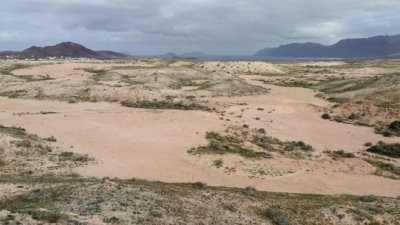
The international scientific community has expressed "its deep concern" about the effect of sand extraction in El Jable de Lanzarote, the most important breeding site remaining in the Canary Islands for the survival of the Canarian houbara and "possibly in the world".
In a joint statement issued last November by the International Union for Conservation of Nature (IUCN), the Species Survival Commission (SSC) and the houbara specialist group have called for a "complete ban" on the extraction of aggregates in El Jable.
The Canarian houbara (Chlamydotis undulata fuertaventurae) has an "exceptional importance" for the conservation of the entire species worldwide. So much so that this endemic subspecies of the African houbara is the only one that is not threatened by uncontrolled hunting or the release of an excessive number of birds bred in captivity.
However, the Canarian houbara, only present in Lanzarote, Fuerteventura and La Graciosa, faces other risks such as the loss of its natural habitat (construction of wind turbines, abandonment of traditional agriculture, overgrazing by goats, etc.), as well as nuisance (by tourists, military training or walkers with dogs, etc.) or collisions with power lines and an increase in the extraction of sand for construction.
In Fuerteventura, the number of males has decreased by 65% in the last 23 years, according to the study carried out by Alberto Ucero this year. In addition to the protection measures proposed by the scientist (such as the restoration of scrubland, the restriction of new roads or the burial of power lines, among others), the expert points out that the population will take years to restore the number of previous specimens and will see its existence reduced on the island, where it will suffer a genetic bottleneck due to little genetic variety among its members.
Meanwhile, in Lanzarote there remains the "most important" population of Canarian houbara "not hunted or genetically contaminated" of the entire Spanish species. For the international scientific community, the island has "the obligation and the opportunity" to ensure the future of the African houbara as "a key element of the Canarian, Spanish and world biodiversity heritage".
In 2018, between Lanzarote and, to a lesser extent in La Graciosa, there were between 440 and 452 specimens of Canarian houbara bustards. Specifically, in the 40 square kilometers of the semi-desert of El Jable the density of houbaras was "relatively high". So much so that 2.15 specimens per square kilometer were identified, reaching a population of 86, 20% of the entire island.
Fragmentation of habitats
The houbara is a threatened species, both globally and nationally. The International Union for Conservation of Nature defends that the extraction of sand in El Jable is "incompatible with Spain's obligation to protect" a Special Protection Area for Birds (SPA) such as this one.
The extraction of aggregates involves the "fragmentation of the habitat" and causes "the decline of species populations". The international scientific community argues that "fragments are often individually too small and too disconnected to be inhabited by animals that need a continuous habitat to survive".
The letter, signed by the co-chairs of the Group Además, insists that it "irreversibly damages" the semi-desert landscape by penetrating to the "bedrock of the clay substrate" and leaving an "ugly and useless view for any other purpose".
Thus, neither the houbara nor other birds will be able to make use of this soil. At the same time, the IUCN adds that the "damage already caused to El Jable is considerable", and that it has gone from a sample of 122 houbara bustards in 2012 to the 86 registered in 2018.
The international scientific community explains that the extraction of aggregates not only "destroys large amounts of vegetation", but also affects the species that live there with the sound. To conclude, it stresses that "any extraction of sand will only cause further disproportionate losses of birds in El Jable and will seriously weaken the immense importance of the site as a crucial defense against the local, national and global extinction of the species.


Add La Voz de Lanzarote as a preferred Google source.
Stay informed with the latest current news.