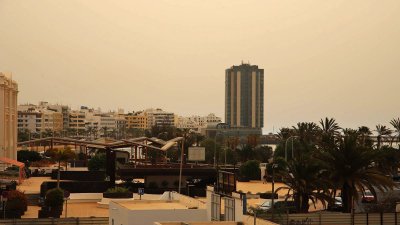
The consequences of climate change continue to affect the population. This time the report prepared by Ecologistas en Acción on air quality in Spain highlights "the numerous episodes of haze" in the Canary Islands. The Archipelago recorded the worst situation in the country in the last decade due to the presence of particles of less than ten microns in the air.
The Canary Islands figures exceed "the daily and/or annual limit values in practically all measurement stations," reveals the environmental association. At the same time, this coincides with a "growing trend closely related to global climate change," according to this study.
As reflected in the graph presented by the association in defense of the environment, Lanzarote exceeds the proposed legal limit throughout the island. This means that the 40 micrograms per cubic meter per year of particles up to ten microns (PM10), largely related to haze episodes, have been exceeded.
The ten stations located on the islands of Lanzarote and Fuerteventura recorded 52 days with more than 50 micrograms per cubic meter of particles less than ten microns, related to dust from North Africa. This places both islands above the normal daily value, and with the highest amount of suspended dust in the Archipelago.
According to the Ecologistas en Acción report, when episodes of particles less than ten microns are "greater than 35 days" per year, "the daily limit established by the regulations is exceeded, and if it is greater than three days, the WHO recommendation is also exceeded. The new proposed limit value being 45 μg/m3, not exceeding more than 18 days per year."
In addition, according to current data, Lanzarote and Fuerteventura are some of the islands that suffer the most from the presence of particles smaller than 2.5 microns.
In Lanzarote there are several stations in charge of measuring air quality, located in: Arrecife, Costa Teguise, the Sports City or Las Caletas. These meters, which can be consulted online on the website of the Government of the Canary Islands, collect the levels of sulfur dioxide, nitrogen dioxide, particles of less than 2.5 microns, particles of ten and ozone.
However, according to the Ecologistas en Acción report, "the diagnosis of the situation regarding the pollutant of particles less than 2.5 microns is still imprecise and a greater effort by the Autonomous Communities would be needed to expand the measurement equipment and increase data capture." The same occurs with the analysis of heavy metals and polycyclic aromatic hydrocarbons, carcinogenic elements.
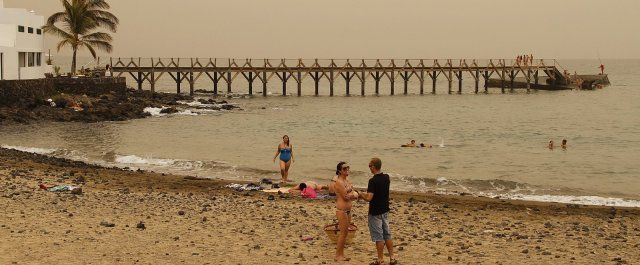
The recovery of economic activity, the return to the use of the engine, are prominent elements for which the air quality in general has worsened throughout the country. While in Lanzarote it continues to affect tropospheric ozone. "Coinciding with the heat waves of mid-June and especially July, there were 220 exceedances of the threshold" throughout the country.


Add La Voz de Lanzarote as a preferred Google source.
Stay informed with the latest current news.