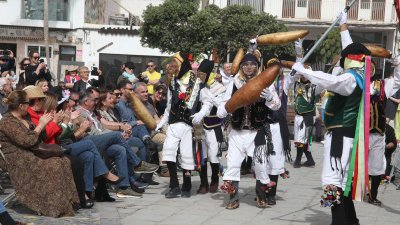
The buches of Arrecife begin their journey to be declared as intangible heritage of the Canary Islands, first, and then to achieve being a 'World Heritage Site' by UNESCO, a journey that begins with the construction of a replica of an old Canarian boat and the recreation of traditional carnivals.
This initiative is sponsored by the association 'Parranda Marinera de Los Buches', which aims to preserve the traditions and original samples of the popular culture of the port of the capital of Lanzarote. Currently, they are collecting documentation and taking inventory of all the cultural manifestations that exist around the buches and the artistic heritage that has been generated around the entity.
But, what is a buche? According to the artist and secretary of the association, Juan David Machado, it is a traditional object that was used in carnivals to hit passersby on the backside and in dances of mockery or ridicule towards the towns of the interior of the island.
The buches come from the stomach of a species of shark that has its habitat on the coasts near the Canary Islands, from which only the outer skin is taken, which is inflated with air as if it were a balloon, after having been cured in brine and dried.
Of these manifestations of the port culture, Machado explains to EFE, there is evidence by documents of various kinds since the 18th century, since they used the clothing of the time although "carnivalized", using sequins, embroidery and bright colors in the fabrics.
"The buches are nothing more than a reflection of our culture", he assures, and then affirms that they are born from a "mixture of traditions" between different regions that have contact with the archipelago, as is the case with Canarian culture in general.
To reach the final goal of protecting this ancestral tradition, the 'Parranda Marinera de Los Buches' organizes "various activities and events to spread" the port culture, while creating "links with other professionals at the Canarian level who are carrying out similar tasks and unite, thus, efforts so that the intangible heritage is taken into account by the regional Government".
A Canarian boat
Among these activities and events that seek to spread the initiative of the association, is the creation of a replica of an old Canarian boat -precursor of the current Latin sail boats- using the riverside carpentry for this.
To carry it out, they have the work of master carpenter Agustín Jordán. "I have been involved for many years in rescuing old things, and in this project we wanted a boat that would represent Arrecife, to remain faithful in the sails, in the figure of the hull", he indicates in conversation with EFE.
Such is the fidelity with which they want to engender this project that they are using, as was done in the past, the woods that can be found on islands such as Lanzarote, which are not as wooded as La Palma or Madeira, and which therefore forced them to use resources limited to their circumstances.
In this way, Jordán is using acacia majorera wood, a species that can be found as an ornamental in public spaces and gardens. Specifically, the rods or twigs that fall from the trees, which he treats to create frames, in what is an authentic "use of resources".
This initiative was presented to the call for artistic, cultural and educational projects of the Art, Culture and Tourism Centers of the Cabildo de Lanzarote of 2023, whose evaluation council gave it favorable votes to sponsor its constructive part.
It has three functions: to be part of the traditional carnivals, as a piece for a future museum that the Parranda intends to open and as a way to favor the conservation of riverside carpentry. And it is that this artisanal manifestation is in danger of disappearing due, in part, to the fact that the Canarian population "does not have a direct relationship with the carpenter, with the culture, with the artisan", in the words of Jordán. He indicates that he, who has traveled through many places, has seen "more respect for that work" in other latitudes.
Carnival dances with buche in hand
Beyond the Canarian boat, in the carnivals of Arrecife, which are celebrated in the first half of February, they also want to be present with a recreation of the traditional carnivals of the city, in which the buches had a great prominence.
On the day of the traditional carnival of Arrecife, the 'Parranda Marinera de Los Buches' will take out its best clothes to honor the port culture and, incidentally, make its work visible to the population. In this task, Rubén Valiente, dance director of the association, plays an important role, in charge of organizing its members to do the dance that day.
"It is not a dance to use, it is not governed to anything beyond yourself, your way of being, dancing and participating with the citizens. And that's why this tradition is so fun and different", says Valiente, who focuses on that interaction with the population that goes out to the streets to have a good time: "That is the carnival in the strict sense".
Although now their efforts are focused on this kind of scenic representation, a "significant group" of people with "joy and desire to participate" has already joined, so they are preparing "something for later" in order to gradually take "that roots to the streets".
With these small steps, the 'Parranda Marinera de Los Buches' intends to bring its plan to fruition and achieve the designation of intangible heritage of an ancestral tradition that, far from what might be expected, has not become stagnant. "We are a totally open, inclusive association, where the lyrics that are being made now speak of today's world, of popular feeling", says Machado.
Therefore, they not only seek to preserve the past and be able to maintain it, but also to "continue innovating from the popular root". And let UNESCO hear it loud and clear.


Add La Voz de Lanzarote as a preferred Google source.
Stay informed with the latest current news.