
Photos: Sergio Betancort
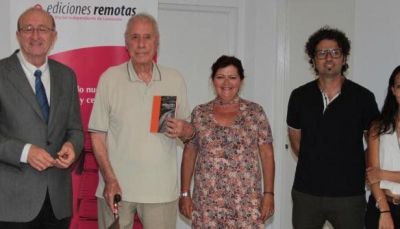
The Municipal Archive of Arrecife hosted last Wednesday the presentation of the book "Prehistory of Lanzarote", the latest work by Agustín Pallarés. The event was organized by the Department of Culture of the City Council of Arrecife and was framed within the festivities of San Ginés.
The prologue is the work of the professor of Prehistory Antonio Tejera Gaspar, who also participated in the presentation together with the author of the book, the councilor Carmen Delgado and the doctor in History María Antonia Perera, one of the archaeologists who has worked the most in the prehistory of Lanzarote.
As the councilor explained, "with his new work, Agustín Pallarés Padilla delves into the keys of the primitive population of Lanzarote and summarizes the main characteristics of the aboriginal culture of the island, such as social organization, religious rites, housing, the use of engravings and ceramics, food or water treatment, among other chapters." Especially noteworthy are the sections dedicated to Agustín Pallarés' pioneering hypotheses about its human settlement and language.
Decades of study
Prehistory of Lanzarote is based on the field work carried out by its author for decades on ancestral customs and its toponymy, together with the reading of classical documents and recent bibliography. In this way, Pallarés presents a broad and complete portrait of the stage prior to the European conquest of Lanzarote.
The book, of 200 pages and with a small photographic annex, is the new contribution of Agustín Pallarés to the publishing house Ediciones Remotas and offers a vision of the society of the Majos. The book is published with the collaboration of the Cabildo of Lanzarote and the City Council of Arrecife.
Agustín Pallarés, five decades of cultural dissemination
Agustín Pallarés Padilla (1928, La Oliva) is the grandson and son of lighthouse keepers, a profession he also practiced for almost four decades. Along with this work, and since the sixties, Pallarés has developed an intense self-taught work of research and dissemination in various areas of the culture of Lanzarote and its islets: history, toponymy, geography, linguistics, natural heritage, etc.
His work has been published in specialized magazines and congresses (Almogaren, Revista del Museo Canario or Jornadas de Estudios de Lanzarote y Fuerteventura), and also in hundreds of articles for the press. He has written the books Diccionario de topónimos de Lanzarote and La isla de Alegranza. Among the recognitions he has received, the appointment of Memorialist by the Board of Official Chroniclers of the Canary Islands and that of Adoptive Son by the Cabildo of Lanzarote stand out.


