
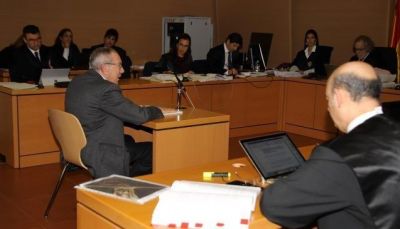
The technicians of the Canary Islands Government who have testified this Wednesday as defendants in the Stratvs case have attributed to "an error" the contradictions that exist in the documents that they themselves signed to authorize that new winery in the protected area of La Geria. In the case of Faustino García Márquez, he issued a negative proposal in October 1998, but only a few months later he went on to report in favor, with the same reports that had previously led him to deny it.
"I put an excessive and erroneous emphasis on it because I wanted to give a quick negative response to this request," he stated to explain his first proposal. Before issuing it, he had requested a report from the Cabildo and another from the Ministry of Agriculture. The first warned that it was a protected natural area and that any aerial construction or construction involving earthmoving was prohibited in La Geria. The second concluded that authorizing a winery of that size was not justified given the area of cultivation that was going to be associated with it.
"I was tired. I interpreted it quickly but it was not a negative report. It was a reservation", said the then head of Services of the General Directorate of Urban Planning of the Canary Islands Government, who emphasized the volume of work they had in those years. "And why did he change his mind months later? Why did he go from saying that the Ministry's report was unfavorable to saying that it was not?" the prosecutor, Elena Herrera, asked him. "What I did was correct an error, correct an erroneous proposal," García Márquez insisted. In the meantime, according to what he explained, he had only received one new element: the allegations presented by the promoter, who, among other things, went on to link more meters of cultivation to the work they intended to carry out. But to change the proposal, a new report was not requested from the Ministry, and it was not verified whether this data on the cultivation area was true. "The law did not require it for this procedure," they pointed out in this regard.
"It depends on how the earthmoving is done"
Regarding the report from the Cabildo that warned that works involving earthmoving were prohibited in La Geria by the Island Plan, both García Márquez and the other accused technician, Armando Villavicencio Delgado, have maintained that this is something that must be "interpreted" and that "depends on how it is done."
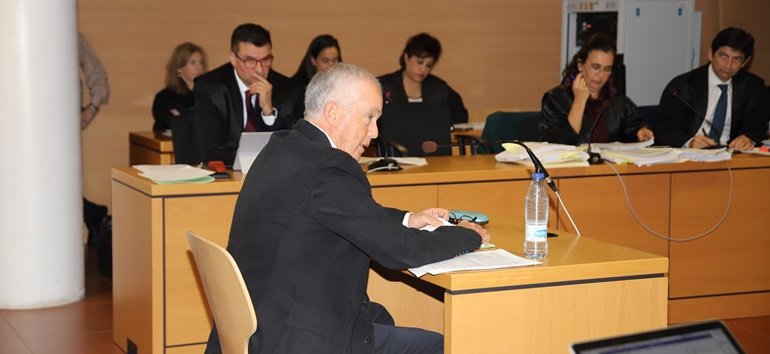
"In La Geria there is earthmoving every day," said Faustino García Márquez in reference to the work of farmers, and highlighting that it is also allowed to build buried cisterns. What he has not denied, unlike what his lawyer did on the first day of the trial, is that La Geria is a protected natural area. However, he defended that, having not been developed with specific planning, it is necessary to "interpret" what the Island Plan indicates and "not apply a phrase without taking into account the rest." Thus, he insisted that the PIOT also speaks of the importance of promoting the wine industry on the island in order to maintain that landscape.
Regarding why he did not request new reports after receiving the promoter's allegations and before changing the meaning of his proposal, he acknowledged that "he could have requested it." However, he added that the deadline to respond to the request had already expired six months ago, so he understood that it had already been authorized by administrative silence.
"Positive silence is for interventions that are planned in the planning, but for those that are not, it is negative," the prosecutor reminded him. "Yes, that's correct... But this is an action not expressly planned, but not prohibited either," added the technician, insisting that "it depends on the earthmoving" to see if a work is affected by that prohibition. In any case, he stressed that what he proposed to authorize "was not a tourist complex," it was a buried warehouse-winery of 900 square meters, which has nothing to do with what was finally built in Stratvs.
A "vague" and "informal" procedure
What none of the three defendants from the Canary Islands Government has been able to clarify is how the promoter's allegations reached the Executive, through a fax from Galerías Rosa, when there was still no definitive resolution but only a technical proposal, which is not usually transferred to the interested party. "It is a vague procedure," "there is a certain vice of informality," responded the then Director General of Urban Planning, Juan César Muñoz Sosa, who emphasized that this procedure only implied a prior authorization from the Canary Islands Government, since later the City Council had to grant the building permit analyzing other parameters.
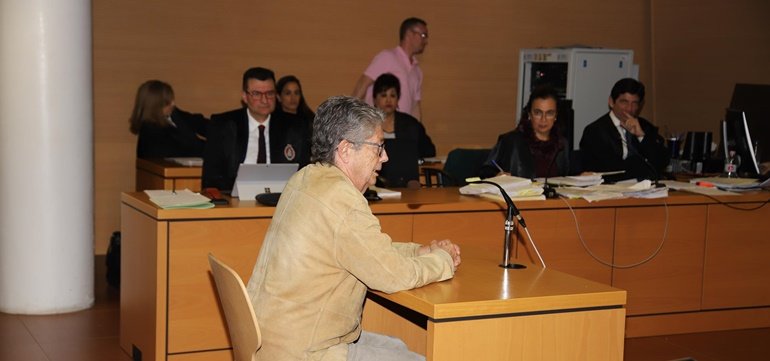
"Sir, this is a regulated prior act," the prosecutor replied, to which Muñoz withdrew the term "vague." However, he insisted that the procedure was "very open" and that "the interested parties called by phone" or "had an interview with a technician" while the file was being processed. However, the other point that has remained unclear is why Juan Francisco Rosa acted as an "interested party" in that file when in theory he was not. He did not even appear as the applicant for the authorization nor was he the owner of the land - his name did not appear linked to this winery until many years later - but even so he received notifications of the file and even the allegations to what at that time was only a technical proposal were sent to the Canary Islands Government from a fax of his company.
"I knew Juan Francisco Rosa like everyone else. I am an older person and I am involved in this sector, so I know him," Juan César Muñoz Sosa responded to questions from the prosecutor, who insisted on knowing what type of relationship they had. "As I could have with a lot of people related to the sector," added the former Director General of Urban Planning of the Canary Islands, who denied that he gave any indication to the technicians that they should authorize this winery.
These, for their part, have stated that they did not know that the real promoter of the project was Rosa and, in response to questions from his lawyer, have stated that the businessman did not offer them any "gift or perk" to report favorably. "I don't know him. I met him yesterday," said the other accused technician, Armando Villavicencio Delgado, assuring that until the trial began this Tuesday he had not even seen this businessman in person.
No hearing was given to the legitimate owners of the land
The authorization request to the Canary Islands Government was presented in the name of Piedad del Río, who is the wife of another of the accused, the architect Miguel Ángel Armas Matallana. According to what he himself declared during the trial, he was the owner of a part of the farm, which came from an inheritance and which had several owners. The others, belonging to the Negrín family, were present in this case as a private prosecution, but withdrew shortly before the trial, when a year ago Rosa finally bought them the land where he had built Stratvs.
"As a jurist, didn't you give a hearing to the rest of the owners?" the prosecutor asked Villavicencio. "The file does not have a title of ownership," the accused responded. The prosecutor then asked that the file be shown to him, for which, among other things, a deed of sale of only one twelfth part of that farm by Miguel Ángel Armas Matallana and Piedad del Río was provided. "I must say that it is the first time I see it," the technician assured when showing him the document. "For me there was no more interested party than Piedad del Río," he insisted, when the prosecutor reminded him that the law requires compliance with this procedure in any file of land with several owners.
For his part, Armas Matallana has stated that he reached an agreement with Rosa to build the winery and rehabilitate the house that existed on that farm, although he has assured that as an architect he did not intervene in the rest of the works that were not authorized in the license, such as the construction of the restaurant and the terraces. Regarding the application for permits, he has stated that although they were processed in his wife's name, they left the negotiations in the hands of Juan Francisco Rosa, until in 2005 they decided to disassociate themselves when they saw that "what he wanted to do was a very large work."


