
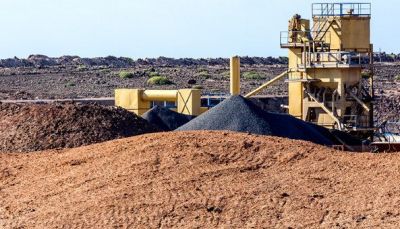
The Prosecutor's Office has opened a criminal investigation into the activity carried out by the family business of former PIL councilor Juan Lorenzo Tavío, which has been operating for years an aggregate extraction plant, a crusher and a cement plant on protected land in Yaiza, in the area known as Hoya de la Yegua de Arriba, in Montaña Roja. For the moment, what has already been initiated are pre-trial proceedings and the Public Prosecutor's Office is collecting reports to determine if possible crimes have been incurred by this company before transferring it to the Court.
One of these reports was requested from the Environment area of the Cabildo, to confirm if the area is included in the Natura Network, "as well as the consequences that this would have in terms of the possibility of authorizing the extraction of aggregates and carrying out the production of asphalt in it." And the response that the Public Prosecutor's Office has received is that this activity could not be authorized in that location.
In addition to being part of the Natura 2000 Network, specifically the Special Protection Area for Birds (SPA), part of the land occupies a "natural habitat of community interest" and is also classified as an Area of Importance for Birds, as it is home to several protected species, one of them threatened worldwide and in danger of extinction. Therefore, according to the information collected so far by the Public Prosecutor's Office, the protection of this land is incompatible with this industrial and mining activity that began a decade ago and was expanded three years ago, allegedly without authorization and without the mandatory environmental impact study being carried out.
A decade operating and expanding its activity
This activity was denounced a year ago in the Prosecutor's Office by the then spokesman for Podemos in the Cabildo, Carlos Meca, who warned precisely of the protection of this space and the possible illegality of the activity, which could constitute crimes against the environment.
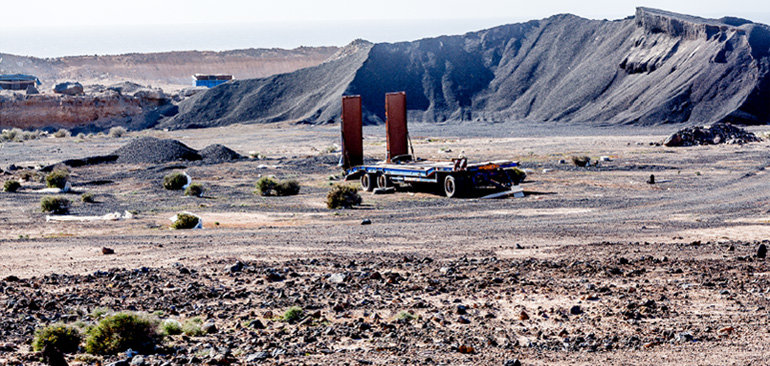
The complaint recalled that the company Hermanos Tavío Santana received an activity license from the Yaiza City Council in 2008, but added that what that license authorized had nothing to do with what was finally being developed, which was also expanded over the years. When that permit was granted, Juan Lorenzo was a councilor of the government group. In fact, that same year he participated in the granting of the activity license to the Stratvs winery, for which two years ago he was convicted of a crime of prevarication along with the rest of the members of that Governing Board chaired by Gladys Acuña.
In 2016, two years after resigning from his position as councilor in Yaiza after 22 years in politics, Tavío himself submitted a prior communication to the Consistory notifying the expansion of his company's activity, trying to take advantage of the procedure that allows a business to start operating before obtaining the mandatory license.
However, the complainant stressed that "the activities of manufacturing asphalt and concrete cannot be authorized through the prior communication procedure," as they are polluting industrial activities. In addition, he warned that there was no declaration of ecological impact on the activities that had been carried out previously and that none had "coverage in current legislation."
The 2014 General Plan already warned of the damage
Within the proceedings opened by the Prosecutor's Office, prosecutor Celia María Asensio has also requested information "about the consequences that the activity has had for the landscape, flora and fauna", although in this case she has not yet received a response, since apparently the Cabildo has not "monitored" this activity in recent years.
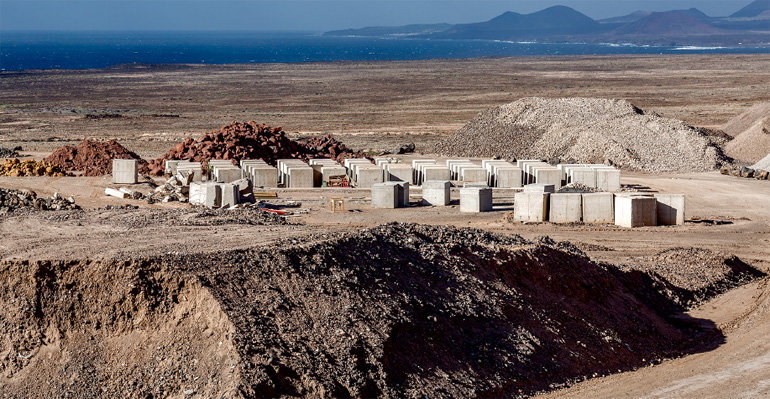
However, the report of the General Plan of Yaiza approved in 2014 pointed out that the extraction of stone and lapilli that was being carried out in that area "causes the alteration and degradation of the original vegetation and loss or deterioration of the species associated with it", as well as "the proliferation of clandestine landfills, creation of roads and tracks" and "introduction of predatory species", causing "loss and fragmentation of habitats and ecosystems and destruction of areas of importance for the species".


