
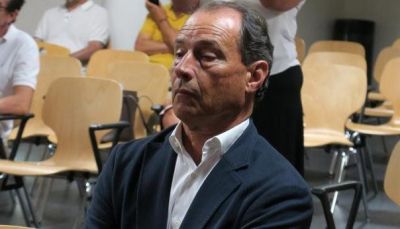
The main trial of the Stratvs case already has a date. The Sixth Section of the Provincial Court has set a calendar of 22 days to hold the hearing, which will begin on September 17 in Arrecife and end on November 15 in Las Palmas de Gran Canaria. The Court plans to travel to Lanzarote for twelve days of the trial, while the other ten will be held at the provincial headquarters of the Court.
The Prosecutor's Office's indictment, in which 15 years in prison are requested for Juan Francisco Rosa, was filed four years ago, in March 2015, but since then only a small part of the case has been judged, focused on the granting of the activity license to the winery. That piece had to be separated when the former mayor of Yaiza, Gladys Acuña, became a member of parliament when she became a regional parliamentarian. In that first trial, the Superior Court of Justice of the Canary Islands sentenced eight of the ten defendants who sat on the bench and who had intervened in the granting of that illegal license - for which the opening was authorized without even verifying what had been built - although Rosa was acquitted of the crime of influence peddling.
In this regard, the ruling stated that the telephone calls that had been intercepted by the UCO, in which Rosa called the Councilor for Urban Planning demanding that license, "do not reveal sufficient pressure" to convict him of influence peddling, which was the only charge against him in that piece. Therefore, only the politicians and technicians who intervened to grant him that permit were convicted. Now, however, the businessman faces charges for more than a dozen crimes of which he would be the direct perpetrator, including crimes against the environment, against land management, against historical heritage, of fraud, of document forgery and of usurpation, and which are the main ones that were investigated in this case.
The administrations "did not put any obstacles to his excesses"
In this second trial, along with Rosa, another ten defendants will sit on the bench, including the architect of the winery, Miguel Ángel Armas Matallana, and public officials and technicians from the Yaiza City Council, the Lanzarote Cabildo and the Canary Islands Government. In its indictment, the Prosecutor's Office points out that the public administrations that should ensure compliance with urban planning and environmental legality "did not put any obstacles to the urban planning and speculative excesses of the businessman, nor to his desire for profit, at the cost of seriously attacking the island environment to the detriment of all the people of Lanzarote".
As highlighted by the investigation of this case, Juan Francisco Rosa requested a license to restore a protected house and to build a 900-meter warehouse-winery and what he did was demolish the house and build a new, larger one, building around it a macro-complex of 12,000 square meters on protected land. Thus, in addition to a large winery, he also built a store, a restaurant, kitchens, walls and various terraces that had no legal coverage and where he held all kinds of events despite lacking a license and with the passivity of the administrations, until the judge investigating this case, Silvia Muñoz, ordered the sealing.
In addition, the Prosecutor's Office maintains that even the first license he obtained, and which had nothing to do with what he ended up building, was also illegal, to which is added that the land where he built Stratvs was not even his. In fact, it has been now, given the proximity of the trial, when Rosa has just bought the land from the families who were involved in the case as injured parties, and who have now withdrawn from the procedure.
"A continuous and premeditated fiction"
In the order that put an end to the investigation of this case, the investigating judge pointed out that the construction of Stratvs was based on a "continuous and premeditated fiction", which began from the request for the first permit. For this they used that pre-existing protected house, which did not even belong to Rosa. That is where the architect, Miguel Ángel Armas Matallana, came on the scene, who had part of the ownership of that land through his family, although they were not the only owners (other owners were those who had appeared as prosecution in this case).
Even, in the first license application the name of Rosa does not even appear but that of the architect's wife, who was the one who requested the first permit. Later, that request was "mutating" - since initially only the rehabilitation of the house was considered and later it was extended to "restoration of housing and warehouse", even simulating that there was also an old winery - and in doing so the signature of the applicant was "falsified", according to what her own husband acknowledged in the Courts.
However, despite not appearing the name of Rosa, the Government of the Canary Islands sent him the notifications about this file. Later, once the permit was obtained, what was built had nothing to do even with the project that had been authorized, and that would also be illegal according to the Prosecutor's Office. And to all this were added other "false data", including cadastral alterations and a delay of four years in the term that had been set to finish the work, without the City Council acting despite having opened a file.
In addition, both the Court and the Prosecutor's Office concluded that "one of the most clearly differentiated elements of this protected space was irreversibly altered, such as the Barranco del Obispo, and at least 44,000 cubic meters were excavated, with the consequent extraction of stone, earth and rofe, the latter being a non-renewable resource and which is part of the elements to be protected in La Geria".
"Serious risk" due to polluting discharges
The indictment of the Public Prosecutor's Office also includes other crimes allegedly committed after the opening of the winery, since there were reports from 2006 until December 2008 warning that the facilities "did not comply with the regulations on wastewater disposal". However, the Island Water Council dependent on the Cabildo even granted permits for the discharge system, despite reports warning of contamination.
In fact, the Prosecutor's Office even points out that a "serious risk" was caused to the balance of the Protected Space and even to the health of people, in view of the contamination parameters shown by the discharges from the facilities, highlighting that only the Court of Instruction put a stop to said contamination, by provisionally closing the complex in view of the permissiveness of the competent municipal and island authorities.
In its indictment, in addition to prison sentences and significant financial fines, the Prosecutor's Office also demands the demolition of the Stratvs macro-complex, the definitive closure of the activity, and the nullity of all licenses and permits that were granted, as well as the public deeds and registry entries made in relation to the Stratvs complex.
In principle, the trial will be held on September 17, 18, 19, 24, 25 and 26 and October 1, 2, 3, 15, 16 and 17 in Arrecife and on October 8, 9 and 10 and November 5, 6, 7, 12, 13, 14 and 15 in Gran Canaria, although this calendar is still subject to changes, in case the parties raise justified objections to any of those dates.


