
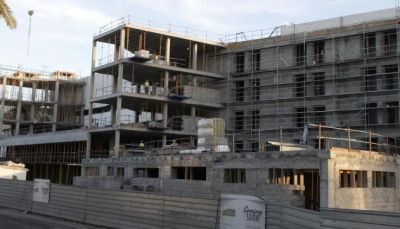
The businessman Juan Francisco Rosa has lost a new battle in court, this time related to the illegal works he started in 2017 at the Fariones hotel. In a ruling dated January 24, the Contentious-Administrative Court Number 4 of Las Palmas de Gran Canaria rejects the appeal filed by Rosa asking that he be "recognized his right" to obtain a license for the works he had started without authorization in the hotel's swimming pool area, and that also required a report from Heritage, as a garden that is protected in the Island Heritage Catalog and in the Tías General Plan Catalog was affected, as stated in the ruling.
"In the absence of the issuance of mandatory reports, such as the Historical Heritage Report of the Cabildo of Lanzarote, and the technical and legal report on the adequacy of the project to environmental, territorial and urban legality, the challenged act must be considered in accordance with the law," the ruling states, thus endorsing the actions of the Tías City Council in not granting that permit.
In fact, the City Council did not even pronounce itself, warning that reports were missing before resolving the request. However, Rosa claimed that he had subsequently provided one from Heritage, although the ruling emphasizes that this opinion did not even rule on whether the works could be authorized or not. Therefore, it rejects all his claims, which involved requesting that the "presumed rejection" of his request by the City Council be annulled or that the license be considered granted "by positive administrative silence", which the Court also dismisses.
"Once the works started, he considered it appropriate to extend the remodeling"
The works at the Fariones hotel are part of the II Modernization Plan of Puerto del Carmen, which has also just been annulled by the Courts. Under that Plan, in September 2016 the City Council granted him a license to carry out some remodeling works, but the businessman started other works that were not included in that license or in the project he had submitted to the City Council to request that permit, as he himself acknowledged in his appeal.
"He alleges that once the works started, it was considered appropriate to extend the remodeling to the pool area, an action that was not covered by the aforementioned license, which led to the opening of a procedure to restore urban legality," the ruling states. It was in October 2017, after visiting the establishment, when the City Council stopped the works in that area of the hotel, also opening a file on other works that were being carried out without legal coverage.
That same month of October, Rosa finally requested a license for the works in the pool area, but without providing either a Heritage report, or a health report from the General Directorate of Public Health, or an opinion on "compliance with the requirements of the Second Modernization Plan of Puerto del Carmen". Therefore, on December 1, 2017, and within that file, the City Council gave him two months to legalize the works by providing all the mandatory reports.
In addition, the City Council itself contacted the Cabildo, sending them the project presented by the businessman and requesting the Heritage opinion. That report arrived only a few days later, on December 15, 2017, but the ruling emphasizes that "it does not rule on what was requested". In fact, what it did was request more information from the City Council, which later sent the Cabildo up to two reports with "additional clarifications" between January and March 2018.
"It is evident that he was not complying with the requirement"
However, Rosa presented that Heritage report to the City Council in January and in March he again requested that his request be resolved, when he still did not have a favorable opinion. According to the ruling, the businessman alleged that after providing that opinion, which was actually empty of content, "he was given the legitimate confidence that the request and attached documentation was correct and that, with this, the municipal requirements were met". In this regard, the ruling insists that what was presented was a report that "did not rule on the matter". "It is evident that with the contribution of said document, the requirement made was not being met," the ruling emphasizes, which also rejects another of Rosa's arguments, who in his appeal even "questioned" whether that report was mandatory.
The ruling also states that the Heritage report was finally issued on May 2, 2018, but emphasizes that the appeal had been filed almost a month earlier, on April 10. "What is proven is that when the plaintiff requests the granting of a license through administrative channels on March 22, and when he files the present appeal, the Historical Heritage report of the Cabildo had not yet been issued," it highlights. In addition, it adds that after the issuance of that report, on July 5, the businessman presented an execution project on all the actions he was carrying out at the hotel without being authorized by the original license, including those of the pool, as the City Council had been requesting, which maintained that they could not be processed as independent permits, which is what Rosa had intended.
Now, the ruling states that although it is not recorded that the City Council has continued the processing of the administrative file on the pool works, the applications for all the works that he started without having a license are "being processed", based on the basic project that he provided in March and the execution project that he presented in July, and that include all the interventions that he began to execute illegally.
Rosa also did not provide reports to the Court
In addition to concluding that the businessman intended to obtain a license without even having the mandatory reports, the ruling points out that Rosa also did not provide reports to the Court to support his theses, with regard to his request that the license be considered granted by positive silence.
"The appellant intends that this judge rule on a controversy of an eminently technical nature, but without providing any expert report in relation to the scope and content of the project," the ruling states, adding that the only report was the one provided by the City Council, which concluded that the LOE to which Rosa appealed could not be applied, because "these are permanent constructions for public and tourist use (hotel clients)", before which administrative silence can never be understood as positive.


