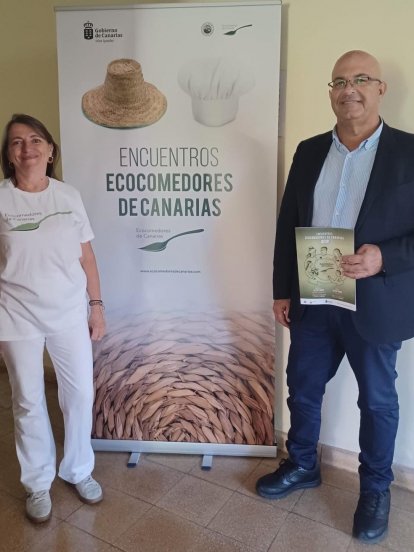
The Ecocomedores program of the Canary Islands Government, which promotes healthy eating among schoolchildren in the archipelago while guaranteeing regular income for organic producers on the islands, has much to celebrate this year.
On the one hand, this year 70 educational centers are being added throughout the archipelago, and on the other, the central government has chosen it as a model for all of Spain, and there are already programs inspired by the Canary Islands initiative in five other autonomous communities.
Lanzarote already has 18 centers incorporated and another six are about to join. But it wasn't always like this. In an interview with the Director of the Canary Institute of Agri-food Quality (ICCA), Lanzarote's own Luis Arráez, we discover why Lanzarote took so long to join the program and the keys to the success of Ecocomedores, in which 32 organic producers from Lanzarote participate.
The Lanzarote Case
"Until the 2022-2023 school year, there was only one center on the island, CEIP Capellanía del Yágabo, because in Lanzarote, it so happens that this is the only center with direct cafeteria management, with its own staff from the ministry."Today Ecocomedores is present in all municipalities and in numerous indirectly managed centers where the responsibility for the menu is managed by catering companies."We've been fortunate that the teaching staff and kitchen teams, along with the catering companies, have understood that even though it's not mandatory, they want to be involved and offer their boys and girls a healthy menu, and they also want to support Lanzarote's farmers," explains the director of the Canary Institute of Agri-food Quality (ICCA).
A central kitchen in Arrecife for ten rural schools
The CEIP Costa Teguise was the first to voluntarily join, followed by CEIP Playa Honda, Argana Alta, Virgen de los Volcanes, La Destila, Residencia Haría, and César Manrique.
In addition, thanks to the Cabildo's investment in the central kitchen of CEIP La Destila, ten one-teacher schools in Lanzarote are supplied from there (transport is paid for by the Department of Education): Los Valles, Caleta de Famara, Soo, El Cuchillo, Muñique, Tao, María Auxiliadora, Güime, Nazaret, and La Vegueta.Thus, Ecocomedores reaches 2,176 diners in Lanzarote and is expected to reach more than 2,600 with the upcoming incorporation of the CEIPs of Titerroy, la Asomada, Doctor Alfonso Espínola, Playa Blanca, Alcalde Rafael Cedrés, and Concepción Rodríguez Artiles. Furthermore, as Arráez confirms, "CEIP Guenia has also shown interest in joining."
Margarita Hernández, technician at ICCA, designed the program that is now being imitated in five autonomous communities
Asked about the program's origin, Arráez explains that we owe it to Margarita Hernández, an agricultural technical engineer at ICCA who designed the program twelve years ago and is its coordinator.Regarding the Royal Decree from the central government, inspired by Ecocomedores, which aims to ensure daily consumption of fresh fruits and vegetables in schools across Spain, offer more fish and legumes, and eliminate sugary drinks, Arráez acknowledges that "it fills us with satisfaction that they are looking to the Canary Islands, because it's true that we have been a pioneering community for twelve years."
The director explains that the Royal Decree was enacted after the minister's (Bustunduy) visit to the Canary Islands to learn about the program. "He was delighted with how things are done, after hearing the opinions of the teaching staff, the cooks, and the students."
Currently, there are similar programs, inspired by Ecocomedores, in Navarra and the Valencian Community: "The nursery schools of Pamplona and the Horta Cuina project in Valencia." Furthermore, Galicia is currently preparing to launch a program that will also be called Ecocomedores, and two other similar programs are in process in Valladolid and for Extremadura.
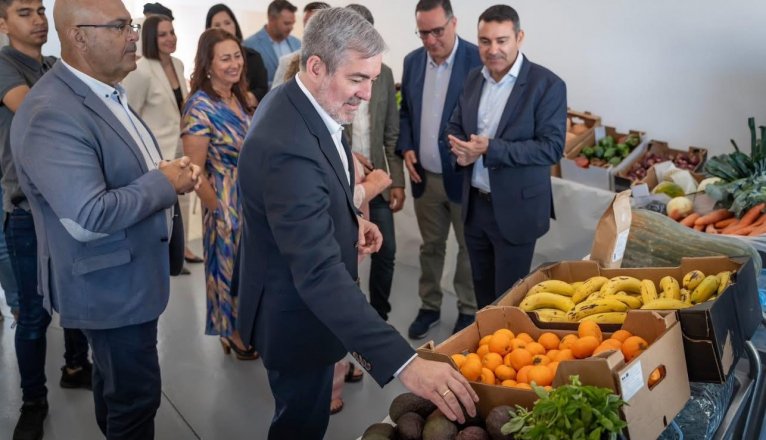
Ecocomedores de Canarias will also receive the national Estrategia Naos award in December: "the most important award given by the Spanish Agency for Food Safety and Nutrition, of the Ministry of Consumption." A recognition for the coordinator and the rest of the ICCA technicians, but also for the teaching teams in the kitchens, and even the families.”
"I say families, because at first, when there are changes in the menus, many times boys and girls resist the change, they get home and say I didn't eat, I didn't like the food. Then many parents get angry without understanding how important it is for their children to start eating healthy and healthily."“Over time, children end up convincing their families and change the menu at home. Believe it or not. There are many boys and girls who arrive at school having never tried a vegetable in their lives.”
Promoting organic farming: 32 producers in Lanzarote
The program has two fundamental aims: "On the one hand, to improve the quality of children's nutrition and on the other, to foster and promote organic agriculture and livestock farming."
"The products must be organic and local, from the Canary Islands." This is the case with vegetables, legumes, fruits, eggs, milk, cheese, yogurts, and artisanal fishing. "It's true that in meat, there's very little organic, some chicken, and in beef, from the island of El Hierro."
What isn't produced ecologically on one island arrives from another; "What Lanzarote exports most to other islands is sweet potato," shares the director of the ICCA.
Regarding the farmers who produce for Ecocomedores, there are already a total of "32, thirty of them belong to SAT El Jable," shares Erráez.In fact, Ecocomedores originated as a course of action for the 2010 plan to promote and foster ecological agriculture and livestock farming in the Canary Islands
For producers to make the leap to organic, the Ecocomedores program could guarantee them regular income from the direct sale of their products at a fixed price and without intermediaries, so they could earn more than with conventional products.
Ecocomedores is supported by various technical tables focused on aspects such as logistics, food, awareness-raising, or production. In this last one, all organic farmers meet to plan all production in the Canary Islands during the school year and agree on prices, which remain the same throughout the year, without fluctuations.
"We wanted agroecology to be much more profitable than conventional farming. We cut out the middlemen. The prices are fair for the farmers and for the educational centers; no educational center has increased the price of its menu for consuming organic products," concludes the Director of ICAA


Add La Voz de Lanzarote as a preferred Google source.
Stay informed with the latest current news.