
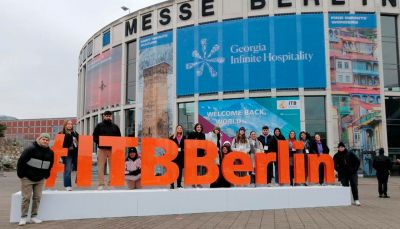
Canarian wine and cheese, the figure of César Manrique and the volcanic landscapes were the main elements that represented Lanzarote at the Berlin Tourism Fair, known by the acronym ITB. In the midst of the debate on the sustainability of the economic model, a group of 29 students from the island's School of Tourism traveled to Berlin for the first time, accompanied by one of their university professors, Pedro Hernández Camacho.
"What surprised me the most is seeing the volume of people that this economic activity moves," says Chaima El Ghazali, a second-year student of the Tourism Degree. Camacho explains that this moment of "disbelief" is experienced by all students when they arrive at a fair of the size of the ITB. "It serves to see that this model is infinite, it has no limits. To learn to swim, you have to immerse yourself in the water," the professor justifies this trip.
Between March 7 and 9, the students were able to enjoy this Fair, but they also spent seven days in the German capital. The Foreign Promotion Society paid for the accommodation and the entrance to the ITB. Meanwhile, the Department of Education of the Cabildo, led by Miriam Barros, contributed 50% of the tickets. "If not, it would not be affordable for the students, the price of the tickets has increased a lot," says the educator. "We only had to pay 200 euros for part of the tickets," says Nerea Correa, also a second-year student.
The debate that was on the table this year at the Berlin Tourism Fair was the tourism transformation and how the technological revolution has changed the promotion of the destination. To this discussion is added an old acquaintance: climate change and sustainability. "The climate and energy crisis is causing us to have to look for other tools to maintain tourism activity, it is difficult to maintain the volumes of tourists that have been reached," predicts Professor Hernández.
"Without transport there is no tourism", explains Pedro Hernández
The debate about sustainability has been taking place for the last eight or nine years at the Berlin Fair, continues the instructor. "The ITB knew that it had to address it. Another thing is that it is not put into practice," says Hernández. In this same line, he points out that "tourism is one of the main vectors that accelerates the climate crisis. In the end, it is nothing more than a citizen in movement and to be able to move you have to use exhaustible and polluting fossil resources. Without transport there is no tourism".
Away from theory and books, these students for seven days visited the German capital and one of the most important tourism fairs in Europe. From the testimonies of all the students interviewed, the word sustainability was one of the great protagonists. To the question of whether the tourism model of Lanzarote is sustainable, Nerea Correa answers: "There is still a step to be taken, it is an arduous process, but they are working to achieve it". Although there is still a way to go, she affirms that in Lanzarote "there is a tourism of higher quality".
"In the stand of Lanzarote it stood out that it was a different destination, its claim was the natural and cultural heritage and that made companies and individuals approach", highlighted El Ghazali.
"Tourist saturation and degrowth, like it or not, are on the table. Does that mean that agreements will be reached and that the execution phase of those agreements will be passed? We don't know," continues the professor.
"From the moment in which an island depends on the outside to be able to feed itself, there is no self-sufficiency or there is no water, one cannot speak of sustainability", says Martha Vidal, a fourth-year Tourism student and fellow at the Higher Council for Scientific Research (CSIC). For Vidal, the word sustainability "is repeated fifteen times in political speeches, but they are empty speeches. They are not telling you anything".
Martha Vidal was in charge of organizing the entire trip, booking accommodation in Berlin or processing group discounts. The young researcher affirms that "in the ITB itself there are many possibilities, trends within the industry itself. It is a world".
Away from the debate, Carmen Pérez is already in her fourth year of studies and took advantage of the visit to the Tourism Fair to satisfy her curiosity. "I was very interested in Korea so I spent a lot of time at that stand," she says.
This fair served these students to see what their position would be in the future working life, what role they would take within the tourism sector and what are the dimensions of this economic model. "My place is in a more creative section within tourism", concludes Chaima El Ghazali.


