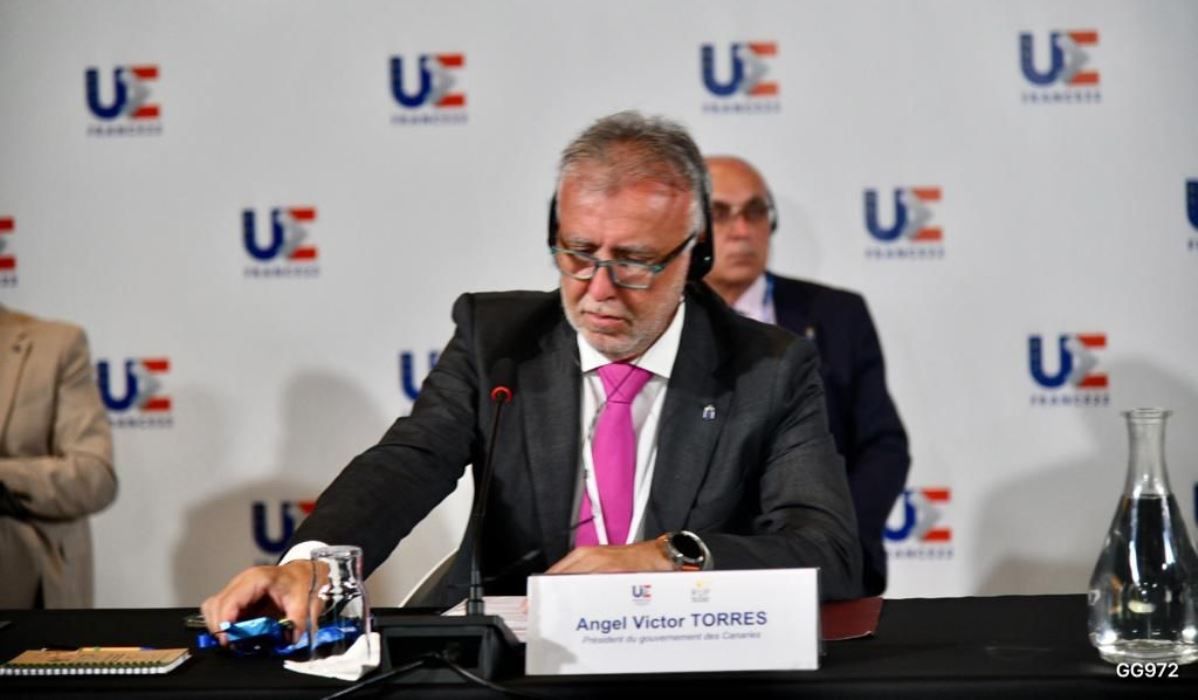
The outermost regions (ORs) of the European Union have obtained from the Commission an exemption until 2030 in connections with their respective states from the green tax that will be levied on aircraft fuel, as announced by the President of the Canary Islands, Ángel Víctor Torres, from Martinique (French Antilles).
On the first day of the meeting held in that department of the Caribbean by the regions furthest from France, Portugal and Spain, Torres stressed that extending this exemption from 2023 (its current limit) to 2030 "is a first step", but does not satisfy the aspirations of the ORs.
"It is not enough. We want it to be for longer and to be applied to connections from any country with the Canary Islands and also to flights and maritime traffic between islands", said the president, in statements released by the autonomous government.
Torres stressed that "that is the progress that needs to be made" and that, in return, the Canary Islands offers "the commitment it is demonstrating in reducing carbon dioxide emissions, with its sustainable development agenda and its clear commitment to renewable energies".
"Complying with the EU's mandate for us to be more sustainable, what cannot be is to tax territories that depend on means such as airplanes and ships because that would seriously affect the arrival of tourists to the ORs, a sector that in the case of the Canary Islands represents 35% of its GDP", he argued.
The Canarian president has therefore called for Article 349 of the Treaty on the Functioning of the EU to be applied "in all its dimension" to the outermost regions and has expressed his conviction that there will be sensitivity on the part of the Twenty-Seven.
Torres also expressed his confidence that, with the support of Portugal and France, Spain "will be able to push forward" these proposals within the Twenty-Seven.
"In any case, we have ratified that until 2030 we will be exempt from that tax for traffic between the peninsula and the Canary Islands", he emphasized.
The regional or local governments of Guadeloupe, French Guiana, Réunion, Martinique, Mayotte and Saint Martin (France), Azores and Madeira (Portugal) and the Canary Islands (Spain) are addressing these days the new EU strategy for the ORs.
The Commissioner for Cohesion and Reforms, Elisa Ferreira, will speak at the meeting on Wednesday.
Ángel Víctor Torres has welcomed the fact that the European Commission has included many of the aspects that the ORs have raised for the new strategy approved on May 3 and presented at this Conference of Presidents of the outermost territories.
The Canarian president highlighted issues such as boosting training for young people, the green transition and ensuring that the ORs have adequate funding within the framework of the European Union, an aspect achieved in the Multiannual Framework 2021/2027.
He also explained to the rest of the ORs the situation that has been experienced in recent years with the migratory phenomenon in the Canary Islands and other regions that are an external border and has called for the EU not only to take into account the singularities of these remote territories in terms of migratory movements, but also to address the management of this phenomenon.


Add La Voz de Lanzarote as a preferred Google source.
Stay informed with the latest current news.