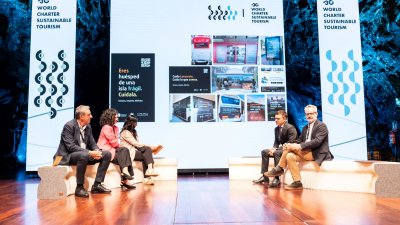
The first thematic block of the World Conference on Sustainable Tourism +30, held this Friday at Jameos del Agua, brought together representatives from some of Spain's most visited destinations to address the phenomenon of "overtourism," its impacts, and the solutions being implemented to move towards more sustainable and balanced tourism models from different perspectives.
The session was preceded and introduced by **meteorologist and science communicator Mario Picazo**, master of ceremonies for the event, who connected the debate to the uniqueness of Lanzarote and the legacy of César Manrique, emphasizing that "sustainability is only real when it protects what we love and guarantees quality of life for those who inhabit the destinations".
Picazo set the conceptual framework for the block by recalling that destinations worldwide are facing the challenge of balancing growing tourist demand with the preservation of territory and the well-being of local communities. In his words, "the pressure on destinations forces us to ask difficult questions: how to manage flows, how to balance expectations, and how to ensure that tourism remains a source of prosperity without compromising what is essential." With that reflection, he gave way to the panel moderated by Cristina Núñez, NECSTouR's Director of Strategy, who emphasized the need to strengthen governance, adequately measure impacts, and "put the voice of the territories at the center of decisions."
What is "overtourism"
During the session, the interventions agreed in defining "overtourism" as the excessive concentration of visitors in certain spaces and times, generating negative effects on infrastructure, ecosystems, housing, and social coexistence. It was also pointed out that it is a complex phenomenon that requires territorial planning, specific regulation, evidence-based public policies, and marketing strategies aimed at rebalancing flows and diversifying the tourism product.
From the Community of Madrid, Aránzazu Urbina highlighted the importance of participatory governance to respond to imbalances between saturated areas and areas with capacity to welcome more visitors. She stressed that "balancing is not about distributing tourists, it is about ensuring that tourism development is consistent with the needs of the territory and with the quality of life of the resident population".
On behalf of the Generalitat of Catalonia, Xavier Font shared results from measures implemented in recent years, highlighting that they are beginning to observe "positive and measurable changes" thanks to new planning tools, agreed-upon limits, and diversification strategies that reduce pressure in certain areas of the territory.
The representative for the Balearic Islands, Miguel Ángel Rosselló, explained how the archipelago is transforming its tourism strategy towards a model that prioritizes de-seasonality, capacity management, and inter-island balance. He pointed out that "measuring volumes is no longer enough: now we must measure values, impacts, and quality".
And on behalf of Lanzarote, as the host destination, Héctor Fernández, CEO of SPEL-Turismo Lanzarote, presented Lanzarote's historic commitment to a sustainability model anchored in climate action, responsible planning, and the integration of policies connecting mobility, territory, housing, and tourism management. "The key is that tourism is not an isolated element, but part of an island project that protects its identity and guarantees its future," he pointed out
Furthermore, the panel explored responses from management and marketing, the growing role of public-private-resident collaboration, measures to mitigate pressure on the territory – from carrying capacity limits to visitor dispersal strategies – and the need to move towards indicators that measure well-being, ecological footprint, and quality of life, beyond traditional figures of overnight stays and spending.
The session concluded with a summary that highlighted a common message: sustainability is only viable when based on data, planning, and continuous dialogue between administrations, companies, and citizens. Mario Picazo returned to the stage to thank the speakers for their contributions, emphasizing that "the tourism management of the future is no longer measured in terms of growth, but in terms of balance and resilience," before moving on to the next session of the day.


Add La Voz de Lanzarote as a preferred Google source.
Stay informed with the latest current news.