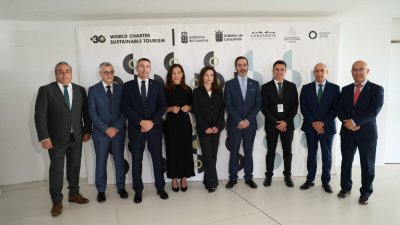
Jameos del Agua hosted this Friday the inaugural session of the adoption of the World Charter for Sustainable Tourism +30, an international meeting that returns the island to the center of the global debate on sustainability and the future of tourism.
The event, which brings together institutions and specialists from different countries, and hosted by the communicator and meteorologist Mario Picazo, opened with a reflection on the environmental and cultural uniqueness of Lanzarote and the visionary legacy of César Manrique.
In his presentation, Mario Picazo highlighted how the philosophy of respect for the territory of the Lanzarote artist connects naturally with the principles that inspire the +30 Charter and gave way to the development of the **three major thematic blocks** that will structure the meeting: tourism, impact and solutions; transparency and trust; and regeneration, innovation and opportunities for truly sustainable tourism
Representatives from the state, regional, and autonomous administrations spoke during the inauguration, as did the president of the Cabildo of Lanzarote, Oswaldo Betancort, who highlighted the significance for the island of hosting this event three decades after the signing of the first Charter in 1995.
“Lanzarote is once again on the world map of responsible tourism. Thirty years later, we reaffirm a commitment that was born here and is part of our identity. This act marks a turning point and new leadership: we want sustainability to be a measurable, everyday reality shared by all stakeholders in the destination. Lanzarote is taking a step forward today to defend its territory, its culture, and the well-being of its people,” the president stated
Betancort took advantage of this forum to announce three measures that "reinforce Lanzarote's commitment to a balanced tourism model": the launch of a voucher for resident families to access hotel stays under special conditions; the creation, through the CACT, of an environmental contribution fund based on voluntary donations to finance protection actions and facilitate negotiations for lodging licenses in progress; and the request to the Port Authority to actively participate in the decision on new cruise ship berths, thus ensuring coordinated and sustainable management of maritime traffic.
For her part, the Minister of Tourism and Employment of the Canary Islands Government, Jéssica de León Verdugo, wanted to emphasize that the +30 Charter that is signed today "is not a document. It is a moral commitment. An intergenerational agreement that we who are present sign to bequeath to the future," she stated.
The +30 Charter is born from a conviction: that tourism cannot be an end in itself; that the ultimate goal is progress, well-being, prosperity and, that these concepts, above all, include the local communities in which the activity takes place, such as the 2,200,000 Canary Islanders,” highlighted the Minister of Tourism.”
In addition, the Secretary of State for Tourism, Rosario Sánchez Grau, underlined the importance of moving towards **a model that combines competitiveness and commitment**. "Spain has the opportunity to lead a tourism that does not renounce excellence and that, at the same time, protects the resources that make it possible. The updating of the Charter reminds us that the future of tourism will depend on brave decisions and on governance that listens and acts," she stated.
Sánchez Grau highlighted that it is “a privilege and a pleasure to be able to do so from a place as inspiring as Lanzarote,” recalling that this island was already a historic setting for world tourism in 1995. He emphasized that tourist destinations have “the commitment and obligation to set an example and improve the lives of those who reside in them,” in line with the Sustainable Tourism Strategy 2030, which defines tourism as a genuine state policy.
He concluded by expressing his wish that "we continue to advance in this shared leadership, towards balanced, innovative, and sustainable tourism," and thanked Lanzarote "for inspiring us today, with its art, its culture, and its capacity to commemorate what we were and celebrate what we are."Another of the guests, the Minister of Tourism, Trade and Consumption of the Basque Government, Javier Hurtado Domínguez, highlighted the importance of sharing experiences and moving forward in a coordinated manner. "Destinations around the world face similar challenges. The +30 Charter offers us a roadmap that allows us to work together to build tourism that brings real value to people, territories, and the planet, through an ethical code of tourism that combines articulated work with all sector stakeholders, as we are doing in the Basque Country," he stated.
Also participating in the opening of the Congress was António D. Abreu, Director of Ecology and Earth Sciences at UNESCO and Secretary of the Man and The Biosphere Programme, who recalled that “tourism is a bridge between cultures and that tourism and conservation are not separate paths. He highlighted that “the MAB programme reinforces the ambition of Biosphere Reserves, such as that of Lanzarote, and stressed that protecting nature and biodiversity is not a luxury, but a necessity,” and that “the future of tourism and the planet depends on our ability to act together.” He concluded by considering that “the Charter sends an unequivocal message: sustainable tourism is not an option, it is the only responsible path, and it can only move forward with passion and true conviction.”
Following the institutional opening, the day continues with three content blocks directly related to the axes of the Global Charter for Sustainable Tourism +30. The first addresses the impact of tourism and the solutions that various destinations and entities are developing to reduce their environmental and social footprint. The second delves into the importance of transparency, trust, measurement, and responsible communication as essential elements of tourism governance. The third block focuses on regeneration, innovation, and the opportunities that arise when tourism is conceived as a driver of positive transformation capable of generating sustainable value.
The session will conclude this afternoon (at approximately 4:00 PM) with the closing ceremony, during which the official adoption of the Global Charter for Sustainable Tourism +30 will take place, a document that updates the principles promoted in 1995 to adapt them to the current climate, economic, social, and technological challenges. The event solidifies Lanzarote as an international benchmark in the construction of a more responsible, balanced tourism model aligned with the protection of the territory and the well-being of the communities that inhabit it.


Add La Voz de Lanzarote as a preferred Google source.
Stay informed with the latest current news.