
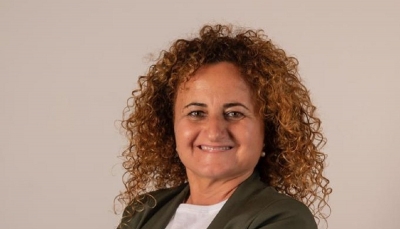
At 18 years old, Nereida Pérez did not know what career to choose, but she was clear that she wanted to study in Tenerife, so when she saw that Agricultural Technical Engineering was offered on the big island, she didn't think twice. Her final degree project was at the Agricultural Farm of the Cabildo of Lanzarote and shortly after finishing it, she got a job at the Regulatory Council.
There she discovered how much she liked the direct contact with winegrowers and wineries and, above all, the task of mediating between them. Pérez took that attitude to the Cabildo during her years as Minister of Agriculture, and in an interview with the radio program Más de Uno Gourmet of Radio Lanzarote, she does not completely rule out returning to politics, although it is a world where "it is much more difficult to get initiatives out, despite the sacrifices".
- How were you trained?
I am from Lanzarote, from parents from the municipality of Haría, from Máguez. I studied Agricultural Technical Engineering. It is true that when I finished COU I didn't really know what to do, as happens to many young people today. I did know that I wanted to go to Tenerife, and since the Agricultural Technical Engineering degree was there, I tried it and I liked it.
- Did your family have a relationship with the countryside?
My father was a baker and my mother a housewife. They had to work in the fields to support their family. My father told me how when he was 10 or 11 years old he went with another brother to sand, in some seretos with camels in the Valle area, in Haría.
In my house there were camels, dogs, rabbits, chickens... that is, from the countryside like poppies, of which I am very, very proud.
- How was the return from Tenerife to Lanzarote?
I wanted to do the final degree project in Tenerife, but due to my mother's illness I had to come, so in the end I developed the project on the wine sector and did it on the Cabildo farm.
- How did you get into the Regulatory Council?
I finished my final degree project in March, with such good luck that in June, they told me that there was a job at the Regulatory Council and that I should go to the interview. I went and from that day, June 11, 1997, I started working at the Lanzarote Wine Regulatory Council.
- How did you become a councilor in the Cabildo?
I owe it to Fabián Martín. A cousin of mine is married to a cousin of his and at the latter's birthday, he proposed it to me. It was 2007, my mother had passed away in January and Fabián told me: now you have to keep your head busier and I propose you go on the Cabildo lists. I told him, no way, no way, at most in Haría... He put me at number six, and I thought I wouldn't even get out with hot water, and we got six. I didn't even know what a decree was.
- What do you like most about working at the Regulatory Council?
When I started my degree I already noticed that I liked the wine world, but when I did my final degree project I saw that I loved it. That direct relationship with the farmer and with the wineries themselves, the task of mediating, I love it.
- How did the winegrowers take your entry into the Cabildo?
They took it great because they saw a close person in the Cabildo. And I never became disassociated from the Regulatory Council because I was in the Ministry of Agriculture. We had many activities such as the Winerun, the Teguise Festival, Saborea Lanzarote...
- Would you go back to politics?
I'm not saying no just in case they take me out of the newspaper archives in two years. (Laughter). I like anything that involves working for something. I am involved in several associations.
But it is true that politics in the end is quite ungrateful. You work a lot, you sacrifice a lot of personal and family time and then you see how things often don't come, the four years go by and they don't come out and the feeling towards the population is that we are standing idly by when it is not like that.
- Is it easier to get initiatives forward in the Council?
In the Regulatory Council almost everything I propose comes out, it is much easier, people listen to you. The Council Plenary is fantastic, because they are always supporting, they always have full confidence in the workers of the Regulatory Council. I feel more fulfilled both personally and professionally. We feel valued.


