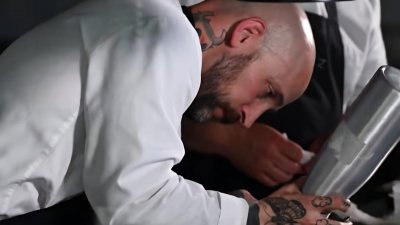
Mikel González Asiaín has just completed one year in Lanzarote as head chef of Alarz, the restaurant of the Gran Hotel de Arrecife, nominated for the Premios Qué Bueno Canarias 2026, which signed him when the Michelin-starred restaurant in Gran Canaria where he worked, had to close.
The cook from Navarre bets on training in an interview with the radio program Más de Uno Gourmet of Radio Lanzarote-Onda Cero and shares his career, experience, and the particularities of the menu he has designed for Alarz.
- Where are you from and how did you get to Lanzarote?
I am from Navarra, half Navarrese and half Basque because my family is also from San Sebastián and I have been in the Canary Islands for 10 years. I have worked in Gran Canaria, in Tenerife and in Lanzarote for a year.
- How did you decide on the world of cooking?
Because I like to eat. (Laughter). A very important part of the training, we talk about it with our teams, is to go out to eat and educate your palate, try different things.
- When did you start?
I started young because my family had businesses, but I studied cooking late, at the Higher School of Hospitality of Aragon.
- Tell us about your professional experience before studying cooking…
I spent quite some time working in Asia, especially in hotel restaurants. At 23 years old, I left for Vietnam, I was also in Thailand and Bali.
- A very different cuisine from Spanish…
Yes, I think it was one of the reasons, something so different from what I had seen, there was a lot to learn, I have always been very restless.
- Why do you decide to study cooking after accumulating ten years of experience?
When I returned to Spain, I wanted to continue working in the kitchen, but in a more professional way, so I decided to enter the Higher School of Hospitality of Aragon. And I take my hat off to my school, we learned a lot, I was 27-28 years old.
When working with my teams, I notice a big difference when people have studied cooking. The language, the way of handling a service, are things that make a difference. When someone calls something by its name, you understand that they have studied, that they have bothered to investigate and know what they are talking about.
- Is this your first position as head chef?
No, I was head chef for 6 years in the south of Gran Canaria at a restaurant called 222 from the La Acuarela group, which has a Michelin star.
- How does the Alarz project arise in the Gran Hotel?
We work, I say we, because part of the team I worked with is here with me, in Las Palmas de Gran Canaria, in a restaurant called Bevir, which unfortunately had to close in October 2024 and they called me from El Gran Hotel, it was something unexpected for me.
- What type of dishes can be found?
We have a tasting menu and we have an à la carte menu, which is a mix between Basque-French and Asian gastronomy with local product.
- Give us an example…
Two of the dishes that I find most fun are mochi that we work with leek from an organic garden from here; and a Saam, which is a Korean dish, with Canarian pig belly and a striped shrimp. They have little time left on the menu, we are going to put them in a future tasting menu.
- How would you define your letter?
A dish in which we try to use local produce to the fullest, with a slightly more classic, French part, with reductions, without chemical thickeners.
Then we have a slightly more fun part, fireworks as I call them, of ups and downs in the Asian part, which has more sour and spicy flavors.
- How important is the work of the front-of-house team?
We have a front-of-house team that is a sweetheart, but in general I would tell you that it is the most complex part. We have realized in recent years, and I think it is a common denominator for all the islands, that it is difficult to find people who want to continue growing within the front of house, we have to make the front of house more attractive because our work without theirs is nothing.
- How do you feel about the nomination for best hotel restoration at the upcoming Qué Bueno Canarias awards?
I am delighted, super grateful, although I try to put that aside and focus on having fun at my job, because if I have fun, the clients do too and if recognition comes, great.



Add La Voz de Lanzarote as a preferred Google source.
Stay informed with the latest current news.