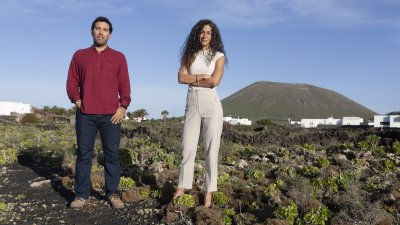
David Shaikh Urbina is a computer engineer and after accumulating twenty years of experience developing innovative products in large technology companies, he decided to start a business.
He arrived in Lanzarote in 2020 with his wife pregnant with their second child. “We had to move house in Madrid and we were afraid they would lock us down again due to covid. We had bought tickets for a holiday in Lanzarote and suddenly we decided to look at houses on the island to stay”.
“Everything went very well, the landlords, in El Islote, treated us as if we were adopted children. The idea was to come for a year, but we were doing so well that we've already been here five and there's no sign we're going to leave”. (Laughter).
A few years ago he founded the company Sherwood Science, focused on developing software for healthcare. "Basically the software used in a hospital to manage the daily clinic, billing, inpatients, a bit of everything that happens in the company".
Today that software is used in hospitals not only in Senegal, but also in Nigeria, Kenya, South Africa and Mali.
"As Saramago said, Lanzarote is not my land, but it is my land. I want to bring software industry to Lanzarote"
Thanks to that experience, he drafted with his wife Carla Rodríguez Cuesta, a Forestry Engineer, a project to create an app, SkincAIr, that with artificial intelligence can detect up to twelve skin diseases.
They presented it to the European Commission's Research programme Horizonte Europa, which had launched a call for innovative solutions in health for sub-Saharan Africa. In June they found out they had obtained five million euros to develop it.
Currently they lead from Lanzarote a team with experts in artificial intelligence and dermatologists from a consortium of twelve research entities, six African and six European such as Kings College London, the Polytechnic University of Madrid or the University of Lucerne in Switzerland.
A billion people affected in the world. How does the project arise?
“One of our clinical management software clients is a reference hospital in dermatology in Senegal. The idea occurred to us to make an application that with artificial intelligence detected leprosy”, he shares.
“Then we **expanded it to detect up to twelve skin diseases**, which the World Health Organization (WHO) groups into ‘**neglected tropical skin diseases**’, which are caused by different bacteria, but share with leprosy the **stigma** they produce,” explains Shaikh.
It is calculated that these diseases affect one billion people in the world, the majority in sub-Saharan Africa, "although they are difficult to quantify because they are attempted to be hidden precisely because of the stigma they entail".
In fact, “one of the big challenges of this project is not in artificial intelligence, but in reaching those patients, because they are people who live in very remote areas, who do not see a doctor normally”.The Madrid entrepreneur emphasizes that leprosy, in reality, “can be easily cured with early diagnosis, but if that person does not receive treatment, it can mean that a limb is cut off”.
"The objective is that it becomes the app of the World Health Organization"
“We are going to collect data and take photos for three years of people with these diseases, which is the biggest challenge, because we have to go to those rural African areas where they have these cases. We want to assemble the largest database in history on these diseases”.
They are hidden cases, “that not any dermatologist can diagnose. Even if you train a dermatologist, after six months their knowledge practically disappears,” if they are not in contact with patients, precisely because of the concealment by families.
We have a letter of interest from the WHO and our final goal is for our application to become the WHO's app to detect the twelve skin diseases.
At the end of the project, which must conclude in 2030, once it has been verified that the app effectively improves the diagnosis of health workers, “the idea is that it appears on the App Store so that anyone can download and use it”.
“I am looking for people in Lanzarote to hire, I would like to contribute to having more technology companies on the island”
Sheikh shows his gratitude to the Chamber of Commerce of Lanzarote, which put him in contact with the European Enterprise Network— a support network of the European Union to help SMEs, startups, universities, and research centers, which advised him on the necessary documentation to obtain funding from the European Commission's research programThe computer engineer shares that he is currently looking for people in Lanzarote to hire. "I would like to create more capacity in Lanzarote, contribute to there being more technology companies so that the island depends less on tourism”.
“I would like to train you and for you to learn in a project as exciting as this one, they would be technical profiles, application development, artificial intelligence, etcetera”.
In addition to Sherwood Science, the pair of engineers has created in Lanzarote the company Tamia Innova Lab, to share “all the knowledge that we have acquired in the Horizon Europe project and the professional knowledge we have from having worked all these years”.
Tamia Innova Lab focuses on “technological development and innovation and we also help companies access Horizon Europe and other grants”.
“As Saramago said, Lanzarote is not my land, but it is my land. I want to bring software industry to Lanzarote for which we only need talent, internet and electricity. We have another project in Horizon Europe that has passed the first two phases, if it is confirmed we will carry it out in Lanzarote”.


Add La Voz de Lanzarote as a preferred Google source.
Stay informed with the latest current news.