
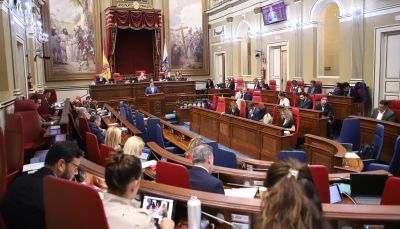
The plenary session of the Parliament of the Canary Islands has unanimously approved urging the regional government to implement a package of incentives for the hiring of domestic workers and design a training plan on the labor rights of this group.
The Regional Chamber has also supported the creation of a technical employment commission in the field of family home service in the Canary Islands Institute for Occupational Safety; implement actions for the prevention of risks and harassment in this group; and enable channels for them to transfer possible violations of their labor rights to the unions.
The promoter of this non-law proposal (PNL), the socialist deputy Gustavo Santana, has emphasized that "once the Government of Spain approved Royal Decree 893/2024, which regulates protection and health in the family environment, bodies such as the Canary Islands Institute for Occupational Safety or the Labor Relations Institute must implement actions to put it into practice."
Regarding the implementation of incentives for hiring domestic workers, he stressed that "it would protect these employees and, incidentally, contribute to bringing to light an important pocket of underground economy and tax fraud, which he has estimated at around 15 million euros."
Despite the affirmative vote of his group, the Popular Party, Deputy Mónica Muñoz Peña has accused the PSOE of "starting the house from the roof" by requesting the implementation in the Canary Islands of a Royal Decree whose content largely depends on the implementation of a computer tool for risk assessment electronically.
The popular deputy has expressed her party's support for the group but has questioned some of the provisions of the Royal Decree, one of them, which imposes new requirements on employers, "who are not entrepreneurs", which will "discourage" the hiring of these employees and will lead to resorting to specialized companies.
Something that she has stated is already happening, since last September she has stressed that an average of 90 domestic workers have been deregistered every day.
Natalia Santana, from the Nueva Canarias-Bloque Canarista group, has expressed her fear that what was agreed today will be limited to "a toast to the sun" and that what was agreed will not materialize because the deputies of CC and PP "do not demand that their councilors put it into practice.
Something that, she has denounced, already happened with other PNLs approved in Parliament related to the promotion of mental health actions or the group of cleaning ladies.
Francisco Linares has justified the support of his group, the Canarian Nationalist, for this non-law proposal "not out of opportunism but out of conviction", as domestic workers are a "unprotected, uninformed, very poorly trained" group, without affiliation to any representative body" and doomed to the underground economy.
Linares has warned that the process of protecting this group "is not going to be easy", because "everything - what concerns them - happens behind closed doors", and has condemned that "many women in the Canary Islands" are still working today "in uniform and with a cap but without a contract."


