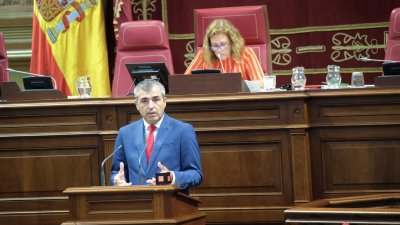
The Canarian Executive will create a shopping basket with 45 basic products which, in the event that some of them are not yet subject to the 0% IGIC rate, will be applied to them, as announced by the vice-president and minister of Economy of the Government of the Canary Islands, Manuel Domínguez, who, however, has not specified which ones.
This is a direct measure to combat inflation in the archipelago, as Domínguez said in the Parliament of the Canary Islands, during an appearance at the request of the Agrupación Socialista Gomera in which he also assured that an agreement had been reached with the agents involved in the distribution chain to carry out this measure.
Domínguez, who has not broken down which products would make up this basic basket, has pointed to the weak economic situation of the Canary Islands in the face of inflationary episodes and has indicated that the impact is greater in the archipelago due to its condition as an outermost region and its high dependence on imports, since more than 92% of inputs arrive by sea.
To this he added the rising cost of raw materials such as cocoa, coffee or animal feed, as well as the increase in energy, financial and labor costs.
The minister has indicated that, in addition to these factors, transport and storage costs particularly affect the Canary Islands, and has called on the central Government to update standard transport costs so that other measures can impact the final price, something with which most groups in the Chamber have agreed.
According to Domínguez, in 2025 food prices have risen by 2.6% in the Canary Islands compared to the national average of 3%, and in January prices increased by 0.4% in the islands compared to 0.6% nationwide.
Regarding the Executive's actions, he indicated that direct and indirect measures have been considered.
Among the next measures to be adopted, he explained that, in collaboration with the sector, this basket of 45 basic products has been defined and he has committed that "shortly" none of these 45 products will have IGIC.
Domínguez has also reiterated the announcement of the creation of a price observatory that will analyze in detail the cost of living on each island and in different areas, including double insularity and tourist areas, where the shopping basket shows higher prices.
The objective, he said, is to better adjust transport aid and funds from the Specific Supply Regime (REA).
He has also advocated for deflating the IRPF so that "the Treasury does not eat up salary increases," and has considered it more appropriate than maintaining the tax measures of the previous Government, which granted compensation of between 125 and 225 euros for the rise in the cost of living.
Opposition parties such as the PSOE and Nueva Canarias have pointed out that IGIC reductions usually end up affecting companies' profit margins and not the price, while Vox has proposed eliminating tariffs such as the AIEM, originally created to tax external products and promote local production.
Regarding the AIEM, the proponent of the appearance, the deputy of the Agrupación Socialista Gomera Melodie Mendoza, has advocated for studying the possibility of a technical review of the AIEM, limited in time and only to certain products, especially basic ones, and controlling the effect of this on prices.
In her turn, Mendoza recalled that according to the Canarian Institute of Statistics (Istac), between November 2021 and the same month of 2024, the basket became 33% more expensive, the largest increase in the entire country, and also indicated the upward pressure on basic products such as eggs (+22%) or olive oil (+57%).
"They are not luxury products, but daily food," complained Mendoza, who warned that the rising cost of basic products creates a "worrying phenomenon" such as changes in eating habits, as many families replace fresh and local products with less healthy options, with the health implications that this entails.


Add La Voz de Lanzarote as a preferred Google source.
Stay informed with the latest current news.