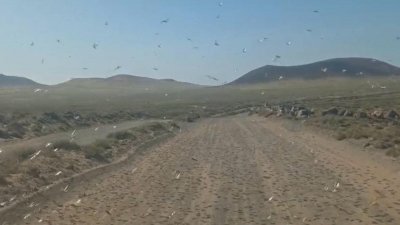
Several readers have sent to La Voz images of the appearance of locusts or desert locust (Schistocerca gregaria) in different parts of Lanzarote such as Arrecife, Costa Teguise, Uga or Tahíche due to the east wind that has caused the arrival of calima.
As some people will recall, twenty years ago a plague of this insect affected Lanzarote, causing havoc in crops and in people's daily lives. At that time, the number of locusts was such that firefighters had to act in some areas to eliminate them.
The locust is an insect that throughout the centuries has arrived from the African continent with the east or southeast winds along with suspended dust from the Sahara desert.
According to the Food and Agriculture Organization of the United Nations (FAO), it is the world's most destructive migratory pest and, in response to environmental stimuli, they can form dense and highly mobile swarms.
Furthermore, it has a destructive capacity in crops, since it daily ingests its weight in food. For example, a swarm of one square kilometer can contain up to 80 million adult specimens, and has the capacity to consume the same amount of food per day as 35,000 people. This has caused it to become one of the accelerators in the famines of Africa and the Middle East.


Add La Voz de Lanzarote as a preferred Google source.
Stay informed with the latest current news.