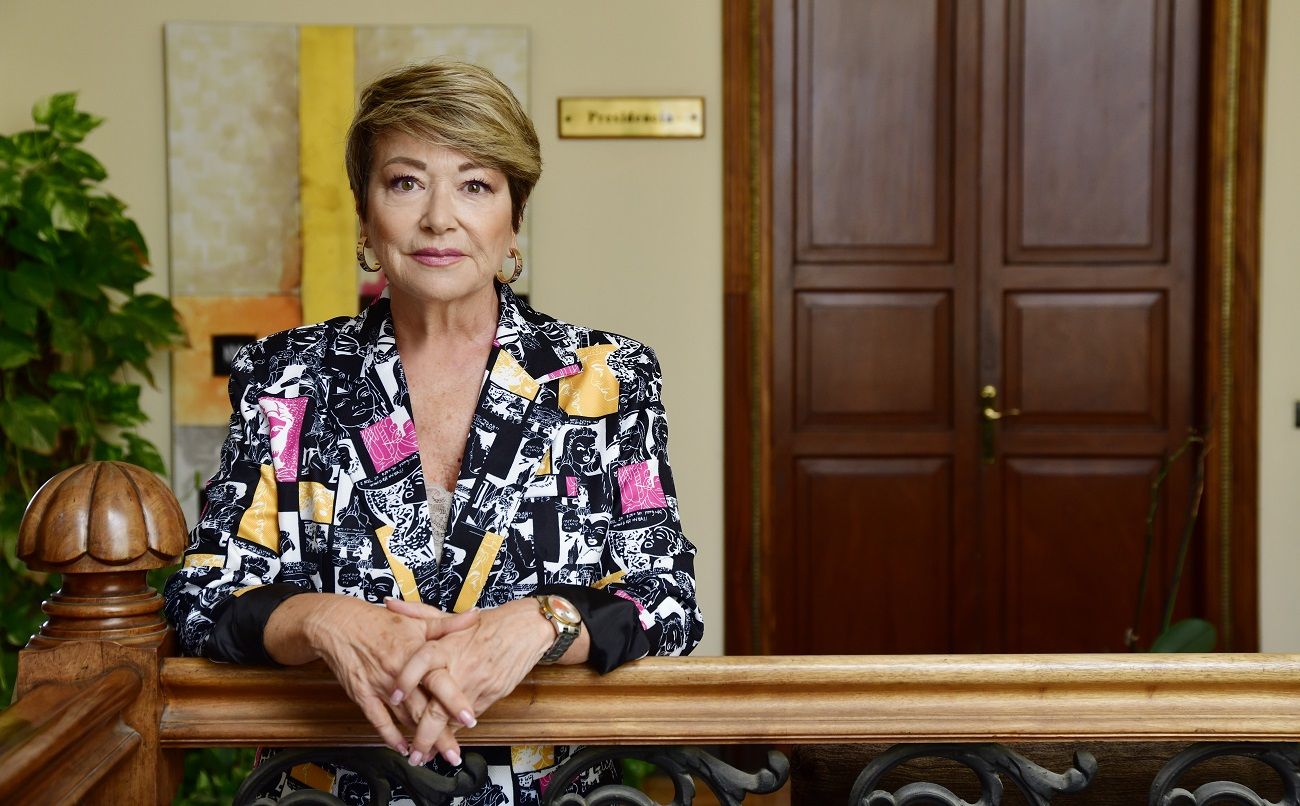
The president of the construction employers' association in the province of Las Palmas, María Salud Gil, analyzes the problems and opportunities of the sector in an interview with La Voz.
“In the construction sector we face serious problems that are a consequence of inflation, energy costs and raw materials, which means that our production costs have increased by 40%”, says the president of the construction employers' association in the province, María Salud Gil.
“Not all the blame lies with the war in Ukraine”, she clarifies, “because already in October 2021 we were warning that our production costs were rising by an average of 26%, mainly as a consequence of the price of energy and shortages.”
“The pandemic caused the immediate closure of all the productive units of the factories, especially in China, and the moment the state of alert is lifted, demand accumulates and exerts a tension on the supply that obviously inflates”, explains Gil.
The president of the employers' association adds that, in addition, when China recovered economic activity, it limited exports so that the materials would be used in Chinese companies, which meant that the shortage in Europe continued to grow.
On the other hand, “port freights rose excessively, sometimes up to 300%. There were times when freights cost more than the raw material of origin”, Gil concludes.
“There are 200 million in public works that are not being executed”
The president of the employers' association explains that “despite the fact that there have been three state royal decrees, which supposedly allow us to revise the prices of public works that we are already executing, they do not de facto allow us to revise 97% of the works that are being done in the Canary Islands”.
“When a bidder who is executing a public work tells the administration that he wants to suspend due to the increase in costs, the administration can respond in two ways, either by accepting that it has to modify the prices, which it does not do, or by sanctioning the company, which means a blow to the company that finds itself in a dead end”, she denounces.
Therefore, many tenders are being left deserted. “In fact, 200 million euros in the Canary Islands are not being executed as a consequence of the fact that there are no companies that go to public tenders because the prices are not those of the market”, she exemplifies.
Public administrations do not usually revise prices once they launch the tenders. What they do do is relaunch the tenders that are left deserted with a new revised tender.
This happened, for example, with the tender published by the Cabildo of Lanzarote in April of this year for the improvement of the connection of the LZ-3 and LZ-20 roads. The tender was published with a budget of 441,164.13 and was left deserted. The Cabildo published the revised tender again in August, taking into account the increase in the prices of materials, for a value of 584,415.41. The project was awarded to the company Hormigones Insulares S. L. (Horinsa).
In the field of private promotion there are also many difficulties. Gil explains that 70% of the real estate developers they have surveyed have their investments withheld due to uncertainty. “The others are finishing their works because it is worse not to finish them since the losses would be equally harmful.”
The sector has an opportunity with the EU's Next Generation funds
“We are also living in a moment of opportunities, we have European funds and the manifest inability of administrations to spend it”, highlights Gil.
For this reason, the builders have signed an agreement with the Canarian Housing Institute to manage all the funds for the comprehensive rehabilitation of buildings and homes. “We are trying to ensure that these funds are spent, it is an opportunity for small and medium-sized companies and therefore we are working on it”, says Gil.
“The Canary Islands has more than a million homes that do not comply with the technical code for rehabilitation in terms of energy efficiency and sustainability terms because they are prior to the year in which that code was published”, explains the head of the employers' association in the province.
“Therefore, we have an opportunity to transform our housing stock to make it more sustainable and contribute to the ecological transformation of the Canary Islands”, she adds.
“In short, we continue, despite everything, creating employment, because we continue to maintain the pulse, with great effort, to continue doing the public works that we can and the real estate promotions that we can”, she summarizes.


Add La Voz de Lanzarote as a preferred Google source.
Stay informed with the latest current news.