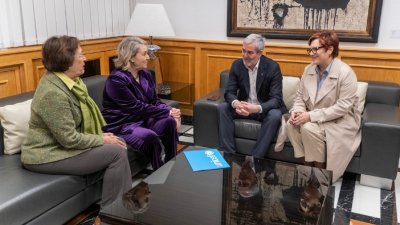
The president of the Government of the Canary Islands, Fernando Clavijo, held a working meeting this Tuesday with the new president of UNICEF España, María Ángeles Espinosa, in which they analyzed the projects launched by the Government of the Canary Islands in collaboration with this non-governmental organization to guarantee the rights of children in the islands and, especially, of the migrant minors.
During the meeting, both Clavijo and the Minister of Social Welfare, Candelaria Delgada, thanked UNICEF for the implementation of mobile units in the archipelago to provide psychological support to unaccompanied migrant minors. The program is developed by the Ministry of Health as a complement to the medical care they receive from the moment they arrive on the Canary coasts.
According to Espinosa, socio-health teams from his non-governmental organization work to help these boys and girls overcome the effects of “the entire migratory process,” including arrival, adaptation to the reception system, and the subsequent transfer to other regions under the protection of the change in article 35 of the Immigration Law. In his opinion, this collaboration with the Government of the Canary Islands is a “magnificent example” of what can be achieved when public administrations and the third sector work together.
The president of the Spanish Committee of UNICEF stressed that the objective is to ensure that the rights of migrant minors are fully met “which are exactly the same as those of any Spanish boy or girl”. Espinosa was accompanied at the meeting with the head of the Canarian Government by the president of the non-governmental organization in the Canary Islands, Rosa Gloria Suárez.
Also, the counselor stressed the importance that the Government of the Canary Islands has counted on the collaboration of the third sector to address the migratory crisis and try to give the best possible treatment to the thousands of unaccompanied migrant minors. Candelaria Delgado thanked UNICEF for the support during these two and a half years in which “we have gone hand in hand” to achieve the regulatory modification that has guaranteed the distribution of these boys and girls.
He/She also referred to the support that this organization is providing to the autonomous community to continue reducing child poverty rates in the archipelago, rates that continue to be very high and that “therefore we must address with initiatives from strategic allies” such as UNICEF.
The meeting at the headquarters of the Presidency of the Government of Las Palmas de Gran Canaria also focused on analyzing the progress of the participatory process launched by the Executive so that boys, girls and adolescents can learn about and contribute their proposals to the draft Canary Law on Childhood and Adolescence.
The objective of this initiative is to place childhood at the center of the elaboration of a norm “key for their well-being and protection,” as highlighted by counselor Candelaria Delgado after the meeting. In this regard, she thanked the collaboration of UNICEF and highlighted the importance of having this non-governmental organization as a strategic ally in the promotion of children's rights in the archipelago.
The Government of the Canary Islands has launched a specific informative campaign aimed at the child and adolescent population with the objective of translating and adapting the legal contents of the draft bill into accessible, understandable, and attractive formats. The purpose is for minors to be able to understand what the future Law on Childhood and Adolescence is, how it is drafted, what rights it protects, and how they can exercise their right to participation in a real and safe way.
Delgado affirmed that this process “represents a decisive step to build a more accessible, inclusive, and realistic law, that incorporates the voices of those who are part of the present and future of the Canary Islands”.
Consultation and participation
At the request of the Department of Social Welfare, Equality, Youth, Childhood and Families, a consultation and participation process is being developed that focuses on something essential: listening to those to whom the law is directed. To this end, activities promoted by UNICEF Canary Islands Committee, the Child-Friendly Cities and the Los Glayus Association have been articulated, with the collaboration of social entities and educational centers of the Archipelago.
Furthermore, the General Directorate for the Protection of Children and Families has commissioned a project for the design, development, and dissemination of educational resources that facilitate child participation from a pedagogical, interactive, and adapted approach. This work promotes meaningful learning and the active involvement of students in the construction of the new norm.
The process has been developed in two main phases. Firstly, the consultation methodology was presented to the technical and professional staff working with minors, as well as tools to motivate the groups and adequately collect their opinions and proposals. Secondly, direct participation spaces were enabled with children and adolescents from VOPIA of Las Palmas de Gran Canaria, the IES Ramón Menéndez Pidal and Santa Úrsula, the playrooms of Tenerife, the Guaidyl day center in Granadilla de Abona, and the migrant childhood entities Mundo Nuevo and Superacció.
In these meetings, the minors actively shared their ideas, concerns, and contributions about the future law, expressing how they live their daily lives, what changes they consider necessary to improve their well-being, and how to guarantee their rights from their own perspective.
The draft Canary Law on Childhood and Adolescence establishes a regulatory framework aimed at guaranteeing fundamental rights, promoting transversal public policies and implementing effective mechanisms for comprehensive protection, specialized care and active participation of minors. In addition, it adapts the autonomous regulations to what is established in Organic Law 8/2021, on comprehensive protection against violence.
The legal text is structured into a statement of reasons, a preliminary title, ten titles, 188 articles, ten additional provisions, three transitional, one repealing, and three final provisions.


Add La Voz de Lanzarote as a preferred Google source.
Stay informed with the latest current news.