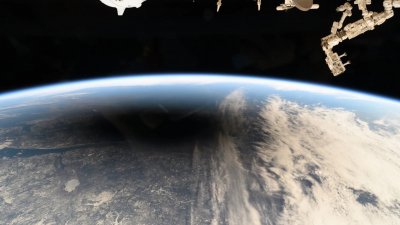
The total solar eclipse this summer will be the first visible from the Iberian Peninsula in the last hundred years. Although it will not be 100% visible from the Canary Islands, it will be partially enjoyable from the archipelago. Lanzarote and La Graciosa will have a privileged spot, as on both islands more than 73% of the solar surface covered by the Moon will be observable. This is according to the data offered by the National Geographic Institute for this much-anticipated event. The first of the three eclipses expected until 2028.
An eclipse is an astronomical phenomenon that occurs when the Sun, the Earth, and the Moon align and the body in the middle, in this case the Moon, casts its shadow on the other. On this occasion, it is the Moon that casts its shadow on the Earth.
Next August 12, a partial solar eclipse can be enjoyed in the Canary Islands, between 18:58 and 20:45 hours. This has been reported by the Institute of Astrophysics of the Canary Islands. That same night, the famous meteor shower takes place, known as Perseids or Tears of Saint Lawrence. From the provincial capitals of the Canary Islands, the moment when the sun will be as covered as possible will be at 19:53 in Santa Cruz de Tenerife and at 19:54 in Las Palmas de Gran Canaria.
Due to the orography of the islands, around 8:00 p.m., the solar eclipse will begin to generate shadows in several points of Lanzarote, La Graciosa and the Chinijo archipelago, but also in the rest of the Canary Islands. The partial solar eclipse from Lanzarote will be greater than in other Canary Islands, where the eclipse will be 66%.
Around 8:30 p.m., almost half of the island surface will be covered by a shadow and around 8:40 p.m. it is expected that the shadow will cover the entire island of Lanzarote.
Where to see the eclipse?
Among the sites proposed to observe the eclipse, Llano de la Baja del Ganado, in La Graciosa; Mirador del Río, in Haría, Mirador de Famara, the town of La Villa de Teguise and La Hoya, in Yaiza, all of them in Lanzarote, are proposed.
At the same time, the Government Subdelegation in Las Palmas has asked the Cabildo of Lanzarote and the City Councils to report if they are going to establish observation points for both phenomena, since it is expected that there will be a movement of residents and tourists.
How to observe an eclipse safely?
According to the National Geographic Institute (IGN), while lunar eclipses can be observed directly with the eyes, solar ones must be observed with protection: eclipse glasses. These glasses are not just any sunglasses, but rather let less light pass through than usual. They cannot be scratched and must be correctly supported on the nose and ears. Furthermore, they can only be removed when the Sun is completely covered by the Moon.
These glasses must be approved, bear printed on their frame the ISO 123312-2-2015 certification, the European Commission mark, as well as the expiration date. In addition, they must filter 100% of ultraviolet and infrared rays and 99.99% of intense visible light. If they have any scratch or perforation, they must be discarded.


Add La Voz de Lanzarote as a preferred Google source.
Stay informed with the latest current news.