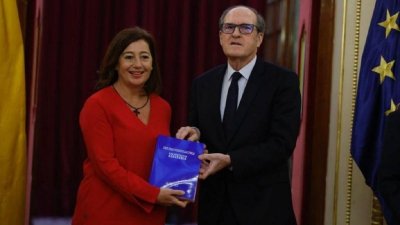
The Ombudsman, Ángel Gabilondo, delivered this Friday morning the Report on sexual abuse in the scope of the Catholic Church and the role of public authorities to the president of the Cortes Generales, Francina Armengol. This response arises after the approval of a Non-Law Proposal (PNL), on March 10, 2022 to make a report on the situation.
The Report has 777 pages and will be hosted in full this morning on the website of the Ombudsman. In it, among other points, details of a survey commissioned to GAD3, legal framework, and conclusions-recommendations that are elevated to the Cortes Generales and the Government of Spain for "the adoption of the necessary measures in order to comply with the objective of the commission", as specified in the aforementioned PNL.
The Ombudsman, as stated in the introduction of the Report, points out that "this is a necessary report to respond to a situation of suffering and loneliness that for years has been kept, in one way or another, covered by an unfair silence." Ángel Gabilondo highlights the importance that the victims have had at all times when addressing the works that are now concluding. "The victims are the first sense, the ultimate sense and the central sense of this Report."
Response from the Church and public authorities
The Report points out that the response of the Catholic Church, at least at the official level, has been characterized for a long time by the denial or minimization of the problem. Some victims have had to face not only denial and concealment, but even pressure and reactions from representatives of the same in which they were blamed for the abuses suffered.
It must be recognized, at the same time, that the Catholic Church is a plural institution and that the Advisory Commission, created ad hoc, was able to detect good and bad practices. And the Report recognizes "the institutional courage of those who have chosen to assume the responsibility that corresponds to the institution for the victimization produced."
For their part, the public authorities lacked adequate procedures to prevent, detect and react to the commission of sexual abuse of minors in the schools of the Catholic Church. Only very recently, in 2021, prevention and detection mechanisms and procedures were introduced for all educational centers of public or private ownership. The majority of cases that have
been reported, despite being a very small part of the reality of the problem, have not found a response from the judicial system.
Recommendations
The Report proposes about twenty specific recommendations. Among them, there is the celebration of a public act of recognition and symbolic reparation to the victims for the prolonged period of neglect and inactivity, in particular between 1970 and 2020. The creation of a state fund for the payment of compensation in favor of the victims and that a special administrative body -created for the occasion- is the one that establishes a procedure for recognition and reparation of the victims of aggression or child sexual abuse in the scope of the Catholic Church. As well as various regulatory reforms for the clarification and reparation of what happened, and to prevent similar events. In addition, among the recommendations is that the Catholic Church must put the necessary means to help the victims of sexual abuse in the recovery process, offering treatment to the victims or family members, when required. And that the dioceses and institutes of consecrated life open to researchers the information contained in their archives. (All the recommendations, in full, can be consulted in Part VIII Chapter 2 of the Report).
Ángel Gabilondo, who has directed the works and chaired the Advisory Committee of experts, emphasizes that the Report has been configured on the basis of testimonies of the victims. "Listening to them is to encounter the voice and experience of pain. And what happened is for them and for society a real disaster." And he highlights, "the Ombudsman does not have as its mission to judge, he is not a judge. He does not have as its mission to legislate, he is not the legislator. Rather, he analyzes, asks, studies, investigates and recommends and suggests."
Testimonials
The Victim Care Unit, also created to address the work of the Report, has collected relevant information on 487 victims, in interviews conducted both in Madrid and outside the capital. Of these, the vast majority (84%) were men. The victims emphasize the emotional and behavioral problems they suffer as a result of the abuses. And a third of these reported having symptoms of post-traumatic stress and, some of them, had experienced depressive symptoms, feelings of shame and stigmatization and suicidal action.
The attention to the victims has been the work of a team formed by specialists hired for the occasion (three psychologists, a social worker, a criminologist and a lawyer-health psychologist, who have had the administrative support of two people). The first victims were attended, in the Victim Care Unit, on July 6, 2022.
The testimonies collected from the respectful listening to the victims reveal the devastating impact that sexual abuse has had on their lives. "In no case does the number of testimonies intend to determine the quantitative scope of the problem. The important thing, when a certain number of testimonies of victims is offered, is to keep in mind the personal singularity of each one of them and the inviability of reducing it to a figure in an accounting", emphasizes the Ombudsman.
In addition to the direct testimonies collected to prepare the Report, other sources from official bodies, the Church itself and media investigations have been taken into account. Special mention requires the collaboration of the newspaper El País, which began its journalistic investigations in October 2018 and has delivered its archives to the Ombudsman institution up to four times to complete the work.
Some of the testimonies collected in the Victim Care Unit, with explicit quotes, are included in Part III Chapter 4 of the Report, after having prior authorization from the author.
Most of the known perpetrators are men. And only a small part of the people accused of having committed abuses have been judged by the civil authorities. The majority were kept in their positions, transferred or, to a lesser extent, judged through Canon Law.
Advisory Committee
After receiving the commission from the Congress of Deputies, work began in the scope of action in three directions. In addition to the Victim Care Unit and thinking about the constitution of a Forum of Associations, an Advisory Committee was created, as indicated, composed of external experts: seventeen advisors who belong to the professional and academic field with experience in victim care, with legal knowledge and victimology, and professionals who have dedicated their lives to teaching or young people or have written and studied about the consequences of childhood traumas in adult life. This Commission has met on thirteen occasions. The first, on July 5, 2022. The last, on September 28, 2023.
More than eighty meetings
The Ombudsman has held, in addition to meetings with associations of victims, more than 80 meetings with the president and general secretaries of the Spanish Episcopal Conference, with the president of the Spanish Conference of Religious and with superiors and members of the same, with the dean of the Tribunal of the Rota, with representatives of institutes of consecrated life, and with the Advisory Committee and Forum of Associations of Victims.
Objective and Methodology
The objective of the Report has been to describe the dimension of the phenomenon, its causes and its consequences in the affected people, so that the recommendations issued are useful for the prevention and reparation of the victims. Likewise, it is expected that the work carried out and the conclusions reached will contribute to the determination of the facts and responsibilities, to the reparation of the victims and to the planning of public policies aimed at the prevention and attention of cases of sexual abuse committed on children and adolescents.
The Report has been carried out from the interdisciplinary analysis of the information collected by various sources, as has been pointed out, among them the own field work, such as a survey carried out by GAD3 for the Ombudsman institution that contextualizes the problem.
This reveals, among other things, that 11.7% of the people interviewed affirm having suffered sexual abuse, before turning 18 years old. 3.36% state that this abuse occurred in the family environment. Likewise, the GAD3 survey also concludes that 0.6% of the representative sample of the population surveyed has been sexually assaulted by a Catholic priest or religious, and 1.13% that the aggression was recorded in the religious field.
72% of those surveyed considered that child sexual abuse is a very serious social problem and 24.4% valued it as quite serious. However, most of the people surveyed considered that adequate measures are not being taken to reduce the problem.
The demoscopic survey, commissioned by the institution following the bidding process of the Administration, contemplates a methodological and numerical significant sample of the Spanish population (8,013 people) from anonymized data collected by the Victim Care Unit that have been subject to statistical treatment and the analysis of the demands and concerns expressed in the Forum of Associations. The disaggregated data of the survey are included in Part III Chapter III of the Report. This is the first survey that has been carried out with these characteristics since 1994, when the Ministry of Social Affairs made a similar one, although the current one includes more questions related to the specific problem examined here, and the sample is much higher.
The Report indicates that "sexual abuse in the Catholic Church constitutes a serious social and public health problem. A problem that has caused much damage. The seriousness of the phenomenon derives from the intensity of the damage suffered by the victims, the number of people affected and the defrauding of the trust placed by them, and by a very important part of society, in an institution that has had an undeniable power in Spain and a moral authority in society."
The conclusions and the subsequent recommendations of this Report do not pretend to be a last word. And even less a definitive solution or a final point, before such a great damage that has affected and that affects so many people for so long. Rather, they aspire to contribute to the awareness initiated a few years ago by the Spanish society, remembering and requiring the Catholic Church and the public authorities that the need to give a response to the victims remains open.
Ángel Gabilondo emphasizes that "the Report provides clarity, data and arguments before a question that is difficult for everyone to address, but that it is essential to do so. It is about assuming responsibilities, which implies responding of, responding before and responding to. And this necessary response requires that the Report that we deliver today to the Cortes Generales, through its president, contribute to the greater awareness of the issue, and to effectively give a response to the victims, a response demanded by them with good reasons."


Add La Voz de Lanzarote as a preferred Google source.
Stay informed with the latest current news.