
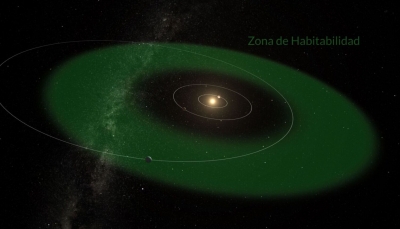
The Astrophysics Institute of the Canary Islands (IAC) and the University of La Laguna confirm the discovery of a super-Earth orbiting in the habitable zone of HD 20794, a nearby star similar to the Sun. This international discovery, the result of more than two decades of observations, opens a window to future studies of atmospheres of planets similar to Earth.
The search for planets in the habitable zone of Sun-like stars is crucial to understanding the possibility of life beyond Earth and to studying conditions similar to those that allowed the development of life on our own planet. In this context, HD 20794, a star with a mass slightly less than the Sun and located only 20 light years away, has always been the object of great scientific interest.
The new planet is the third planet discovered in that system, after the discovery of two super-Earths published more than a decade ago. The new planet has been named HD 20794 d and is a super-Earth with a mass 6 times that of Earth and takes 647 days to complete an orbit around its star, 40 days less than Mars. This orbit places it in the habitable zone of the system, that is, at the right distance from its star to maintain liquid water on its surface, one of the key ingredients for life as we know it.
It is precisely the combination between the distance between the planet and the star, and the proximity of the system, which makes it especially attractive, making it a perfect candidate for observations with the Extremely Large Telescope (ELT), the 40-meter telescope of the European Southern Observatory (ESO), or future space missions of the space agencies ESA and NASA.
“This is the perfect type of planet for the characterization of atmospheres of terrestrial planets with next-generation instruments and missions,” explains Nicola Nari, researcher at Lightbridges S.L. and doctoral student at the University of La Laguna, and lead author of the study, published this Tuesday in Astronomy & Astrophysics. “In fact, we hardly know any similar planets,” says Alejandro Suárez Mascareño, researcher at the IAC and co-author of the work, who insists that this new planet, “will surely be one of the first that we can study.”
This discovery has been possible thanks to the study of more than 20 years of radial velocity measurements of the spectrographs ESPRESSO and HARPS, both installed in the observatories of ESO, in Chile and in which the IAC collaborates. These instruments, among the most advanced in the world, are capable of measuring the minute variations in the speed of stars associated with the gravitational pull of the planets in the system. “Very few instruments in the world are capable of providing the level of precision necessary for a discovery like this,” explains Nicola Nari.
With the aim of going even further, the team applied sophisticated processing techniques to the spectra obtained. “We worked on the analysis of the data for years, analyzing and gradually eliminating all possible sources of contamination,” explains Michael Cretignier, co-author of the study and researcher at the University of Oxford. This thorough analysis revealed the presence of a candidate signal, identified in 2022. Immediately, the team launched a new observation campaign to confirm it. “After two years adding new measurements, we can confirm that we have a robust detection,” adds Nathan Hara, researcher at the Marseille Astrophysics Laboratory.
Although the planet is in the habitable zone of the system, it is too early to say whether it could harbor life. Its high mass and eccentric orbit make it a world very different from ours. Unlike the orbits of most planets in the Solar System, the orbit of HD 20794 d is not circular but elliptical. The distance to its star changes significantly, causing the planet to move from the outside of the habitable zone to the inner edge, throughout its year.
“HD 20794 d is not a second home for humanity, but its position and peculiar orbit give us a unique opportunity to study how habitability conditions vary over time and how these variations can influence the evolution of the planet's atmosphere,” says Alejandro Suárez Mascareño, researcher at the IAC and co-author of the work.
The researchers Jonay I. González Hernández, Atanas K. Stefanov, Rafael Rebolo, Carlos Allende Prieto and Enric Pallé have also collaborated in this publication from the IAC.


