
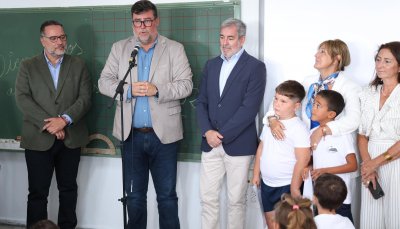
The president of the Canary Islands, Fernando Clavijo, together with the Minister of Education, Vocational Training, Physical Activity and Sports, Poli Suárez, inaugurated this Tuesday the 2025/2026 school year at the Güime Center for Early Childhood and Primary Education (CEIP), in the Lanzarote municipality of San Bartolomé, with an emotional event that marked the welcome to the classrooms of nearly 107,000 students from the Early Childhood and Primary Education cycles throughout the archipelago. And a prelude to the incorporations of the rest of the educational stages, which will do the same during this week and the next until completing the return of almost 236,000 students.
Fernando Clavijo celebrated the "opening of the new school year, which kicks off activity in the Canary Islands classrooms." The president of the Canary Islands recalled his Government's commitment to "continue strengthening a system that is a driver of equality and progress, where every child and young person, regardless of the island or municipality in which they live, has access to a quality public education." In this regard, Clavijo stressed that it is "one of the greatest challenges and at the same time the greatest opportunity for the future of the Canary Islands: investing in the training, talent and capacity of our young people."
In addition, the president of the Canary Islands Executive added that "the steps taken by the Government of the Canary Islands are aimed at a more inclusive, closer and better prepared education to face the challenges of our time, from climate change to digital transformation. That is the path we have set for ourselves as a Government and that today begins to become a reality in the classrooms."
After choosing on this occasion to inaugurate the new course in a small single-teacher school, the Minister of Education, Poli Suárez, highlighted the importance of this type of center as a "fundamental pillar of our educational system, because they represent closeness, personalized attention and rootedness to the territory." In this regard, he cited CEIP Güime as an example, "with just twenty students, but which demonstrates how education keeps our rural communities alive and guarantees equal opportunities regardless of where you live." Suárez stressed that "the commitment to this model is absolute: we are not only going to maintain it, but also reinforce the resources that allow it to continue being spaces of quality, inclusion and future."
Likewise, Suárez set some of the objectives of the academic year: "In addition to the commitment to quality and accessible education throughout the Canary Islands, this year we have the goal of continuing to reduce the student-teacher ratio per classroom, strengthen the teaching staff, simplify bureaucracy so that teachers dedicate more time to teaching and improve the adaptation of centers to phenomena such as high temperatures." Added to this is the determined boost to Vocational Training, "with new centers and groups, and the consolidation of the zero to three year stage, ensuring that no child is left behind in their access to education," he pointed out.
The regional Minister of Universities, Science and Innovation and Culture, Migdalia Machín; the Minister of Education of the Cabildo of Lanzarote, Ascensión Toledo, the mayor of San Bartolomé, Isidro Pérez, and the coordinator of the Collective of Rural Schools of Lanzarote, Sebastián Acosta, also participated in the opening ceremony, as well as the center's teaching staff and the students' families. Representing them, several students read verses about education, followed by the music of the timple players Gabriel Cubas Morales and Auristela Cubas Páez, who performed pieces of Canarian folklore such as Chipude or Pájaro Campana.
For his part, the highest representative of San Bartolomé, Isidro Nuez, expressed that the choice of this municipality and, specifically, of its single-teacher schools "is a firm reflection of San Bartolomé's commitment to public education." He stressed that it is "a moment of joy and excitement, and, above all, of giving value to rural schools on this island and in the Canary Islands in general." In this regard, he recalled that from the City Council "we have always worked to promote new educational infrastructures and to value the role they play in society," citing as an example the agreement signed with the Ministry of Education for the construction of the CEIP Alcalde Alexis Tejera Lemes.
Start of the course
This Tuesday, classes have begun for a total of 106,919 students of Infant and Primary education in centers throughout the archipelago. This kicks off a new academic year that will mobilize as a whole nearly 236,000 students in all educational stages. Tomorrow, Wednesday, 60,909 students of Compulsory Secondary Education will also join the classrooms, and on Thursday, it will be the turn of the 24,980 students of Baccalaureate.
From Monday, September 15, the calendar will be completed with the incorporation of Vocational Training students and the basic, intermediate and higher level training cycles, which together total just over 43,000 students, as well as the rest of the teachings.
Likewise, the public education system of the Canary Islands will have this year with more than 28,000 teachers and around 5,000 members of non-teaching staff, who join this collective effort playing key roles in services such as administration, guidance, cleaning, transportation and maintenance of educational centers.
Lowering of ratios
This year begins to apply the progressive reduction of the ratio of students per classroom in the groups of four and five years of Early Childhood Education -from 23 students to 20-, first and second grade of Primary -from 25 to 22- and in first and second of Compulsory Secondary Education (ESO) -from 27 to 25-, under the agreement reached in April with the trade union organizations. A historic milestone that has allowed to set a multi-year plan until 2027 to place the maximums in 16, 18 and 20 students in Infant, 22 in Primary and 25 in Secondary. With these figures, the Canary Islands is placed among the autonomous communities with the best indicators in this area, which contributes to a more individualized and higher quality education.
To meet this objective, the 2025/2026 academic year starts with a reinforcement of 700 additional teachers in the public centers of the archipelago. This increase allows the creation of 114 new groups in Infant, Primary and Secondary, as well as 81 in Vocational Training. An important part of the incorporations is concentrated in the staff of attention to diversity, with 168 specialists in Therapeutic Pedagogy and 140 educational counselors, to which are added new teachers in Infant and Primary. These measures guarantee better learning conditions and strengthen equity and educational inclusion in the Canary Islands classrooms.
Infrastructures
With the aim of guaranteeing the start of the course in the best conditions, the Ministry of Education, Vocational Training, Physical Activity and Sports has allocated this summer more than 9.3 million euros to improvement and conditioning works in more than a hundred educational centers of the islands. Among the actions include the creation of enclave classrooms, the modernization of electrical and sanitation facilities, the improvement of accessibility, the removal of asbestos and various interventions in patios, dining rooms, toilets and sports courts.
To this investment are added more than 700,000 euros in the acquisition of educational furniture and specific actions such as the completion of shade spaces in different schools and institutes, with a budget of 1.5 million euros. These interventions, together with the reinforcement in sports infrastructures and paving works, are part of the strategy of the Government of the Canary Islands to modernize the network of public centers and offer safer, more accessible and adapted spaces to the current needs of the educational community.
New centers
The Ministry of Education, Vocational Training, Physical Activity and Sports has expanded this year the public network with the creation of four integrated vocational training centers (CIFP), located in Valverde (El Hierro), San Sebastián de La Gomera (La Gomera), Morro Jable (Fuerteventura) and Santa María de Guía (Gran Canaria), as well as two new compulsory education centers (CEO) in Arona (Tenerife) and Las Palmas de Gran Canaria. This measure responds to an educational management based on efficiency and adaptation to the growing demand of students in these teachings.
Along with this, the Shock Plan of Educational Infrastructures of the South of Tenerife 2024-2031 continues, with an investment of almost 85 million euros destined to the creation of ten centers and the expansion of another twenty. Among the most recent actions are the commissioning of the new CIFP of Adeje and the execution of projects that include new classrooms, extensions, shade spaces and enclave classrooms in different parts of the islands, with the aim of improving learning conditions and responding to the needs of the educational community.
After the interventions of the authorities, the attendees made a tour of the facilities, with stops in the classroom of Therapeutic Pedagogy, destined to the specialized attention of students with specific needs of educational support; the classroom of Infant, which reflects the commitment to a teaching of proximity and personalized; the school garden, conceived as a living space for learning in sustainability, traditional agriculture and teamwork; the school canteen, which constitutes a fundamental service to guarantee work and family conciliation; and the library, nucleus of promotion of reading in the rural environment.
Add La Voz de Lanzarote as a preferred Google source.
Stay informed with the latest current news.


