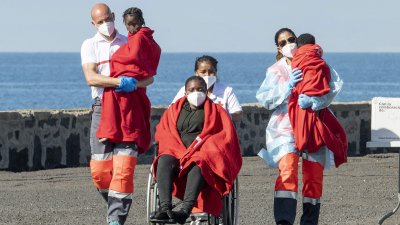
One year after its approval, the legislative reform for the relocation of unaccompanied migrant minors is close to its objective: the Canary Islands, Ceuta and Melilla are close to exiting the emergency situation in which they found themselves, and the rest of the communities provide a dignified reception to the children despite the open political and judicial battle.
This modification of the Immigration Law changed the way Spain welcomes unaccompanied migrant minors who arrive in the country: instead of being the responsibility of the communities where they arrive -Ceuta, Melilla and, above all, the Canary Islands-, these must be transferred to all communities based on certain criteria.
The measure arrived at a critical moment, especially for the Canary Islands, which came to host with its own resources almost 6,000 young people, and raised blisters among the communities governed by the PP, which claimed not to have resources to host the youngsters.
More than 1,100 minors relocated
According to sources from the Ministry of Territorial Policy and Democratic Memory, one year after the approval of the royal decree-law, more than 1,100 unaccompanied migrant minors have been relocated from the Canary Islands, Ceuta, and Melilla to the rest of the autonomous communities.
This figure includes young people transferred by order of the Supreme Court to the central Executive so that it would attend to minor applicants for international protection, almost 450.
The figures are far from that initial estimate of 4,400 children and adolescents because not all the relocations that were foreseen have been completed within the deadline -the idea was for the Canary Islands, Ceuta and Melilla to exit the migratory contingency situation-, but also because many files have been archived, for example, because the boys have reached the age of majority.
According to the latest data collected by the Government, the Canary Islands has transferred about 200 children and adolescents to other communities due to the reform of the immigration law; Ceuta, more than 400 and Melilla, just over 60.
Sources from the Ministry headed by Ángel Víctor Torres draw attention to the fact that the Canary Islands, which had the most urgency to relieve its resources, has transferred by this mechanism barely 200 young people when, they assure, they have more than 700 completed files whose transfer has not occurred and only depends on the archipelago.
Canary Islands, Ceuta and Melilla, close to exiting the contingency
As Minister Torres pointed out a few days ago, Ceuta and Melilla are close to exiting the migratory contingency situation, declared because they reached triple their reception capacity, and the Canary Islands will also do so "very soon".
The Canarian Executive has done the math and also sees this near future: According to data provided to EFE, currently the islands are looking after 3,596 children.
But removing those who are in the national asylum network (476), those who have arrived in recent weeks and will be transferred in about 15 days (267), those who will soon turn 18 (276) and those who are in the process of being relocated (216), the Government calculates that in the coming weeks the Canary Islands will host about 2,361 when a year ago it exceeded 5,500.
Those figures would place it very close to the end of the contingency, marked at 2,211 minors, triple its ordinary capacity (737).
For its part, the Government of Ceuta is not so optimistic: although it celebrates having achieved the transfer of hundreds of minors, they underline that the frequency of entries of other boys by swimming keep the city with services "collapsed". Until last March 13, it was hosting 308 minors when its limit to exit the emergency is 81, triple its capacity (27).
Sources from the Ministry of Youth and Childhood have assessed the impact of the reform "very positively" because it has guaranteed the best interest of children and adolescents and has "very significantly eased the tension" in the reception systems of Ceuta, Melilla, and the Canary Islands. They have stressed that beyond judicial appeals, "blockage attempts" and "dehumanization" strategies by the PP communities, the royal decree has been complied with "normally" thanks to the work of the professionals in charge of reception in the different territories.
The communities comply despite the political and judicial battle
The prior negotiations and the final approval of the royal decree-law raised a war between the PP communities and the Executive, which has had its continuity this year in the form of judicial appeals before the Constitutional Court, by ten PP communities and Castilla-La Mancha; the Supreme Court, in the case of the Community of Madrid; or the High Court of Justice of Madrid, with Aragon.
However, and while Justice resolves these challenges, the truth is that the communities have complied with the reform and have welcomed all the minors who have been transferred.
According to data provided to EFE by the different regional governments, these have prioritized small resources, many of them in rural areas; they have guaranteed their schooling and have provided them with integration tools such as Spanish classes or their enrollment in local sports teams.
Small homes in the rural environment
It is the case of Aragon, one of the most belligerent communities against the central Government on this matter. It has hosted 84 children and adolescents this year and has opted for the rural environment, with small coexistence centers that reproduce a family environment versus large facilities.
Also has opted for this model, which allows "better social integration and closer contact with monitors" Cantabria, which has served 33 young people, and Castilla-La Mancha, where the NGO Accem has highlighted the synergy opportunities between these young people and the elderly in rural areas and the importance of training, with young people who later even take the step to university.
The Xunta de Galicia assures that "it has complied at all times and the law continues to be complied with" despite its discrepancies with the model: it has taken in 78 minors for whom it has launched a center in Monforte de Lemos (Lugo) and enabled more places in another one in Burela (Lugo), while La Rioja, where 64 young people have been transferred, acquired an old monastery in Logroño to house 14 boys.
Navarra has attended to 43 children and adolescents: In the case of those under 16, they go to school, and among the older ones, some continue studying and others take courses more focused on employment, "like any other minor" fostered by the autonomous community.
Catalonia has only received 31 through this mechanism because historically it is one of the areas that most takes in alone migrant minors and in the case of the Balearic Islands, the greater migratory pressure it has had this year has been taken into account and it has only received four young people from the Canary Islands.
Some autonomous Governments have declined to offer data on the reception of minors in their community this year.
And now, what?
The royal decree-law gave a one-year deadline to reallocate the boys who were already in the communities declared in contingency and this type has ended without the objective having been met.
To know what will happen now, Minister Torres has submitted a legal query to the State Attorney's Office and, although the Government's will is that work can continue on the referrals beyond this Wednesday, this will depend, in large part, on the goodwill of the autonomous communities.



Add La Voz de Lanzarote as a preferred Google source.
Stay informed with the latest current news.