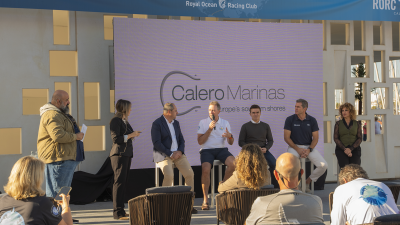
On the morning of this Thursday, the 11th edition of the RORC Transatlantic Race was officially presented, which will start next Sunday, January 12, 2025, from Marina Lanzarote to Camper & Nicholsons Port Louis Marina in Granada. This prestigious event will cover 3,000 nautical miles and bring together crews from 18 countries, who will compete in a test of skill, endurance, and ambition.
José Juan Calero, CEO of Calero Marinas, highlighted: "11 years ago, together with the Royal Ocean Racing Club, we created what would be the first regatta to cross the Atlantic. This year, the RORC celebrates its centenary, which makes it a particularly significant year. In economic terms, this competition has contributed 44 million euros to the island over its eleven editions, with an average of 4 million per edition."
Jeremy Wilton, CEO of the Royal Ocean Racing Club (RORC), emphasized that this regatta is one of the club's most outstanding competitions, with a route of nearly 3,000 nautical miles. "The aspirations of this regatta also include giving international visibility to the island of Lanzarote and highlighting its magnificent climatic conditions. The participation of children in different activities allows us to strengthen ties with the local population."
He also mentioned the case of the boat Helsinki, which departed from Finland and has traveled 5,000 nautical miles to be present: "They left at a temperature of -20 ºC and are now enjoying a climate of 20."
In the institutional sphere, Elisabeth Merino, Councilor for Tourism of the Arrecife City Council, expressed her gratitude for having chosen the facilities of Calero Marina in Arrecife as the starting point for this prestigious event.
For his part, Héctor Fernández, CEO of SPEL, stated: "From Lanzarote, by supporting this type of event, we seek to qualify the destination, and the RORC Transatlantic Race fits perfectly into this strategy. Lanzarote currently leads tourist spending in the Canary Islands, but our goal goes further: we want to strengthen our relationships with collaborators who help us continue to grow." Finally, Juan Monzón, Minister of Sports, assured: "From the Cabildo, we will always lend a hand to this type of public-private projects that enhance our island through sports. I wish all participants the best of luck."
Also present at the presentation were the sailors David Vera from Tquila and Joan Vila from Maxi Lucky. For Vera, who currently lives in Lanzarote, it is a luxury that this competition starts at home: "The Canary Islands have always been a privileged place for sailing and you rarely see these conditions and so well prepared with first-class infrastructure."
Vila, the first Spaniard to be part of the Hall of Fame of the America's Cup, highlighted: "This competition serves as a bridge for the fleet from Europe to move to the Caribbean and, on a sporting level, it is a very demanding challenge during the long journey, which is what we sailors like. Here it is really impressive the marinas that there are, in few places you find being able to be next to the hotel of the boat and being able to walk to the boat. Everything is easy and this is what is much appreciated."
The regatta will feature 16 top-level boats that will compete in various categories, including IRC One, IRC Two, Class40, and multihulls, offering an exceptional nautical spectacle.
IRC One
The Swan 78 Victoria (FRA), commanded by Hubert Wargny and Christophe Fresson, starts as the main favorite, with a high-level team representing the Yacht Club de France. It is followed by the Santosha (FRA), a Finot Open 50 with a distinguished record in transatlantic regattas. In addition, the Carkeek 45 Ino Noir (GBR), a light and fast boat, promises to be competitive in fast sailing conditions.
Finally, the JV52 Haspa Hamburg (GER) stands out as the youngest team, with a crew mostly made up of people under 30 years old. Time corrections will determine if Victoria can overcome its rivals, needing a significant margin against its competitors.
IRC Two and Class 40
In this category, the two Class40s, Tquila (GBR) and Rock’n’Roll (GBR), are the main contenders. Tquila, with a more modern design, is expected to lead its class and challenge the record set in 2021 by Palanad 3.
Also competing are outstanding boats such as the Swan 651 Spirit of Helsinki (FIN), with an advantage in upwind conditions, and the Lombard 46 Pata Negra (GBR), a veteran with experience in previous editions of the regatta. Another participant is the JV44 Fujimo (POL), which will seek to take advantage of its light classification to achieve a good performance.
Multihulls
The multihulls present a great variety, from fast trimarans such as the Finn (USA) and the Dakota (FRA) to the light Perros-Guirec (FRA). The Rayon Vert (FRA), winner of previous editions, competes as a couple and could repeat its success if the ideal conditions are met. The Finn, a custom design inspired by the MOD70, can reach high speeds and is emerging as one of the favorites in its class.
For its part, the Dakota, despite being heavier, has the potential to complete the regatta in about 12 days with favorable wind. Finally, the Perros-Guirec, a classic 2,200 kg multihull, combines its low weight with ambitious aspirations, including participating in the Route du Rhum 2026.
Lanzarote: an ideal destination for sailing
Once again, Lanzarote demonstrates why it is an international benchmark in sailing competitions. Its unique weather conditions make it an ideal place for regattas and training throughout the year. The island has already hosted other prestigious competitions such as the RC44 Cup Calero Marinas, world championships, and Olympic qualifiers of different classes, establishing itself as a destination that never disappoints sea lovers.
Followers will be able to enjoy this regatta in real time thanks to satellite trackers that will show positions, courses, and corrected times. More information and access to live tracking are available on the official event website.
The RORC Transatlantic Race is supported by Lanzarote Sport Destination, the Art, Culture and Tourism Centers (CACT), Turismo Arrecife, and the collaboration of the Real Club Náutico de Arrecife (RCNA).



Add La Voz de Lanzarote as a preferred Google source.
Stay informed with the latest current news.