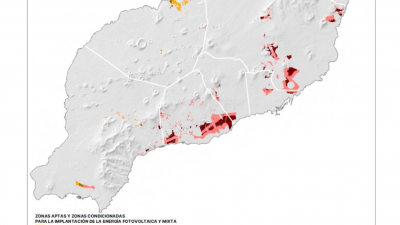
The Ministry of Ecological Transition of the Government of the Canary Islands, led by Mariano H. Zapata (PP), approved at the end of January a decree-law that allows moving forward with renewable energy installation projects in Renewable Acceleration Zones (RAZ) without the need to present an environmental assessment, replacing it with a non-impact procedure. A simpler mechanism that does not require the participation of other institutions. At the same time that it eliminates the criterion of preventing the installation of renewables on land with a natural slope of more than 50%.
It should be remembered that Lanzarote was the first island of the archipelago, through the Cabildo, to agree on these acceleration zones on the island. However, the Island Government has asked to rectify the defined zones to install renewables, after denouncing "a colossal error" in the maps published by the Canarian Executive, which open the door to installing solar panel fields and to occupy more than 3,100 hectares of undeveloped territory in Lanzarote.
Decree-Law 5/2024, which modified the Climate Change and Energy Transition Law of 2022, already included the simplification of procedures, but currently the change is limited only to those classified within the acceleration zone.
After being validated in the Parliament of the Canary Islands, this modification has become incorporated into the legal framework of the archipelago. The Department, in the hands of the Popular Party, justified the use of this tool to modify again the Climate Change and Energy Transition Law of 2022, which it already modified in the form of a decree-law in June 2024, alleging that the changes are "of extraordinary and urgent necessity". However, the opposition has criticized the abusive use of these legal mechanisms. Furthermore, it has also modified the Law of Land and Protected Spaces of the Canary Islands.
At the same time that it has already entered into force as a decree-law, the initiative has also been taken as a bill to the Parliament of the Canary Islands and since this past March 10 it is in process to receive amendments.
No answer about the "error" in the published maps
With this context, a new chapter is added to the conflict that faces the Cabildo of Lanzarote, led by Canarian Coalition and the Popular Party, with the area of Ecological Transition of the Government of the Canary Islands, in the hands of the Popular Party.
Among the most controversial points of this modification, the Ministry of Ecological Transition of the Government of the Canary Islands has opened the door for projects located in renewable acceleration zones to be subject to the procedure for determining no environmental impact and not to environmental assessment, as the law stipulated until now. This possibility will be available for all authorizations requested before the Government of Spain fully transposes European Directive 2023/2413 into Spanish law.
Only those that are carried out on Natura 2000 Network spaces, those located in Natural Heritage and Biodiversity areas, those projected in the marine environment, or those that involve the construction of overhead lines with a voltage greater than 220 kilovolts and more than 15 kilometers will maintain the need to present an environmental assessment.
But, what does this imply?
Projects that request their authorization before Spain fully adapts to this European directive, will not be subject to Law 21/2013 on environmental assessment. Instead, the developer must submit an application for environmental impact determination and an executive summary prepared by the same developer, addressing the "main impacts of the project", as well as an application for the start of the assessment, where the motivation, location and characteristics, etc., appear.
The environmental body will have two months to determine the environmental impact of the project within a period of two months from when it receives the documentation. In it, it must determine whether or not the project generates significant effects on the environment and if it must undergo an environmental assessment procedure.


Add La Voz de Lanzarote as a preferred Google source.
Stay informed with the latest current news.