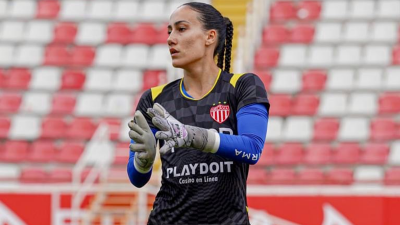
Ithaisa Viñoly is a 23-year-old goalkeeper who, thanks to her talent, has managed to make the leap to women's football in Mexico. Born in San Bartolomé, the footballer started playing football from a young age because it came from her family. From her grandfather and her father she inherited the love for this sport, and with the latter she began to take her first steps.
"I grew up with a cousin of my same age and we shared toys and in the end we have grown up sharing hobbies and he was very fond of playing ball, so we always played and I wanted to be a goalkeeper but my father was a goalkeeper and he knows how complicated it is, so his first reaction was to refuse to let me be one too because his protective side came out", she says.
As a result, Viñoly tried other sports such as basketball or tennis but knew that her destiny was football. "I tried every sport you can imagine but it lasted a month because I ended up getting bored", she says, but at the age of six, while her father was making dinner, she said to him: "Dad, I want to be a goalkeeper and I don't care what you say".
"He laughed and told me that okay, that I would be a goalkeeper but with a deal, that I would do my homework first and then we would go to the San Bartolomé football field to train, and if I lasted until August, I would start as a goalkeeper, so I was doing my goalkeeper training for five months before starting in the first year of the under-12s and I didn't get bored, but I ended up loving it", she recalls.
Her career began at C.D. Orientación Marítima as a forward, but then she focused her time in football in Lanzarote at Sporting Tías, where she started as a goalkeeper and where her father was her coach.
The leaps out of Lanzarote
The young woman later started in a goalkeeper academy and at the age of 15 she started to leave Lanzarote, since at the age of 14 girls can no longer play in male teams. For this reason, she had to go to Tenerife to play for Granadilla.
There she met her coach who took her to her next destination, the United States, but before that she spent two years preparing well for the university entrance exams. "Then I went to the United States where I played in New Hampshire and then I ended up graduating in Psychology in Miami", she says.
"There an agent saw me play but my coach didn't allow me to talk to him because he even came with a shirt from the rival university but a week later by chance I met him again and he proposed that the starting point to return to the professional league is Mexico, which is like a springboard, and I have been in the country since August", she explains.
After spending six years outside of Spain, what Viñoly wants most is to be close to her family and friends. "I still have that desire to continue abroad but not so much anymore because my father is a very important figure in my life and he hasn't been able to see me play for six years, so I need my family a little more, that the people I love can enjoy with me something that I dedicate so much time to each year", she reflects.
This stage in Mexico will last a semester, which will be a bridge for the athlete to close that stage abroad, "especially to return to Europe", she says.
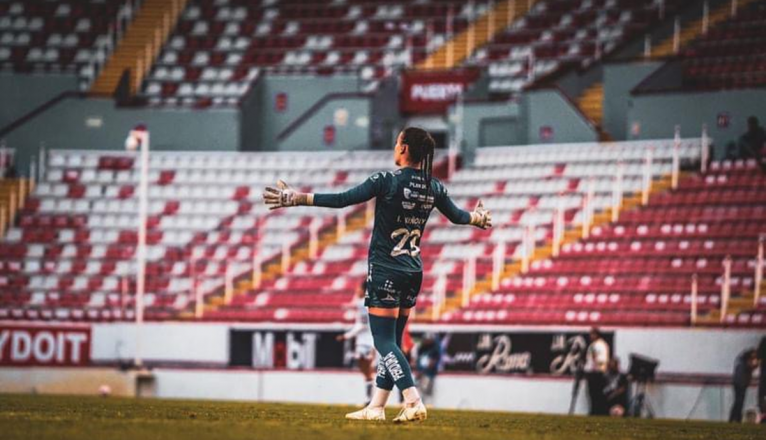
The experience in Mexico
Her stay in Mexico is mainly about adapting to a culture full of contrasts but, above all, about training and formation as a goalkeeper. Her routine before training begins with a strong breakfast and then she goes to the physiotherapist. "I start by activating in the gym, that is, activating the muscles, and I also do strengthening, depending on whether the season is long", she says.
"Then the physical trainer would come in, which is team work and we do an hour of gym and then we go to the court, where we train for two hours. Then we eat at the club, then to the physiotherapist and I usually leave the club at about four in the afternoon more or less", she explains. All this while the Lanzarote native is studying a course in sports psychology, whose master's degree she wants to do soon.
The change of culture and food caused some problems for Viñoly, especially in the diet. "The food is spicy, that is, the reality is that it is spicy and it irritates you, and I even got irritable bowel syndrome and was out of competition for a month", she declares.
The problems with the seasoning of the food affected her digestive system for a long time. "I told my teammates that I wish I had their Mexican stomachs to be able to enjoy the food as they enjoy it, that is, I had teammates who ate super spicy bag potatoes and added even more spice to them", she says with a laugh.
However, in terms of the welcoming capacity of the Latinos, the goalkeeper highlights that "they welcome very well because they are very simple people and always have a smile on their face and everything becomes very pleasant in that way because the nostalgia you feel for being away from home becomes more bearable".
In sports, Viñoly reveals that she also had some adaptation problems because it is "a very vertical football". "I said I was a quarterback because it was a lot of the goalkeeper looking for the long ball and many goals were scored that way in the league", she explains.
"In Spain football is a lot about touching the ball very quickly but you use the eleven players on the field but in Mexico, as long as it is direct and effective, the better", she says. "I had to adapt a lot to the verticality of the game", she continues.
More visibility with women's football
In the midst of the rise of women's football, the role models for boys and girls are no longer exclusively men, but also women. "In Mexico, I might go to the supermarket and there were small children who recognize you and talk to you", she declares.
"I think it's very nice that you have children who also have female role models because I grew up always having male role models, I never had a female role model until years later when more girls started to be seen", she argues.
"Three weeks ago we had a training session when one part of the field was training the boys' team and the other side was us, and we did an open doors training session and a school came and I thought: Well, this is the social movement that is needed", she says.
Sexism has always been and is present in this and many other sports. The athlete recalls an anecdote that reflects that sexism. "When I was little, my father took me to try out for Atlético de Madrid and they took me, but it turns out that for girls there was no residence like for boys, but if I accepted to enter, my family had to move to Madrid to take care of me because they were not responsible", she reveals.
Finally, Viñoly did not take that train but life had many other trips prepared for her that have led her to become a goalkeeper with an innate talent.



Add La Voz de Lanzarote as a preferred Google source.
Stay informed with the latest current news.