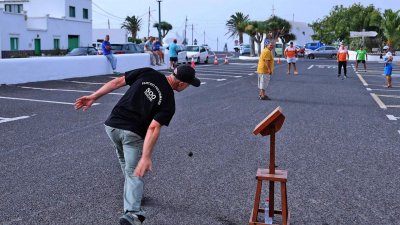
In the world, there is a wide range of sports, from the best known and most practiced, such as soccer or basketball, to the most unknown and minority sports, such as pelotamano. This traditional sport of the Canary Islands, very popular in Lanzarote and Fuerteventura, has been practiced on the islands for centuries. In fact, there is evidence of the existence of the "ball game" on some islands, such as Lanzarote or Gran Canaria, in the 17th century.
Handball is one of the traditional games of the islands that has best maintained its original form, which is why it has barely changed over the years. Furthermore, it is a game that one does not get to know in depth until it is practiced regularly and all possible situations are experienced.
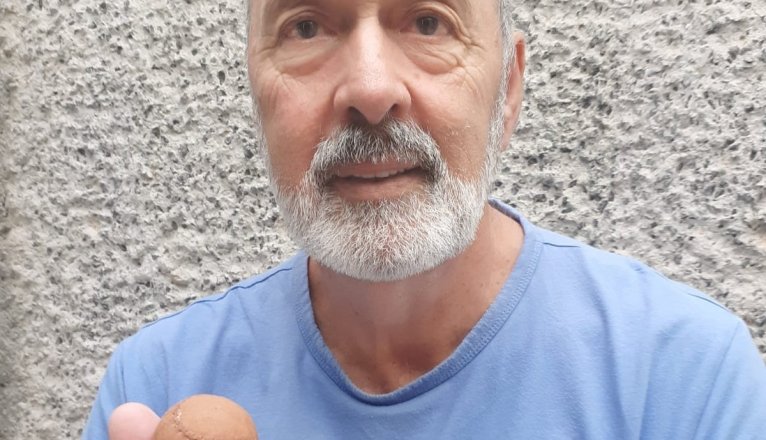
Juan Hernández is one of the people who has spent fifty years fighting to preserve and promote 'pelotamano'. From a very young age, he learned to play this sport at his grandmother's house, in Tiagua, one of the epicenters of 'pelotamano' in Lanzarote. "We would sit in the street when we were five or six years old to watch people play," he recalls.
With the arrival of the Civil War and the subsequent dictatorship, this game stopped being played for years. When Hernández moved to Gran Canaria, he began working with Paco Osorio and others to revive it.
When he was young, Juan Hernández says that most of the games were played in Teguise. "There were no telephones and we would let people know that we were going to play on the weekend," he explains. Among the players were Cayetano Tavío, Benigno Rodríguez, Manuel Arbelo or Juan Bonilla, who "were among the last to keep the game going until the sixties in a sporadic way, almost all from Soo."
How to play
When playing, the teams are called "partidos", which are made up of players from Tiagua, Soo, and Teguise. Tiagua is precisely the Lanzarote town that has been celebrating a tournament for the Socorro festivities for almost fifty years.
When playing, it is done with two teams of five players and a ball the size of an egg, approximately 45-47 millimeters in diameter, which is made of rubber, goatskin, and wool. "We have always tried to ensure that the leather is of animal origin, but the wool can be replaced with a synthetic one," he clarifies.
In the past, it was played on dirt courts or roads; any surface was valid for having a good time practicing handball. However, nowadays it is played on municipal courts with pavement, although Hernández emphasizes that this change "has hardly made any variation." In addition, it should be noted that it is a sport in which there is no referee and no set time of play.
A detail that Juan Hernández emphasizes is that "the court was called a ball game," which is why there are documents from the early 1600s that mention this term in the sale of houses in Teguise.
The playing field is between 60 and 70 meters long and eight or nine meters wide, where five against five play through two "matches," that is, two teams, to "maintain the tradition." The game begins by taking the ball out with the bounce, a kind of bench that can be made of wood or stone, depending on the area of the island. "In Maciot, Femés, Yaiza or Las Casitas stone was used, while in Teguise it was made of wood," he says.
The serve is made from the opposite side of the court and must pass over the division of the playing field, as in tennis, but without a net. However, when returned by the opposing team, it can be returned in any area, as in soccer. On each team, only one player can hit the ball in each play. If two players hit the ball, it is a foul. It is also a foul if the ball is hit with any part of the body other than the hand, or if it goes out of bounds.
Furthermore, these fouls lead to counting points of 15, 30, 40, and 50. Reaching 50 counts as a 'chico' [boy], and every five chicos is a 'pajero' [straw stack]. "On the line that divides the field, the chicos are marked with lines, and when five chicos are made, they are erased and a circle is drawn around the stone. In the past, by analogy, people related the shape to a straw stack, which is why it was called that," Hernández explains.
Pelotamano draws from other similar sports practiced around the world, such as in Italy and the Netherlands. "What pelotamano has done is adapt to the idiosyncrasies of the Canary Islands," says Hernández. "When we played with Dutch players, we didn't understand the language, but they have practically the same rules in the game they play, so we understood each other perfectly," he continues.
An Unrelenting Fight to Preserve Handball
The limited knowledge that exists about this sport endangers its survival. Many of the people who played this game decades ago in Lanzarote have already died or are very old, which complicates the generational handover.
The preservation and dissemination of "pelotamano" involves some schools and institutes in Lanzarote, where its practice has been encouraged so that students know about it and are aware of its historical and identity-related importance.
That it is practiced in schools "depends on the teacher who is teaching the class and their degree of sensitivity because normally the more they invite you is for the celebration of Canary Islands Day and one no longer wants to go because they only call you during those dates," he points out.
In this sense, Hernández highlights that the General Directorate of Sports is carrying out courses on traditional Canarian games such as 'pelotamano' (handball). "When we gave the courses to teachers on 'pelotamano', the Cabildo gave each of them a ball, which costs around 300 euros, which was a great help. We were in charge of giving them a ball so they could play with the children," he recalls. Now, the public administration has provided some material in some institutes.
Regarding the lack of handball clubs in Lanzarote, Hernández explains that "the statutes of the old club that existed were allowed to expire and have not been renewed due to the enormous bureaucracy involved in their creation."

Add La Voz de Lanzarote as a preferred Google source.
Stay informed with the latest current news.