
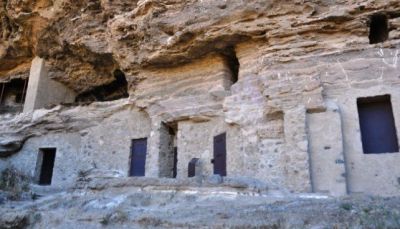
The archaeological site of Risco Caído has achieved great international projection to be declared a World Heritage Site by UNESCO. This has been possible thanks to the effort in the archaeological work of cleaning and cataloging rock engravings, domes, niches and basins, in addition to the maintenance, structural reinforcement, conservation and restoration works. This set of works has had the firm institutional support of the Cabildo de Gran Canaria.
The knowledge that has been transmitted has crossed borders: news in the press, four conferences with international presence of famous archaeoastronomers, a program of visits, etc. From the report submitted to UNESCO, the archaeoastronomical element of the sites is one of the central axes on which the application is based. That is why it is surprising that, of all the sacred mountain spaces included in the report, no study is presented in this line. We only find a general reference to the equinoctial phenomenon that occurs from the so-called Almogarén del Bentayga and, above all, emphasis is placed on a beam of light that enters through an elevated window in the so-called cave 6 of Risco Caído that determines, according to the project's researchers, a marker or astronomical calendar. Therefore, it is striking that no relationships with the celestial sphere are defined in the numerous cavities and spaces considered sacred by the researchers.
In this line, at the end of 2017, some studies were published in the Iruene Magazine that investigate the archaeoastronomical interpretation of these sacred spaces (Martín, M.A. The cereal cycle: Sanctuary caves of Risco Caído, Risco Chapín and Acusa Seca. pp. 42-83. A summary can be seen at https://www.bienmesabe.org/noticia/2018/Enero/las-cuevas-sagradas-de-risco-caido-barranco-hondo-gran-canaria-custodian-el-protocolo-cosmico-ritual-del-ciclo-agricola).
The Risco Caído settlement is made up of 21 artificial caves. They are located at the top of a steep cliff that forms a ledge on the left bank of Barranco Hondo (Artenara). The ones classified with the numbers 6 and 7 stand out, which preserve inside an important group of trianguliform rock engravings, domes, niches and basins.
In this archaeoastronomical context, if the intention was to determine the arrival of the spring equinox so that symbolically the light fertilizes the triangles, it seems strange that this first ray of light that enters through the window does not "impact" on any motif and you have to wait a while until it starts to touch some of them. It is also striking that the Sun's path along the wall is centered on a very small space, leaving a large part of the rock panel in absolute darkness. It does not seem logical that more than half of the motifs never receive sunlight. Even when the summer solstice arrives, this light does not move along the wall over anything differentiated and significant. It does not even die on any basin on the ground. There is nothing to distinguish it from the rest of the days on such a marked day in the indigenous calendar. For his part, the researcher José Barrios García
(2017) also shows his skepticism about the existence of solsticial or equinoctial "markers" in the aforementioned cavity. He also notes the absence of archaeoastronomical studies that support these approaches (Some considerations on the protection policies of the archaeoastronomical heritage of Gran Canaria: the cases of Cuatro Puertas and Risco Caído. XXII Canarian-American History Colloquium).
On the other hand, a large part of the place is completely renovated externally with artificial walls of stone ashlars that completely close cavities 6 and 7. The original orifices or entrance doors, which were large, were walled up. This artificial enclosure, which was done with the best intentions of preserving the site, modified and denatured its original architectural physiognomy, leaving it in a state that never existed (fig. 1). The worst thing is that it destroys an entire immaterial spatial ideology based on the temporal transit of sunlight on the triangles sculpted on its walls. Now we are faced with the dilemma of whether Risco Caído should have been rebuilt in that way or not. The problem is that such a forceful intervention falsifies the past, by incorporating fictitious constructions - especially walls and doors - that did not exist in the way they are recreated today.
In the current "Practical Guidelines for the application of the World Heritage Convention" of UNESCO, it is insisted not to reconstruct archaeological remains, clarifying some exceptions, yes, before exhausting the consolidation and repair of the sites and always based on a complete and detailed documentation that does not involve erasing any trace in the course of the works. In Risco Caído we believe that a serious error was committed, because if what is at stake is a World Heritage declaration based on archaeoastronomy, the restoration carried out has eliminated many of its possibilities.
What was Risco Caído like 1,000 or 500 years ago? Despite being in a ruinous state with appreciable detachments, the caves had considerable openings. Nothing to do with what we see today. When the Canarians chose the place to build their cave-temples, they must have observed the positions of departure, on the horizon, of the most significant stars. Then, when the constructions were finished, they observed on the walls how far and how the largest arc of sunlight that entered the cavities moved and carved the triangles just from the line that demarcated the light. In this way, they established the limits on the walls to carve the triangular motifs in the solstices and equinoxes.
In this place, the real protagonist is the light. A rough calculation of how cave 6 was without the recent enclosure ashlars would help us imagine the ray of sunlight entering through the large openings of the entrances to the cavities, progressively illuminating the petroglyphs on the wall as it moves until the Sun reaches its northern end (summer solstice) impacting on the back wall to illuminate all the triangular motifs. Being oriented towards the NE, if it had not been closed, the oversized light that enters through the window would be greatly reduced when the Sun penetrates through the portico to the height that marks the line where the engravings were carved.
With these enclosures, a new scenario has been created that is perceived only after artificially generating total darkness inside the cave. By carrying out an intervention that reconstructs the cave complex and completely closing it with walls and small entrance doors, a dark enclosure is created inside that gives the window a prominence that it did not have. The aggressive intervention originated a new situation that directs all attention in a certain direction, burying with it the distinctive feature of its true identity.
It will be necessary to consider a re-deconstruction that seeks technical solutions that guarantee its original conservation, allowing the entry of light and that the path of the Sun can be appreciated throughout the year through the rock engravings, domes, niches and basins. Only then can we understand at least part of the cosmic and ritual reality of the cavities. Everything that surrounds the archaeological site has been devalued, the context, the landscape, the sky, the stars... originating a museum space within a new context. It seems that the apparently spectacular takes precedence over the sacred and profound meaning of those spaces.
Why does cave 7 go unnoticed by archaeoastronomers? Simply because it does not have any windows. However, it contains many more engravings (about 70 triangular motifs) distributed along the three walls of the cavity. Being oriented towards the East, the first sunlight enters its interior throughout the year, which is why there are rock engravings on the side and back walls. In the summer solstice, sunlight preferentially illuminates the right wall (South) which contains 18 engravings. As the months progress, the light moves towards the back wall, which registers 32 triangular engravings, and during the winter solstice it covers the left wall (North) which contains about twenty trianguliform motifs. Currently, the enclosure and consolidation works sealed the entrance, preventing the appreciation of the path of sunlight on the rock engravings, domes, niches and basins.
The rest of the sacred caves of the Island, located in Risco Chapín (Candiles, Caballero, Cagarrutal), Acusa (Cueva de las Estrellas and Cueva Pintada), Silva Jeréz, Morro Ávila, Cuevas de Lezcano, Cueva del Guayre, Cueva de La Paja del Lomo de La Punta... that contain carved or painted triangles, bands of paintings with almagre and pointillism on the interior walls, do not have enclosures.
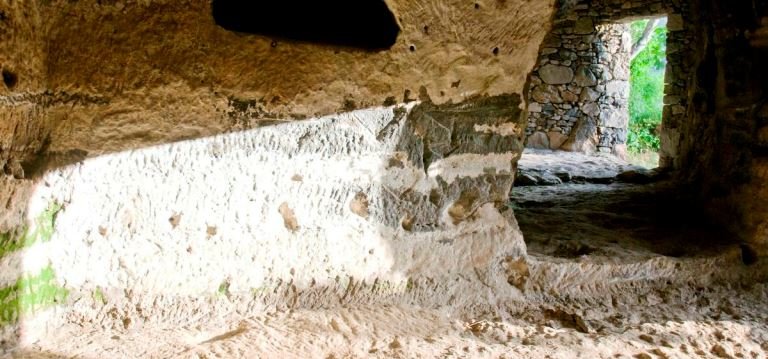
We would like to stop, for a moment, at the last of the caves mentioned, located about 350 m away from Risco Caído. Thanks to the invaluable collaboration of Luis León, who traveled to the place coinciding with the summer solstice, it was possible to verify how sunlight penetrates through the door and illuminates the wall where the trianguliform rock engravings are located (fig. 2). The penumbra of the first motifs is due to the fact that the wooden frame and some small rocks placed between it and the wall, added historically, reduce the space for the entry of light. This is a parallel case, equivalent to what happened, at least in part, in Risco Caído.
Another aspect that some researchers have constantly insisted on is the one related to considering cave 6 of this complex as a "precise calendar" (Julio Cuenca in El diario.es 01/12/2017). Although this topic is complex and would require an extensive analysis, we point out some considerations. The first is that we have not found any justification for this statement, except for the generic entry of light from "a few days before" the spring equinox, until a few days after the autumn equinox. As we said previously, the precise moments of the solar sprouting in the equinoxes are not marked in any way in the vault of cave 6. Nor is there any significant engraving that marks the arrival of the summer solstice.
The ancient Canarian population did not need to build such complex caves to locate themselves in time. Following the annual cycle, marked by the Sun, is relatively simple, establishing its course between the two solstices by means of posts, embedded stones or geographical events. The need for precision in the moments of the annual cycle was not mainly economic, but ritual. The ceremonies had to be performed on the precise day that corresponded and the economic cycle was linked to that sacred cycle. That precision was not given by the Sun but by the stars. For the case at hand, it would be the appearance of the Pleiades at dawn or dusk that would determine the key moments of the ritual calendar (see the articles by J. Cabrera González: The ancient island calendar, that of M.A. Martín González cited above in the Iruene Magazine, nº 9 and that of Miguel A. Martín González and Oscar R. Sánchez Artiles: The mountain sanctuaries in the microcosm of the island of Gran Canaria, in the Iruene Magazine, nº 5, 2010). The important thing in Risco Caído was not to mark time, but to perform the rituals that linked the celestial, terrestrial and underworld in precise moments of the cosmic cycle (E. Pérez Cáceres: The spirits of the sea: The cult of ancestors among the natives of the Canary Islands. Revista Iruene nº 9). And that cycle was perfectly controlled by indigenous knowledge from multiple locations.
We hope that the technological deployment, the advertising strategies and the primacy of the supposedly spectacular, do not end up hiding the wisdom and the profound meaning that these sacred caves contain. The Canarians not only demonstrate great knowledge in the construction of these temples, but also manifest a broad-minded worldview that re-links the cosmos, the earth and human life. It is the expression of a deep spirituality. In our opinion, that is the true value of Risco Caído and the rest of the cave-temples of the Island of Gran Canaria.
By Eduardo Pérez Cáceres and Miguel A. Martín González


