
In our daily lives, teachers, we look for tools and methodological resources that facilitate us to educate in a complete way, not only in content. Fervently we seek resources that allow us to combine content, values, emotions, and ways of understanding life.
But many times the most profound lessons are in our classrooms, in what our students tell us, their creations.
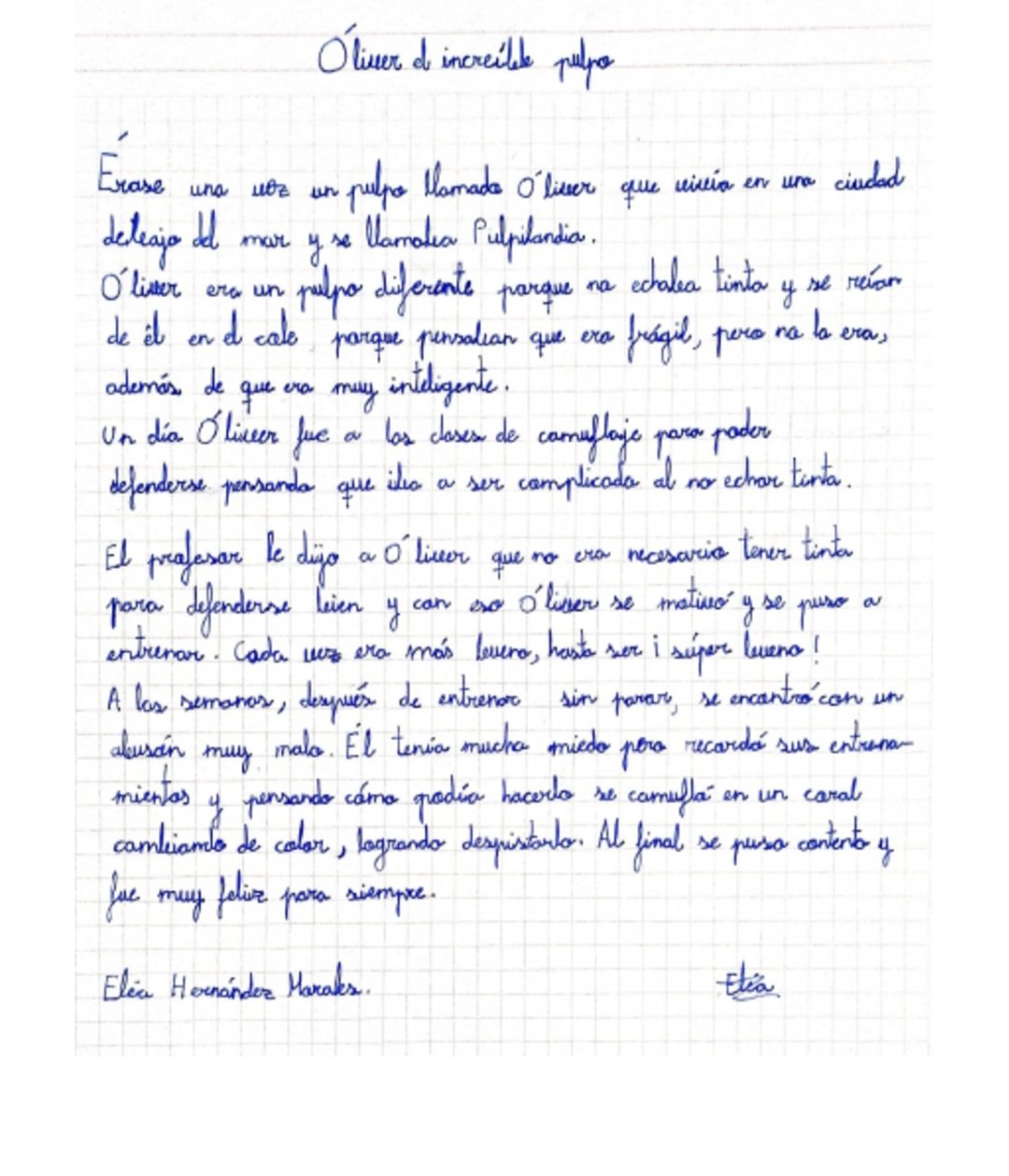
This story is written by a girl named Eléa, where she tells us a story of an octopus named Óliver, who could not squirt ink.
I thank you for sharing this story, for your imagination, and for that sensitivity with which you have conveyed such an important great message. Your story is not just a children's story, but a way of looking at life, a way of understanding others with respect and of course a love, that clearly originates at home.
That octopus in your story, is not just any octopus, he cannot do what others do, expel his ink to defend himself, that makes him weak in his environment, someone who doesn't fit into the world, this situation is experienced day by day in classrooms, children who feel different and insecure.
The truly important thing about your story, is not the initial difficulty but the path you choose for Oliver, he doesn't give up, nor does he get trapped in what he cannot do, he decides to make an effort and learn. He discovered camouflage, he practices it and achieves self-improvement. His new ability makes him feel safe.
All this that you have developed naturally, connects with the principles of current education, deeply. As David Bueno tells us, the brain has an enormous capacity for adaptation, that our brain plasticity, which allows us to develop new capacities throughout fe our life.
Eléa, without technicalities you explain to us that we are not limited by what we don't know how to do, but rather we are open to discover new paths.
Now I emphasize that the deepest part of your story, that this octopus is not defined by its difficulty, there is no anger, nor rejection, only a search and trust. All this is not by chance, it is a way of facing life, it is learned at school, but above all at home, in the daily example
I not only saw your creativity, but also the values you have, such as perseverance, empathy, calm, difficulty, and self-confidence. All this speaks of you but much of the environment where you are growing.
This great gift of yours will help me as a teacher, to work in the classroom, essential aspects, such as self-esteem, the acceptance of diversity, resilience, and empathy.
Sometimes we forget that students are not only receivers themselves learnings but also bearers of meaning and of teachings.
When children write, they are not only performing a school task, but they are showing how they understand the world, and that is where education gains meaning.
And at a social level, it makes great sense because now society emphasizes comparison the fast and immediate success, you propose to us, to stop; accept differences and that we must c9nfiar in finding our path. That is HOPE, a hope that is not abstract but a concrete attitude to adapt and believe in ourselves.
You have taught us that there is another way to move forward, and that difficulties can be beautiful opportunities. It's not just a story, but you show the love with which you are growing and you already know how to share with others.
Not only have you created a story, but a lesson for society. Because, in education, there is no deeper learning than that which is born of true love and transforms into great growth. Juani Alemán Hernández



Add La Voz de Lanzarote as a preferred Google source.
Stay informed with the latest current news.