
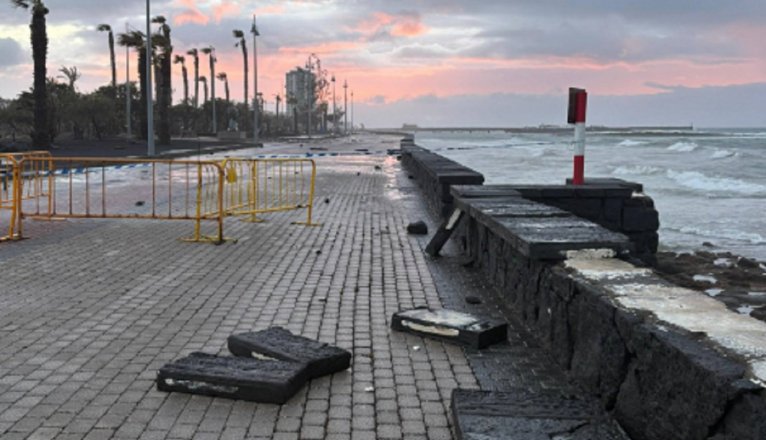
The strong swell generated by the passage of the high-impact storm Therese has caused several damages and destruction on the coast of Arrecife. Rubble and pieces of fallen walls, cobblestones and destroyed promenades have been seen on Friday morning.
The high-impact storm, the nineteenth to be named in the season, has left several yellow warnings on the island of Lanzarote since last Wednesday due to rough seas. The State Meteorological Agency (Aemet) warned that waves of between four and five meters were expected, which could occasionally double in size.
This phenomenon coincided with periods of high tide, where the height of the combined tides with the strong swell also forced the Directorate of Emergencies of the Government of the Canary Islands to declare the pre-alert for coastal flooding. Until 6:00 p.m. this Friday afternoon, the island is under a yellow warning for swell.
It is not the first time that the sea destroys part of Arrecife's coastline, it already happened in June 2024, when the sea swept away the walls and promenades of the Commercial Pier.
From early morning, Arrecife's city council has announced that it is working to recover the seafront promenade.
The climatic forecasts already warn of the rise of sea level
Given the rise in sea level generated by the warming of the planet, global experts are considering different climate scenarios depending on whether or not the emission of greenhouse gases is reduced.
In 2024, the Nasa (National Aeronautics and Space Administration) created a system to know the places in the world most affected by the rise in sea level, among them, Arrecife was found. The climate projections, with data collected between 1995 and 2014, draw possible scenarios based on the increase in terrestrial temperature, depending on whether the emission of greenhouse gases is stopped.
This tool showed that during the 2040s the sea would rise by 14 centimeters in Arrecife, up to 33 centimeters in 2080 and half a meter in 2150. This situation will worsen in the worst-case climate scenarios, the sea could grow up to 81 centimeters by the end of the century and up to 1.29 meters in 2150.
A research carried out by Nature Communications already warned at the beginning of the year that the Canarian population will be very exposed to coastal floods caused by the rise in sea level as a consequence of climate change. This will translate into more erosion on the coast and also into social, economic, and environmental losses.
Among the predicted climate scenarios, in the best case reaching the decarbonization targets for 2030 and in the worst continuing with the burning of fossil fuels throughout the century, the affected population in 2100 could vary between 60,000 and 90,000 people.
Add La Voz de Lanzarote as a preferred Google source.
Stay informed with the latest current news.


