
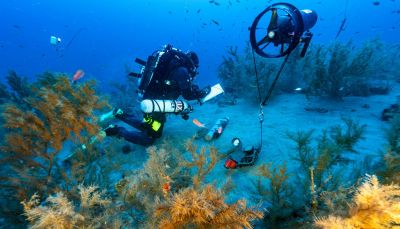
A team from French television will be doing a report this weekend on the DEEP LIFE research, focused on the study of the black corals of Playa Chica. The coastal area is of great environmental importance because it has been declared this year Kilometer Zero of the Black Coral Forests of the World Biological Corridor.
The data collection and experimentation project involves the UNDER THE POLE team, in collaboration with the Centre National de la Recherche Scientifique (CNRS-France), and the University Institute of Sustainable Aquaculture and Marine Ecosystems (IU ECOAQUA) of the University of Las Palmas de Gran Canaria (ULPGC).
From the IU ECOAQUA of the ULPGC they confirm the "excellent nature of these corals" and point out that "the French colleagues are impressed by the richness, the good state of conservation and above all the dimension of the black coral forests of Playa Chica, compared to those of other areas of Europe where they have been studied".
For the mayor and the councilor for the Environment, José Juan Cruz and Carmen Gloria Rodrguez, "it is fortunate for the municipality to have the presence of researchers of the natural environment, that a habitat in such a good state of conservation as the seabed of Playa Chica and, especially, the black coral forests can be studied and protected," says Rodrguez.
From the City Council of Tas they point out that "the inclusion of the black coral forests of Playa Chica within the World Biological Corridor denotes its importance within an international project, which is already in the five continents, and that seeks the creation of a continuous terrestrial and oceanic route of world biodiversity that supports the survival of the set of species and ecosystems of the planet".
Various national and international personalities and institutions work and collaborate in the International Committee of the World Biological Corridor. Among them, the United Nations Global 500 awards, Dr. Birute Galdikas and Joaqu Araujo, in addition to the Princess of Asturias awards Eudald Carbonell, Jos Mara Bermdez de Castro. Also present are the oceanographer Sylvia Earle, the COP25 and COP26 Oceans Champion, Max Bello, as well as the daughter of the famous Ecologist Flix Rodrguez de la Fuente, Odile Rodrguez de la Fuente.
In addition, it has the participation of several universities such as the IUSA University Institute of Animal Health and Food Safety of the University of Las Palmas de Gran Canaria, the University Institute CIBIO (Ibero-American Center for Biodiversity) of the University of Alicante, (BIOECOMAC) Biodiversity, Marine Ecology and Conservation of the University of La Laguna Tenerife, TaCoBi (Taxonomy and Conservation of Biodiversity) Consolidated Research Group of the University of Len.
To them are added Proyecto Gran Simio, the zoologist Fernando Gonzdez Sitges, International Orangutan Foundation, Philippe Cousteau Foundation, European Bison Reserve of San Cebrin de Muda, the NGO A forest for planet earth, Novia Salcedo Foundation of the (ECOSOC). Also included in the International Committee of the World Biological Corridor are cities, municipalities or Biosphere reserves, international museums or former diplomats from various countries.


