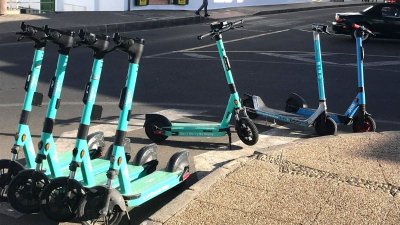
The Yaiza Town Hall sent a requirement this past Thursday to the companies dedicated to renting electric scooters in Playa Blanca. In the document, it requested that "voluntarily" and "within ten days" remove the personal mobility vehicles (PMV) from the coastal town as they "do not have the necessary qualifying title to carry out said activity." The council has indicated that it "can adopt the appropriate measures" in the event of non-compliance, including removing the vehicles from public roads by its own means.
Yaiza "already submitted the Sustainable Mobility Ordinance to public consultation in order to regulate the use and circulation of scooters, bicycles and all personal mobility vehicles, and to define a specific title, with a sanctioning regime, for the lucrative exploitation of PMVs." Once the public consultation period is over, the municipal government plans to take the "initial approval of the normative text to the next plenary session."
“We have citizen complaints about the invasion of scooters in public space and circulation on sidewalks and pedestrian streets such as Calle Limones or the promenade, in such a way that while the ordinance comes into effect we intend to guarantee the safety of pedestrians, also requesting the collaboration of private users who also cannot circulate on pedestrian streets. The scooter is a mobility alternative, but we cannot ignore that it is a vehicle and like any other is obliged to respect the signage,” emphasizes Mayor Óscar Noda.
In this same sense, the Councilor for Urban Planning of Yaiza, Karina Centeno, recalls that “the proposed ordinance considers the circulation with skates, skateboards and PMVs on sidewalks and areas intended for pedestrian use as a serious infraction. This fact means disturbing road safety and the fluidity of traffic on the roads, while at the same time it is an offense to pedestrians, especially for those who have some type of functional diversity.”
Yaiza trusts in citizen understanding “because the interest of the town hall is none other than to guarantee the proper use of public space, improving traffic flow, the safety of people and the environment,” they conclude.



Add La Voz de Lanzarote as a preferred Google source.
Stay informed with the latest current news.