
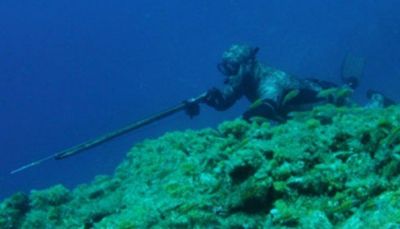
The Canary Islands Association of Underwater Fishermen of the Canary Islands has denounced that the regional Government "marginalizes" them with respect to "the rest of recreational fishermen".. And, according to this organization, the underwater fishermen of the archipelago can only carry out their activity "on 20% of the coast" of all the Canary Islands "despite the fact that according to the FAO it is the most sustainable fishing method", while the rest of recreational fishermen can do so "in 100%, except in marine reserves that have a special regime".
According to the secretary of the Canary Islands Association of Underwater Fishermen, Ovidio Pérez, "the problem arose in 1986 when the Canary Islands had the fishing fleet that went to the Saharan fishing ground and that fishing bank was lost". "They began to strafe the boats, they could no longer go fishing and had to stay fishing in the Canary Islands," he says.
"The fleet was very large, they competed with each other in the waters of the Canary Islands and asked that recreational fishermen of the time not be able to fish because they competed with each other. The demand was for everyone, but the administration saw that it could not take them all out and did so with the one that was less numerous to see if it calmed the spirits a little," explains Pérez, who affirms that this is how the underwater fishermen were given that restriction "without any foundation".
In Lanzarote they only have three areas
In 2003, according to the secretary of the Canary Islands Association of Underwater Fishermen, the regulations were updated and the restrictions on this group were eliminated, but the rest of the fishermen "saw an acquired right" and, after "pressure", in 2007 it was legislated again limiting the areas of underwater fishing. In Lanzarote, specifically, there are only three areas where underwater fishermen can carry out their activity, one in the area of Tinajo, between Punta La Gaviota and Punta Jurado; another in the south, between Papagayo and La Tiñosa, and the third between Punta Tierra Negra (near Los Ancones de Costa Teguise) and Punta Pasito in Mala.
"And we want to fish where the others fish because the restriction of underwater fishing, in terms of extractive capacity, is the same as in the rest of recreational fishing and that happens throughout the national territory. The only place that has this particularity is the Canary Islands and because of what I was saying about what happened 30 years ago," claims Ovidio Pérez.
A study that certifies that it is the "most sustainable" fishing
"We have the same rights and underwater fishing is the most sustainable of fishing activities," says the secretary of the Canary Islands Association of Underwater Fishermen, who points out that it is not only the FAO that says so, but that the Government of the Canary Islands received in October a study that it commissioned and that was prepared by the University of Las Palmas that evaluated the impact of underwater fishing "and that is very clear". "Underwater fishing does not have more impact than the rest of the arts," says Ovidio Pérez, who affirms that, according to said study, the underwater fishing areas even have "more biomass and larger fish".
"So, if we are the most sustainable and we have the same rights as the others, because the sea is a public good that we can all access under the same conditions. Why is the rule not updated and we are put as in the rest of the national territory," questions the secretary of the Association of Underwater Fishermen of the Canary Islands. However, "the Minister of Fisheries does not legislate or restore our right, seeing 6,000 Canary Islanders with our right violated day after day", he concludes.


