
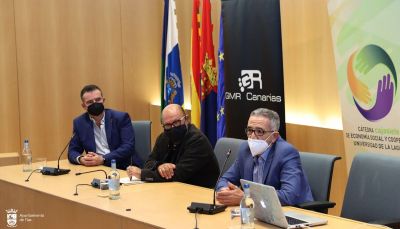
The municipality of Tías has become the "Lanzarote benchmark for cooperativism in the primary sector", after having hosted the fourth session corresponding to the cycle of Cooperativism in the Primary Sector of the Canary Islands, which GMR Canarias and the Cajasiete Chair of Social and Cooperative Economy (CESCO) have been organizing during the last quarter of the year.
The second deputy mayor and councilor for Citizen Participation, Nicolás Saavedra, opened the event and elaborated on the two initiatives "incipient and that we promote with great enthusiasm and enthusiasm" in the municipality: "community gardens in Tegoyo and the Re+Flota labor reinsertion project".
"The challenge is not to create companies, but to create profitable companies. A totally pioneering market niche in Spain is going to be exploited, as the first cooperative project for the cultivation and transformation of the prickly pear is already underway," said the second deputy mayor.
"We want this to be only the first step in the creation of new employment niches and a new relationship with our fields and the natural environment through the collection and consumption of local and zero kilometer products," added Nicolás Saavedra.
Debate on cooperativism
The cycle of Cooperativism in the Primary Sector of the Canary Islands, which was closed by the mayor of Tías, José Juan Cruz, included the interventions of the CEO of GMR Canarias, Pablo Zurita, the director of the CESCO Chair, Cándido Román, the manager of SAT FAST, Ricardo Torres, and the professor of the University of La Laguna, Juan Miguel Díaz.
Pablo Zurita stated that "from the Government of the Canary Islands we understand that it is essential to support associative work and support the operation of cooperative companies." "The purpose of these conferences is to debate, encourage and show our unwavering support so that this cooperativism can become a reality," said Zurita.
In his speech, Cándido Román, director of the Caja Siete company chair of the University of La Laguna (ULL) and the University of Las Palmas de Gran Canaria (ULPGC), explained the research work carried out by his team, also formed by Ana María García and Vanessa Yanes. Through this work, we know "how agri-food cooperatives work in the Canary Islands."
The oldest cooperative in the Canary Islands, with 107 years of history, was represented by Ricardo Torres, manager of SAT FAST. Torres shared his experience and assured that "people associate because they want security and want to sell their product." SAT FAST arose in 1914 in the valley of La Orotova with 23 farmers, and currently has "with 328 farmers and this year estimates to invoice about 28 million euros". They export 60% of the products through Coplaca and the rest is distributed in the archipelago.
The legal and administrative information was provided by Juan Miguel Díaz, professor at the ULL, who recalled that it is important to have "an advisor specialized in cooperatives when carrying out the procedures to found it correctly". "The creation of a cooperative is like that of any company, but the distinctive thing is that the advisor knows the cooperative model well," said Díaz.


