
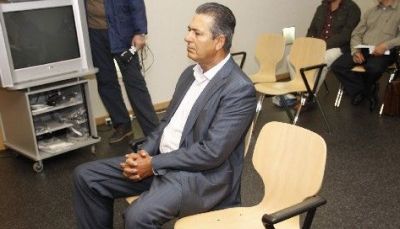
The former mayor of Yaiza, José Francisco Reyes (PNL), faces a sentence request of two years in prison for urban planning malfeasance. On Monday afternoon, the trial against him in the Criminal Court of Arrecife was adjourned for sentencing. The prosecutor increased the initial sentence request of 10 years of disqualification from public office and also requested two years in prison.
The events date back to 2004. According to the prosecutor's accusation, Javier Ródenas, the resident of Yaiza, José Eugenio Camacho, requested a building permit and an opening license for a restaurant in the town center. The property, about 200 years old, would be on territorial protection rustic land and therefore the change of use from housing to restaurant is not allowed.
The Prosecutor's Office maintains that the key is that the works required a positive territorial qualification from the Cabildo of Lanzarote and said permit was not requested. When the Court, due to the complaint of a neighbor that gives rise to the trial, requests that qualification, the island institution answers negatively.
During the trial, José Francisco Reyes testified as an accused and four technicians from the Island Planning Office, the license applicant, a neighbor who reported the construction of a black well, and the person in charge of the renovation works of the property testified as witnesses. The defense lawyer, Felipe Fernández Camero, waived the statement of Antonio Lorenzo as a witness and the Prosecutor's Office waived the complainant, who was going to testify by videoconference and finally could not due to technical problems.
The former mayor literally stated that he did not read the reports he signed regarding the granting of the license and that "in general" he does not read the documents. "I trust the officials and the technicians, who are the ones who understand" and added that "even if I read them, I will understand little because I do not understand urban planning or that type of laws." The prosecutor highlighted that it does not say anywhere that the opinions are positive in order to grant the license. Subsequently, the defense highlighted that it is not specified that they are negative.
"I don't remember it"
"I imagine that the land was urban because it is surrounded by houses," Reyes pointed out, to which the judge immediately asked who he blamed for the events then. He pointed out that no one, that he limited himself to saying the system that exists for granting licenses. "Has something like this happened to you before?" asked the head of the Court. "I don't remember, I don't know," the former mayor replied.
According to Reyes, the requests enter the General Registry of the City Council, then go to the Technical Office and are passed on to him later with the opinion "whether it is positive or negative."
The technicians of the Cabildo pointed out, in a summarized way, that the change of use (from housing to restaurant) is not allowed on rustic land. The General Plan of Yaiza classifies that land as rustic. In any case, they pointed out that the territorial classification of the Cabildo was necessary as it was a work on that type of land.
Rustic land
Finally, the prosecutor pointed out that the basis of the malfeasance lies in the fact that the former mayor granted the license without having the mandatory territorial classification, since it was rustic land. He pointed out that the mayor was warned that he had that classification by up to three municipal technicians plus the secretary and the president of the Cabildo. For the prosecutor, it is proven that Reyes knew that it was rustic land and still gave the license without asking for the classification.
For his part, Fernández Camero highlighted that the prosecutor mixes two licenses, two different administrative procedures, the opening license and the building license and that it has not been proven at any time how the Island Planning Ordinance (PIO) classifies the land object of the litigation. He argued that even if it were rustic land with territorial classification, the territorial classification by the Cabildo would not be necessary.
The defense lawyer pointed out that the change of use is for the building, not for the land and focused part of his defense time on highlighting the antiquity of the house and the limited intervention in the property, consisting of some bathrooms and a kitchen. Reyes, finally, pointed out that he was not aware that "such a small work would lead me to this situation."
ACN Press


