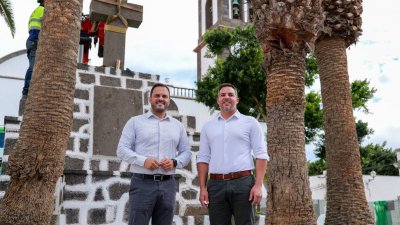
The Francoist cross in Plaza de las Palmas, known as the cross of the fallen, and placed next to the church of San Ginés, returned to its location this Monday after being removed during the rehabilitation works of this public space and after the Cabildo of Lanzarote announced that it would not be reinstalled due to being against the Historical Memory Law.
The mayor of Arrecife, Yonathan de León (PP), who is also the deputy secretary of organization for the PP in Lanzarote, along with the island councilor for Public Works of the Cabildo de Lanzarote, Jacobo Medina (PP), have been photographed next to the cross to celebrate its reinstallation.
A cross placed during Franco's visit to Lanzarote
This Cross of the Fallen stood atop a monument with a plaque honoring the fifty or so deceased from the Nationalist side during the military uprising that triggered the Spanish Civil War (1936-1939) and which led to almost four decades of Francoist dictatorship
In the years following the Spanish Civil War, "a large black cross painted on the wall and a plaque attached" to the Church of San Ginés commemorated the Arrecife residents of the Nationalist side who died during the conflict. In the 1950s, during the renovation of the Church and the Plaza de Las Palmas, this cross was removed to open a central door in the parish's facade. The disappearance of the cross "caused a stir among the local population," according to a 2018 investigation into the historical memory of the square that this outlet has accessed.
During the remodeling of the square by the multidisciplinary artist César Manrique, the Francoist Government Delegation ordered the Arrecife City Council to build this cross in the square, and the council committed to having it ready for the caudillo's visit to Lanzarote on October 29, 1950. These works were financed by the Spanish Executive on the island.
They allude to a provisional withdrawal and ignore the Democratic Memory Law
According to both members of the Popular Party, who defended this in a statement, and contrary to the version of their government partner, Coalición Canaria, "the cross was removed provisionally due to a technical recommendation," as the use of "cranes, heavy machinery, and earthmoving generated risks to its stability."
"From the very first moment, specialists agreed that the best way to preserve, conserve, and protect it was to temporarily dismantle it until the most complex phases of the work were completed." However, sources from the Cabildo of Lanzarote informed La Voz that it was going to be removed for failing to comply with the Democratic Memory Law.Likewise, both have highlighted that "there is no longer any risk to the heritage piece, which has allowed its safe replacement".Mayor Yonathan de León highlighted this Monday that the square, along with the artistic work by César Manrique, "symbolize the progress in the recovery of the city's heritage, which joins other ongoing municipal projects."
An Arrecife plenary agreement
In addition, the mayor of Arrecife has assured that they have complied with the law: "We complied with the agreement of the Governing Board and the plenary agreement that established that the cross and the monolith should remain in their original place." The restoration work on the square, agreed upon by the Governing Board of the Arrecife City Council, would "focus exclusively on the pavement, flowerbeds, lampposts, gardening, and the cistern of the square. That commitment has been respected from day one."The mayor also stressed that "this work was necessary to dignify a historic space that for years had called for comprehensive intervention" and assured that "the historic casuarina tree in the square has been preserved, as planned and as was the will of the institution and the residents."He also thanked the Minister of Public Works of the Cabildo "for the permanent coordination and joint work from the Public Works Department that has allowed this rehabilitation to advance firmly and within the planned deadlines".For his part, the island councilor for Public Works of the Cabildo, Jacobo Medina, has maintained that the technical reasons that motivated the removal and subsequent replacement of the cross: "From the start of the work, the technicians determined that the piece had to be protected from the use of cranes and earthmoving. The fundamental thing was to guarantee its integrity and avoid any damage."Medina added that "with the intervention already well underway and without risks of affection, the replacement has been carried out safely, respecting the symbolic and historical value of the element."The councilor insisted that "the rehabilitation of Plaza de las Palmas was a necessary, highly demanded action that will allow the historic center of Arrecife to have a more accessible, more pleasant, and fully renovated space.""In a few days," he added, "the technical acceptance of the work will proceed, and residents will be able to once again enjoy a well-maintained, modern, and updated square after decades without an intervention of this magnitude."The rehabilitation work, which is in its final week, represents a comprehensive improvement of the environment, incorporating new urban furniture, universal accessibility, and a complete renovation of the public space while respecting its historical and symbolic elements.Finally, the Arrecife City Council has recalled that the project has been financed by the Planning and Projects Area of the Cabildo de Lanzarote, managed by the vice-president and minister of Finance and Contracting, María Jesús Tovar, through European Next Generation funds


Add La Voz de Lanzarote as a preferred Google source.
Stay informed with the latest current news.