
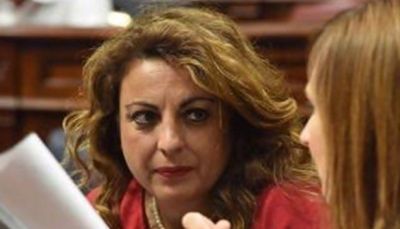
The plenary session of the Parliament of the Canary Islands on Wednesday censured the political management carried out by the Minister of Employment, Social Policies and Housing of the Government of the Canary Islands, Cristina Valido, in matters of dependency. All the political groups in the Chamber, with the exception of CC, supported the PSOE's motion, which becomes the first censure of a minister that is approved in the Canarian Parliament.
The initiative also requested that the Government of the Canary Islands design and apply "urgently" a plan to improve the system for autonomy and care for dependency in the archipelago "in order to reverse the management carried out by CC". This part of the proposal will be recovered by the PSOE in the processing of the Draft General Budget Law of the Autonomous Community for 2019. "We will not give up continuing to defend the rights of these people and presenting as many initiatives as necessary for the development of appropriate policies," warned the socialist spokesperson for Social Policies, Teresa Cruz Oval.
In the plenary debate, Cruz argued in detail the reasons that have led the PSOE to present this censure and presented data such as the fact that "58% of the people who have requested dependency do not receive the benefit", that "20,578 receive the dependency benefit while 28,150 are waiting to receive it" or that the Government "steals" from another 13,199 the possibility of enjoying the tax breaks to which they could be entitled because they are in that condition.
Likewise, the socialist spokesperson for Social Policies indicated that only 72.91% of those who have requested dependency have a resolution compared to 90% of the rest of the communities and regretted that the incorporation into the system has been limited, in almost two years, to 3,719 people, recalling that the figure was 3,000 people in just one year when Patricia Hernández (PSOE) directed the autonomous department.
Deaths of people "for whom the system has not arrived in time"
"In the Canary Islands, four people die daily for whom the dependency system has not arrived in time. Meanwhile, the minister continues to build a system for the future, when the future is precisely what these people lack," said Teresa Cruz, who accused the CC Government of being responsible for the "shameful figures that make it clear that the CC Executive has let the dependency system die."
The socialist spokesperson for Social Policies insisted that the Clavijo Government "does not truly believe in dependency and is trampling on the dignity of these people and their families" and regretted that these two years have been "the great lost opportunity" to give a boost to the system. She also warned that, if we continue on the same path, "we will be fueling the structural poverty of the Canary Islands, in such a way that in the future we will have an army of poor women who, after working for years caring for a family member in a situation of dependency, have no right to any future."
To close her speech, Teresa Cruz Oval thanked the majority of the Chamber for their support of the initiative. "We owe it to the people in a situation of dependency in this land who do not deserve a Government that is not up to their demand: to gain more life to the years and not more years to life."
Measures contemplated in the plan proposed by the PSOE
The motion approved in the Chamber contemplated a series of measures within the framework of the urgent plan proposed by the PSOE to reverse the current situation and that decayed with the amendments. However, it will be recovered by the PSOE in the processing of the 2019 budgets.
The first of the actions, according to the party, involves incorporating into the autonomous budgets of 2019 an increase in the allocation for the network of services and benefits for the protection of people in a situation of dependency of at least 20 million euros compared to 2018.
Likewise, it calls for the approval of a progressive increase, in the first quarter of 2019, of the financing of dependency in the Canary Islands for the period 2020-2022, in such a way that in each budget year at least 20 million euros are incorporated to update the network of services and benefits for the protection of people in a situation of dependency.
The third measure is the signing of an addendum, before the end of the first quarter of 2019, to the cooperation agreement between the Autonomous Community and each of the seven island councils to make effective the corresponding budget increase for that year. It also calls for the incorporation into the autonomous budgets of 2019 of an economic item amounting to 700,000 euros for the preparation and execution of an inspection plan to monitor, verify and control the set of services and benefits for the protection of people in a situation of dependency.
The reduction of regulatory dispersion, the reduction of the waiting list, the improvement of the training of non-professional caregivers to obtain adequate professional qualifications, the increase in the ratio of benefits per dependent person or the development of a portal for attention to dependency in the Canary Islands are other of the proposals defended by the PSOE.


