
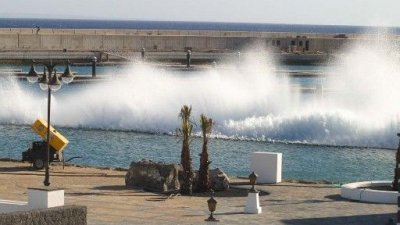
The "Yate case" has allowed to reconstruct the inexplicable chronology of the Marina Rubicón marina, by reviewing the entire file and the judicial proceedings in which this work was immersed. And what has been found is that the promoters began to build without a single permit, requested a license from the City Council when the works had been going on for more than two and a half years and were almost finished, and, in addition, it was granted in just six days.
And all this was done despite the fact that, according to what the Apmun has now pointed out (in a report made as a result of these judicial proceedings), Marina Rubicón has no legal coverage in the planning. Neither a port was planned there in the Yaiza General Plan, nor did the Island Plan contemplate it, nor was a Special Plan made to cover an infrastructure that would have to be classified as a general system. And to make matters worse, the Apmun maintains that it also violated the Coasts Law, because the plot is located in an area of public maritime-terrestrial domain. All this is what has been highlighted by the case that investigates the alleged plot for the massive granting of illegal licenses in Playa Blanca, which has now fallen on this port, and has allowed to reconstruct an inexplicable chronology.
August 13, 1998. Puerto Deportivo Marina Rubicón S.A., through Francisco Armas, requests authorization to build the port to the Ministry of Public Works of the Government of the Canary Islands.
November 16, 1998. In an expert report carried out for the Ministry of Public Works, Faustino García Márquez reports unfavorably to the project. He warns that it has not been classified as a general system, nor is it contemplated in the island planning, nor has a Special Plan been developed for its organization.
August 2000. The works begin without having any type of authorization. The only thing they had was the Impact Statement issued by the COTMAC on June 9, 2000, which was not published and which, in addition, established many conditions. They did not have a municipal license, and had not even requested it.
October 31, 2000. The Minister of Public Works of the Government of the Canary Islands, Antonio Castro Cordobez, grants the administrative concession to carry out the works. It includes several conditions and warns that they will also have to obtain the necessary authorizations and permits in accordance with current legislation. By then, the works had been underway for more than two months.
November 2000. The Agency for the Protection of the Urban and Natural Environment (Apmun) of the Government of the Canary Islands opens a disciplinary proceeding against Marina Rubicón, because they had started the works even before having the authorization from the Canarian Government. The sanction was not applied. That same year, the Seprona also denounces the works and a criminal proceeding is opened in the Court of Instruction Number 4 of Arrecife. Alleged crimes against the environment and historical heritage are investigated by the promoters (Juan Francisco Rosa, Rafael Lasso and Francisco Armas) and the author of the technical project of the port, Jesús Escribano. Environmental groups join the complaint. In the procedure, the promoters are represented by Felipe Fernández Camero and his daughter, Juana Fernández de las Heras.
February 20, 2001. The Secretary of State of the Ministry of the Environment urges the Government of the Canary Islands to paralyze the execution of the works. The environmental groups, very active on the island at that time, had denounced the construction of the port and had been staging different acts of protest.
June 6, 2001. The Court of Instruction Number 4 of Arrecife dismissed the case opened against the promoters of Marina Rubicón. The complainants appealed, but the appeal was also dismissed on November 19. The Prosecutor's Office itself asked that the appeal be dismissed. The prosecutor attached to that court on that date was Miguel Pallarés (political nephew of Fernández Camero), who for years was coordinator of the prosecutors in Lanzarote (since 2008 he has been off the island).
March 26, 2002. The company Consulting Turístico Canaria S.A., of the businessman from Gran Canaria, Juan Padrón, who was building a shopping center on the adjoining plot, addresses the Yaiza City Council requesting the suspension of the works of Marina Rubicón. It is based on the fact that the construction of the marina does not have a municipal license. It also alludes to the irregularities of the concession of the Government of the Canary Islands. Despite the fact that he was an interested party, he was not given a hearing. He also questions that this land is not suitable for commercial use and that it violates environmental conditions. In addition, he emphasizes that he was forced to set back the building that he had planned to comply with the easement of coastal protection and, however, Marina Rubicón was allowed to install a commercial area in front of his plot, and therefore attached to the sea.
September 4, 2002. Marina Rubicón returns to the Courts. Juan Padrón files a contentious appeal due to the lack of response from the City Council and requests the stoppage of the works. The City Council itself (which had not even been asked for a license for the port) responds in court opposing the stoppage of the works, with arguments very similar to those of the promoters. It even asks the Court to demand a bond from the complainant. In the procedure, Felipe Fernández Camero represents the City Council. His daughter and office partner, Juana Fernández de las Heras, defends Marina Rubicón. The City Council and promoters assure the Court that the works are already finished, and therefore cannot be "stopped". The complainant denies it and assures that they are still working.
February 14, 2003. The Court suspends the works and qualifies the municipal silence as "patent and ostensible of radical nullity". The City Council and Marina Rubicón again address the Court, insisting that the works are already finished.
March 2003. As a result of a complaint from Juan Padrón, the Court of Instruction Number 2 of Arrecife opens a new criminal proceeding, this time for disobedience. Rafael Lasso was accused of having continued with the works despite the court's stoppage order.
March 14, 2003. Rafael Lasso, on behalf of Marina Rubicón, requests the license from the City Council, more than two and a half years after having started the works.
March 20, 2003. The mayor, José Francisco Reyes, grants them the license, only six days later after it was requested. It is based on a report from the municipal building surveyor, Alfredo Morales, and another from the secretary of the City Council, Vicente Bartolomé Fuentes (both accused in the "Yate case"). None of them warns that the General Plan of Yaiza did not contemplate a marina in that location. It was also not foreseen in the Island Plan, but the City Council does not ask the Cabildo for the report of compatibility with the PIOT. In addition, according to what the Apmun has now pointed out (in a 2011 report), the plot is located in a maritime-terrestrial public domain area (and not of easement, as the technicians of Yaiza maintained). In the license file, the execution project on the basis of which the reports were made and the license was granted is not even recorded (only a basic project approved by the college of engineers, not architects), there is no detailed building report, there is no technical conditions sheet, there is no measurement status, there is no budget obtained by unit prices of work, nor is there a signature or technical direction of a senior architect, there is no approval from the college of architects, nor is there a health and safety study. But the license is given. In his decree, the mayor states that "they must start the works within a maximum period of six months". However, the promoter and the City Council itself had been alleging in court that the works were already finished.
March 21, 2003. The promoters present a writing asking that the case be filed. They argue that it no longer makes sense, because they have just received the license from the City Council.
April 2003. Juan Padrón challenges the license before the City Council and returns to the Court. He presents photos with a notarial record of March 12 to demonstrate that the works continue and describes the action of the defendants as "mockery, if not a challenge to the knowledge and understanding of the room, falsifying reality". He also accuses the City Council of "connivance" with the promoters and emphasizes that it positioned itself "on the side of the offender, protecting their conduct and falsifying reality". The plaintiff emphasizes that any work without a license would not only entail its stoppage by the courts, but by the administration itself, which the Yaiza City Council did not do.
May 23, 2003. The Court issues a new order, maintaining the precautionary measure of stopping the works. He warns that although the promoters have provided the license, the contentious process will continue its course and they will not be able to resume the works until the case is judged and there is a final judgment.
June 27, 2003. Juan Francisco Rosa and Jesús Escribano, on behalf of Marina Rubicón, sign a contract with Juan Padrón (on behalf of Consulting Turístico Canaria) by which they will pay him 1.8 million euros. In exchange, Padrón undertakes to desist from the five contentious lawsuits that he had opened, to also abandon the criminal lawsuit, to present writings in all the administrations in which he challenged any act related to Marina Rubicón and desist from it and not to present any other complaint or claim in the future. Otherwise, he should return the money to the owners of Marina Rubicón, in addition to paying them 3 million euros in compensation.
July 1, 2003. The Court receives a writing signed by Juan Padrón, desisting from the contentious appeal. That same day, the businessman sends another writing to the Court Number 2 of Arrecife, also withdrawing the private accusation in the criminal process against Rafael Lasso, for an alleged crime of disobedience.
September 16, 2003. The Court Number 2 of Arrecife files the criminal case against Rafael Lasso.
April 28, 2004. A judicial order files also the contentious-administrative case against Marina Rubicón, which investigated its alleged illegality, due to the withdrawal of the complainant.
August 2010. Six years after all the proceedings were filed, the Justice system is once again focusing on this marina. Within the framework of the "Yate case", which investigates the existence of an alleged plot for the massive granting of illegal licenses in Playa Blanca, the prosecutor asks that the Yaiza City Council be required to provide a certified copy of the administrative file of the building license of the Marina Rubicón Marina. The investigation, which tracked the assets of José Francisco Reyes, found purchases in cash and with money of unknown origin worth more than one million euros. Among these purchases was that of the boat "El Pachi", which was paid between the end of 2003 and mid-2004. The yacht was docked in Marina Rubicón and never paid for the mooring. Now, in addition to investigating whether this "benefit" responded to a gift to the mayor, the case will also determine the alleged illegality of the port.
Add La Voz de Lanzarote as a preferred Google source.
Stay informed with the latest current news.